The Funding Gap in NATO Defence Tech
The landscape of funding for defence technology within NATO reveals a significant geographical disparity. Despite European member states committing hundreds of billions of euros to the defence sector, only a small fraction of these investments translates into venture capital for local tech startups. Recent data indicates that since 2019, approximately 85% of all venture funding allocated to defence tech within NATO has been captured by US-based companies.
This imbalance raises significant questions about Europe's ability to develop and maintain its own autonomous industrial and technological base in the critical defence sector. Europe, in fact, accounted for only 6.2% of these investments, a percentage that reflects a strategic and technological dependence on external actors. Such a situation can have long-term implications for technological sovereignty and the resilience of European infrastructure.
Implications for Technological Sovereignty and Innovation
The concentration of venture funding in the United States for defence tech is not merely an economic issue but a strategic one. A robust and locally funded innovation ecosystem is crucial for ensuring data sovereignty and control over critical technologies. This principle extends far beyond defence, touching sectors such as artificial intelligence and Large Language Models (LLM), where the choice between on-premise deployment or external cloud solutions is also driven by control and compliance requirements.
For European organizations evaluating LLM adoption, reliance on external providers for hardware, software, or funding can entail risks in terms of security, latency, and Total Cost of Ownership (TCO). The ability to develop and deploy AI solutions in self-hosted or air-gapped environments largely depends on the availability of a local technological ecosystem and capital that supports such development, from basic research to the industrialization of components like silicon and software frameworks.
The European Response: A €500 Million Fund
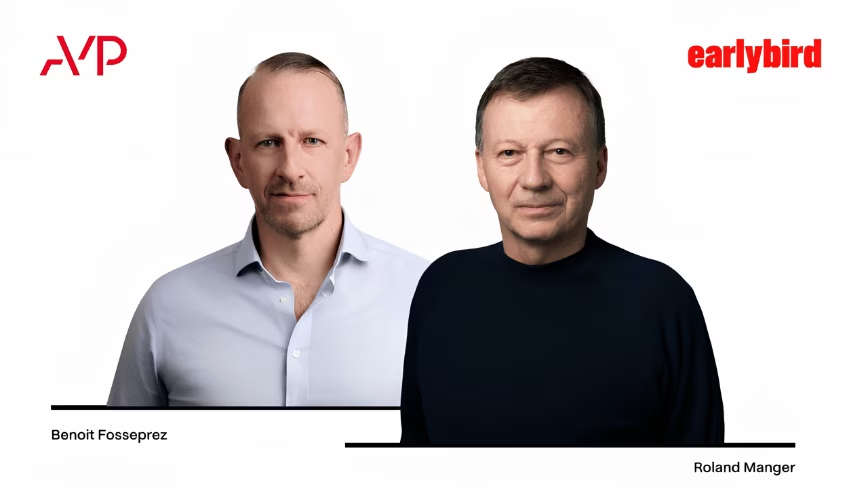
To address this gap and stimulate European innovation in the defence sector, two major venture capital players, AVP and Earlybird, have announced the creation of a new €500 million fund. The stated goal is to redirect a significant portion of capital towards European startups operating in defence technology, thereby promoting the development of innovative solutions and strengthening the continent's industrial base.
This initiative aims to create a virtuous cycle, attracting talent and investment within Europe and reducing reliance on external capital and technologies. The fund intends to support companies working on emerging technologies, from cybersecurity to AI for defensive applications, helping to build a more resilient and locally controlled technological infrastructure. Such an approach is crucial to ensure that strategic decisions and sensitive data remain under European jurisdiction.
Future Prospects for European Technological Autonomy
The launch of this fund represents a significant step towards strengthening European technological autonomy in the defence sector. However, the challenge is broad and requires coordinated commitment from governments, investors, and businesses to build an ecosystem that can compete globally. The ability to fund and scale local innovation is essential not only for defence but for all strategic sectors, including those heavily reliant on advanced artificial intelligence.
For companies operating with AI/LLM workloads, the availability of local capital and expertise can facilitate the adoption of on-premise architectures, offering greater control over aspects such as VRAM, throughput, and latency, which are critical elements for inference and training of complex models. AI-RADAR, for example, offers analytical frameworks on /llm-onpremise to evaluate the trade-offs between different deployment strategies, emphasizing the importance of considering data sovereignty and TCO as key factors in infrastructure decisions. Ultimately, initiatives like this are fundamental to ensuring that Europe can define its own technological future, rather than depending on others.



💬 Comments (0)
🔒 Log in or register to comment on articles.
No comments yet. Be the first to comment!