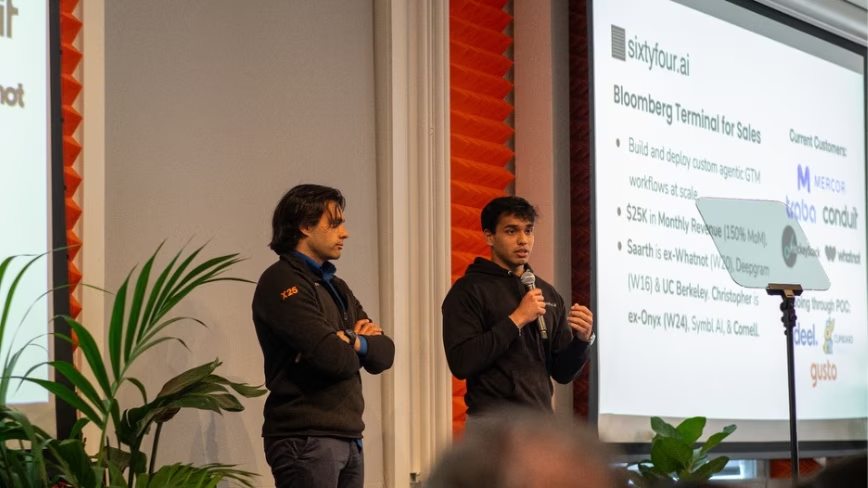
There’s a quiet mantra echoing through many AI research labs: point a Large Language Model at the web, take its answer, and trust it. Saarth Shah and the team at Sixtyfour have flipped that logic. For them, every build of their research agents goes through a ruthless exam – a basket of hand-crafted questions from experts, yielding an objective score. Only what raises that score gets shipped. A measurement obsession that shifts the center of gravity from claiming to proving.
As recently described, this approach reflects a maturing industry: as LLMs leave prototypes and enter production, blind trust is no longer enough. In regulated domains, or when choosing on-premise deployment to maintain data sovereignty, the ability to validate agent performance in a reproducible way becomes a requirement, not a luxury. By building an evaluation stack as an integral part of their development cycle, Sixtyfour demonstrates a viable path: verified questions, quantitative metrics, and evidence-based decision-making.
The crux is that LLMs are probabilistic machines. Without a verification layer, even the most capable model can produce convincing but incorrect results – so-called hallucinations. In traditional software, automated testing is the norm; for AI agents, we are still in the early days. Sixtyfour proposes treating each agent response as a hypothesis to be tested, not as a given fact. A key element is human involvement in curating the validation dataset, anchoring the entire process to a verifiable quality benchmark. It’s an antidote to the trend of models evaluating models, risking the amplification of systemic errors.
For those assessing on-premise deployment, the message is clear: a self-hosted agent demands even stronger verification robustness, since you can’t offload checks to third-party cloud services. Data ownership entails reliability ownership. AI-RADAR offers analytical frameworks to weigh the trade-offs between performance, cost, and sovereignty, but the technical choice at Sixtyfour highlights a universal principle: measure, measure, measure.
It remains to be seen whether this approach will become industry practice or stay confined to demanding niches. The signal is strong, though: the era of ‘trust me, it’s an LLM’ is ending, and those investing in evaluation stacks today are preparing to build agents that don’t just talk, but prove they know what they’re talking about.





💬 Comments (0)
🔒 Log in or register to comment on articles.
No comments yet. Be the first to comment!