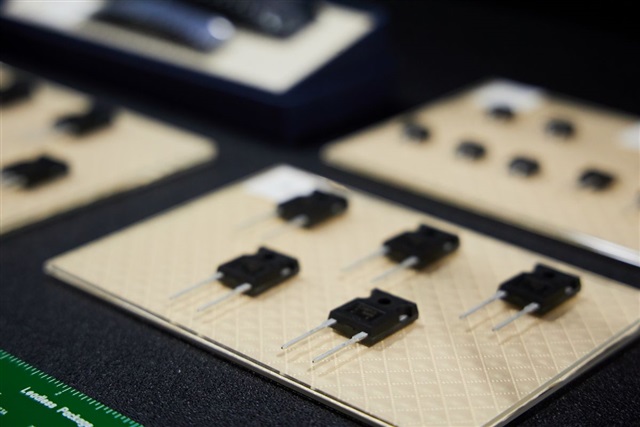
According to DIGITIMES, demand for AI servers has pushed power device lead times to 270 days. An order placed today will ship in nine months. We’re not talking about CPUs or GPUs, but about the silicon that converts, regulates and distributes electricity inside every machine: MOSFETs, IGBTs, voltage regulators, gallium nitride and silicon carbide semiconductors. Without them, even the most powerful accelerator is a paperweight.
The invisible architecture that powers AI
A GPU like NVIDIA’s H100 can draw more than 700 watts; a single server board houses eight of them, pushing power demand above 5 kW in a few square centimeters. Managing such currents requires multi-phase voltage regulator modules, low-loss rectifiers and high-frequency converters, all running in extreme thermal conditions. Many of these devices are made on mature, 200 mm wafer lines already stretched thin because they serve automotive and industrial markets too. The jump to 270 days isn’t a glitch: it signals a structural deficit, amplified by the AI race.
Who loses and who wins on the on-premise front
The hardest hit are organizations aiming to keep inference and fine-tuning in-house. Large cloud providers, armed with multi-year contracts and allocation priority, can plan procurement ahead; those building private infrastructure – research labs, regulated firms, public administrations – get pushed to the back of the queue. The promise of data sovereignty (“keep it in your data center”) crashes into a supply chain that can’t deliver. The result is a widening gap: hyperscalers accelerate while those seeking autonomy face scaled-down roadmaps or unsustainable spot prices.
The second-order effect is a two-speed market. State-funded contracts and well-financed projects may still secure components after months; smaller players are forced to fall back on less power-hungry GPUs, accepting lower inference throughput or narrower context windows, which degrades LLM-based service quality. At the third order, soaring lead times could speed up adoption of more efficient architectures: 48 V power delivery, direct-to-chip liquid cooling, distributed conversion. Cutting the number of power components per GPU becomes a design imperative, not just an engineering nicety. Meanwhile, the shortage may shift production capacity from sectors like industrial electrics or automotive toward AI computing, creating chain bottlenecks in less visible but equally critical domains.
Beyond the GPU: a lesson in fragility
The 270-day figure shouldn’t be read as an isolated spike. It reveals that AI’s hunger for compute feeds on an ecosystem far wider than accelerator cards. Media attention focuses on teraflops and tokens per minute, but the real choke point can hide in a humble voltage controller. For anyone planning on-premise deployments, the message is clear: time-to-hardware is becoming as strategic a variable as total cost of ownership, and the sovereignty game rides on procurement capability as much as on data locality.








💬 Comments (0)
🔒 Log in or register to comment on articles.
No comments yet. Be the first to comment!