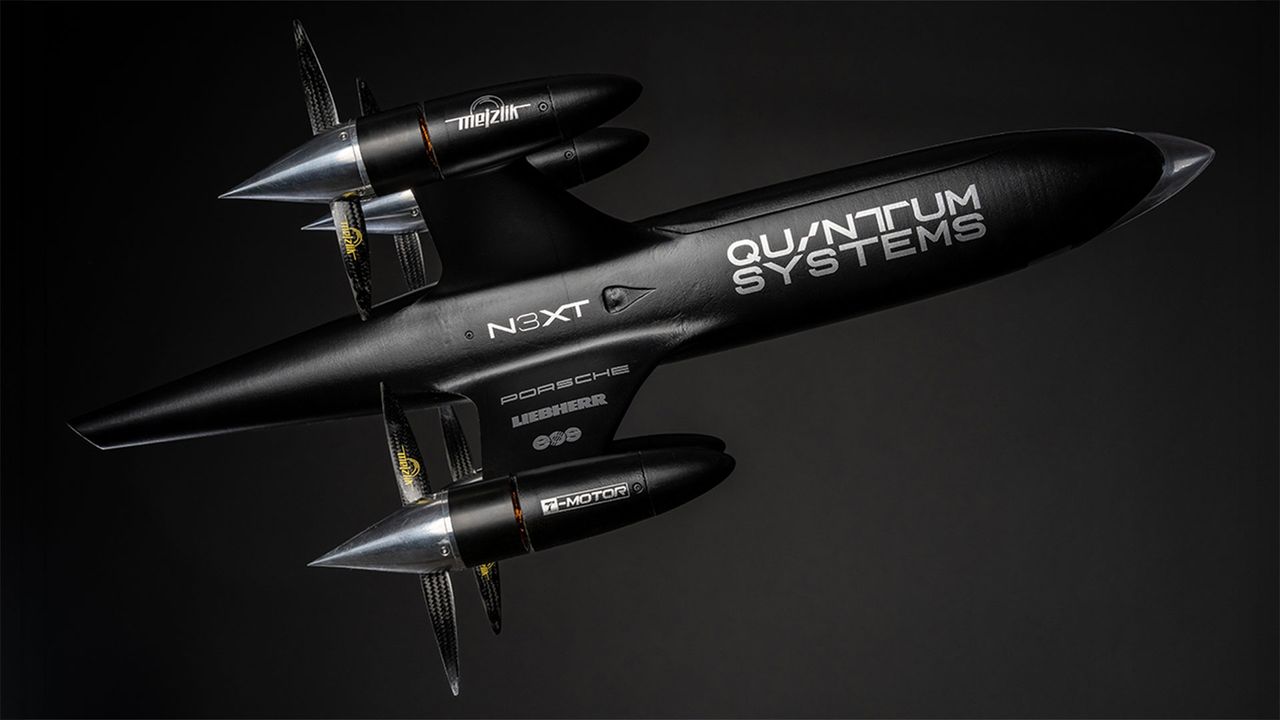
A prototype electric drone developed by a German firm has redefined the boundaries of unmanned flight, hitting a speed of 434 miles per hour (about 698 km/h) and shattering the official previous record of 409 mph. The team is now preparing for Guinness World Records certification, but the striking figure isn’t just the speed — it’s the drone’s intended role as an anti-aircraft interceptor.
The engineering achievement goes beyond aerodynamics or electric motor power. A vehicle designed to intercept airborne threats must react in fractions of a second, make autonomous decisions, and exchange data with ground systems in real time. All that demands localized computing power, embedded in a small form factor and fed by batteries that already push propellers to extreme regimes. In short, it’s a problem of computing at the edge — where latency and data sovereignty become non-negotiable factors.
Edge computing in flight: what it means for defense systems
Modern defense platforms are shifting intelligence from centralized data centers toward peripheral nodes. Whether distributed sensors, reconnaissance drones, or combat aircraft, the requirement is the same: process data on the spot, without relying on connections that could be jammed or delayed. In this scenario, every gram counts, and each watt of power consumption subtracts energy from propulsion. The German record spotlights how dedicated hardware, likely based on ARM or FPGA architectures with neural accelerators, can make the difference between a reactive interceptor and a vulnerable one.
Observers of on-premise deployment for LLMs and AI workloads will notice striking parallels. When an organization chooses to run inference locally, it does so to control data, cut latency, and manage total cost of ownership (TCO). On the drone, constraints are multiplied: there is no liquid-cooled server rack, just a vibrating airframe flying at 700 km/h. Yet the demand for local, self-hosted, resilient computing is identical. While the enterprise world evaluates GPUs with 80 GB of VRAM and quantizes models to fit on edge servers, aerospace squeezes the same principle to the extreme, with custom components and software tailored to specific architectures.
No official details have been released about the record-breaking drone’s onboard electronics, but the context points to advanced compute units for sensor fusion and autonomous flight control. The performance needed for an interceptor — detect, track, maneuver — implies ultra-low-latency processing pipelines, similar to those built in industry for visual inspection or process control using computer vision models.
The German company hasn’t issued any statement on a commercial roadmap, but the decisive leap past the official 409 mph is more than a record: it’s a calling card for a new generation of defense drones that use electric propulsion not only for zero emissions, but for the architectural flexibility that modern power electronics enable. In an industry where onboard AI is becoming the real force multiplier, the speed record can also be read as a dress rehearsal for edge computing under extreme operational conditions.




💬 Comments (0)
🔒 Log in or register to comment on articles.
No comments yet. Be the first to comment!