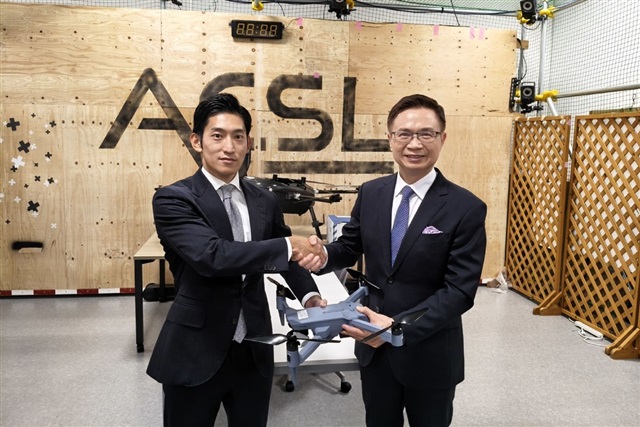
When a Japanese drone company decides to bet on Taiwan for its supply network, the first instinct is to think of chips and semiconductors. But ACSL’s move – and its official commitment to TADTE 2027, the Taipei defense exhibition – deserves a more layered reading, because it captures a structural shift in the autonomous systems supply chain.
Today’s drones are no longer simple remote-controlled objects. They fly thanks to computer vision, SLAM-based navigation, obstacle recognition, and increasingly they integrate language models for human interaction or environmental understanding. Every onboard algorithm requires real-time inference, meaning embedded computing power that must work without a cloud connection: a deployment context that is de facto on-premise, or rather pure edge, where latency and data sovereignty are non-negotiable.
That’s why ACSL’s supply chain expansion toward Taiwan is not a simple post-China diversification play. It signals that drone competition is moving from mechanical assembly to ultra-low-latency hardware-software integration. Taiwan, with its concentration of foundry and advanced packaging (TSMC, ASE, and the growing ecosystem of AI chips for edge), becomes the pivot of a supply chain where control over components – from sensors to NPUs – cannot be easily outsourced.
The losers in this dynamic are generic outsourcing models, where a drone maker buys pre-packaged cognitive modules without being able to influence the computing architecture or data flow. The gainers are integrators capable of co-designing the drone and its inference platform, choosing nearby, trusted production nodes. In this light, ACSL’s brief announcement is a clue that the autonomous vehicle market is retracing the path already blazed by enterprise generative AI: the search for on-premise stacks that can be trained locally and secured under one’s own jurisdiction.
For anyone evaluating the deployment of Large Language Models in their organization, the parallel is instructive. Just as a drone that cannot afford to phone the cloud for every decision requires trusted embedded inference hardware, so too a business that wants to retain control over its data must plan for self-hosted infrastructure, with right-sized GPU, VRAM, and fine-tuning pipelines not dependent on third parties. ACSL’s move toward Taiwan therefore concerns not only aviation enthusiasts, but anyone who values TCO and sovereignty over their intelligent applications.
Finally, there’s a strong geopolitical signal. Participation in TADTE 2027 is not just any booth: it’s an embrace of a defense ecosystem that makes supply chain security an explicit pillar. And within that pillar, AI is not abstract software but silicon, testing, and assembly. Taiwan becomes the crossroads of a silent alliance between robotics, on-device AI, and strategic autonomy.






💬 Comments (0)
🔒 Log in or register to comment on articles.
No comments yet. Be the first to comment!