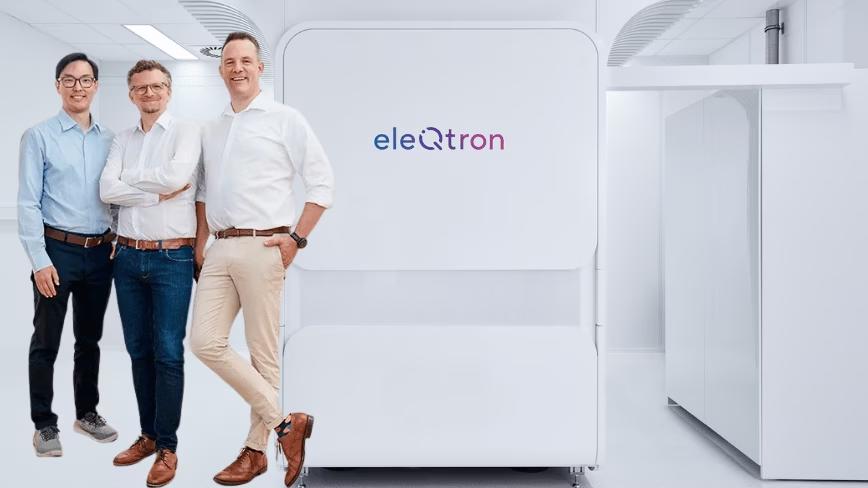
A Significant Boost for European Quantum Computing
German scale-up eleQtron, specializing in trapped-ion quantum computing, has announced the closure of a €57 million Series A funding round. This investment represents one of the largest operations of its kind in the quantum computing sector in Europe, signaling growing interest and confidence in the continent's technological potential.
Historically, the commercial landscape of quantum computing has seen European laboratories excel in fundamental research and innovation, while most venture capital for commercialization came from US and Asian companies. eleQtron's success suggests a shift in this dynamic, strengthening Europe's position in the development and commercialization of cutting-edge quantum technologies.
Trapped-Ion Technology and Its Potential
Quantum computing, unlike classical computing which relies on binary bits (0 or 1), leverages the principles of quantum mechanics, such as superposition and entanglement, to process information through qubits. This allows for the solution of extremely complex computational problems that are intractable for current supercomputers. Trapped-ion systems, like the one developed by eleQtron, are one of the most promising architectures for building quantum computers.
They use electromagnetic fields to confine and manipulate ions, which act as qubits, enabling quantum operations with high fidelity. This technology has the potential to revolutionize sectors such as cryptography, drug discovery, materials science, and the optimization of complex algorithms, including those that could one day support next-generation artificial intelligence models. The ability to handle exponentially more complex calculations opens up new scenarios for massive data analysis and the simulation of complex systems.
Market Context and Infrastructure Implications
The investment in eleQtron is crucial for the transition from laboratory research to the creation of scalable and reliable quantum computing infrastructures. For organizations looking at the future of data processing, the emergence of strong European players in quantum computing raises important questions about data sovereignty and control over strategic technologies. Although quantum computing is still in an early stage compared to current AI/LLM workloads, its evolution will require complex infrastructure decisions, potentially leaning towards on-premise or hybrid deployments to maintain control over sensitive data and intellectual property.
The evaluation of Total Cost of Ownership (TCO) and the ability to operate in air-gapped environments will become determining factors for future quantum applications as well. For those evaluating on-premise deployments for computationally intensive workloads, AI-RADAR offers analytical frameworks on /llm-onpremise to assess the trade-offs between self-hosted and cloud solutions, an approach that will be increasingly relevant for emerging technologies like quantum computing.
Future Prospects and Technological Leadership
eleQtron's funding round is not just a success for the company itself, but a positive signal for the entire European quantum computing ecosystem. It demonstrates that the continent is ready to invest not only in basic research but also in the commercialization of cutting-edge technologies. This financial boost is fundamental to accelerate the development of quantum hardware, improve qubit stability, and increase computing capacity, bringing closer the day when quantum computers can tackle real-world problems on a large scale.
The global competition in quantum computing is intense, and investments like this are essential to ensure that Europe maintains a position of technological leadership. The ability to develop and control these critical technologies will be a key factor for digital sovereignty and economic competitiveness in the coming decade, potentially influencing the future of Large Language Models and AI infrastructures as well.





💬 Comments (0)
🔒 Log in or register to comment on articles.
No comments yet. Be the first to comment!