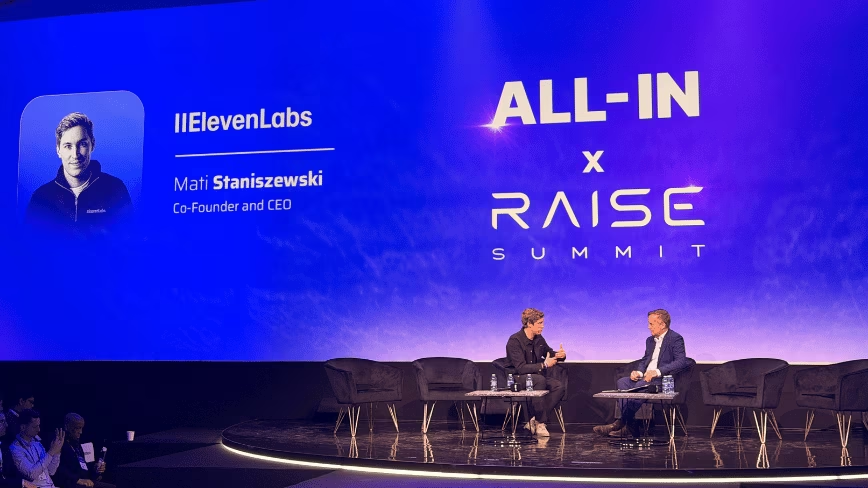
Paris, Cour Napoléon of the Louvre. The ALL-IN podcast took its live show to the RAISE Summit and put Mati Staniszewski, co-founder and CEO of ElevenLabs, in the hot seat. Jason Calacanis opened with the sharp questions: revenue, competition, and whether a voice-focused startup can outlast giants like OpenAI and Anthropic. “It’s the best time to be building,” Staniszewski replied, pointing to the speed at which the company reached roughly $600 million in revenue.
The figure, even if approximate, signals something structural: realistic text‑to‑speech is no longer a peripheral commodity. ElevenLabs has turned voice into a hundred‑million‑dollar product, carving out a space that generalist labs could theoretically colonize but struggle to command with the same depth.
The “best time to build” thesis rests on two pillars. First, unprecedented access to GPUs, foundation models, and open‑source tooling lets lean teams iterate faster than big tech. Second, the nature of the voice domain itself: perceptual quality, expressiveness, and linguistic localization cannot be solved with a generic multimodal model. They require curated datasets, dedicated training pipelines, and fine‑grained latency control — all areas where a specialist builds a competitive moat.
The infrastructure and sovereignty node
For those watching the market through a deployment lens, ElevenLabs’ story shines a light on an underexplored area: where does voice inference actually run? Today the answer is nearly always the cloud, and ElevenLabs is no exception. But voice — unlike a text chatbot — enables use cases where network latency and data residency become non‑negotiable criteria. Call centers, healthcare, internal communication tools in regulated sectors: all push toward hybrid or fully on‑premise architectures.
The question is not whether big labs can replicate voice performance; it is whether they can offer the sovereignty guarantees that European companies, for instance, demand under GDPR. This opens room for self‑hosted solutions or edge inference on dedicated devices, where TCO is measured not only in dollars per API call but in control over audio flows and compliance.
Winners and those at risk
With $600 million in revenue, ElevenLabs raises the stakes for the entire ecosystem. Long‑term winners may not only be labs that build ever‑larger models, but those who package voice capabilities in forms that can be distributed outside their own cloud. Enterprises already investing in hardware for on‑premise LLMs — for example, GPUs with ample VRAM for quantized inference — could progressively add voice workloads to the same stack, provided the models are optimized for constrained environments.
Conversely, players betting solely on the cloud risk losing the most lucrative segments, where voice becomes part of critical processes and a simple API does not satisfy security officers. This is a pattern already seen in the evolution of databases and messaging systems: start in the cloud, then, once the service becomes infrastructure, bring at least part of it back on‑premise.
In this light, Staniszewski’s answer — “it’s the best time to be building” — carries meaning beyond surface‑level optimism. Building today also means designing models and architectures that can land on heterogeneous hardware, not only in the provider’s data centers. The real contest, for ElevenLabs as for anyone in applied AI, will be deciding whether to remain a cloud service or become a component that enterprises can govern on their own turf.








💬 Comments (0)
🔒 Log in or register to comment on articles.
No comments yet. Be the first to comment!