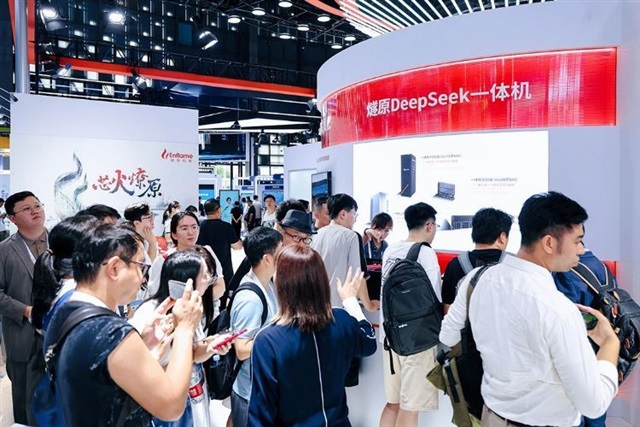
Enflame's listing, scheduled for September 11, closes the IPO cycle of China's four major domestic GPU makers. The news matters beyond finance: it signals that Beijing is building an AI supply chain that does not depend on Western accelerator vendors. For teams planning on-premise infrastructure and thinking about data sovereignty, the completion of these listings raises a precise question: will the capital raised be enough to close the gap not only in silicon, but especially in the software ecosystem and memory bandwidth?
The issue is not any single company. Four listings in succession show that China's capital markets see AI chips as a strategic priority, not a niche bet. U.S. export restrictions have accelerated a path that would otherwise have taken years: domestic producers must not only fabricate GPUs, but make their solutions compatible with existing development frameworks, inference engines, and fine-tuning pipelines. Without that layer, alternative hardware remains a theoretical option.
Here the structural challenge emerges. A GPU is also evaluated by its available VRAM, memory bandwidth, and efficiency in handling tokens during inference. But the hardest part to replicate is not the silicon: it is the software on top. LLMs trained and deployed on NVIDIA stacks benefit from years of optimization. A Chinese domestic producer targeting the internal market must convince deployment teams that its stack does not introduce friction when moving from one environment to another. IPOs provide liquidity, but they do not automatically create a mature ecosystem of tools, drivers, and libraries.
This story also matters outside China. The emergence of an alternative GPU supply pole changes incentives for global vendors: it reduces one-sided dependence and creates, at least potentially, a second market for components and skills. At the same time, it introduces fragmentation of standards that can complicate hybrid and multi-cloud deployments. For European enterprises evaluating self-hosted infrastructure, more hardware options do not automatically translate into lower TCO or greater control: the choice depends on driver availability, support for quantization, and integration with orchestration frameworks.
Enflame's IPO, read together with the other three, is a sign of financial maturity but not yet operational maturity. The challenge for the coming years will be the ability of Chinese producers to turn capital into a stable, documented software ecosystem compatible with existing pipelines. AI-RADAR follows these dynamics also in its analyses on /llm-onpremise, where the trade-offs between alternative silicon and consolidated stacks become clear in local deployment cases.





💬 Comments (0)
🔒 Log in or register to comment on articles.
No comments yet. Be the first to comment!