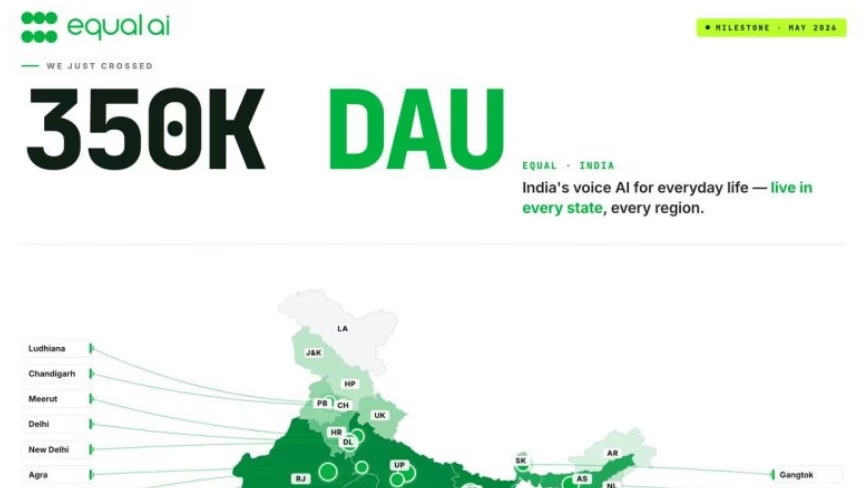
Equal AI: An AI Assistant to Combat Phone Spam
Equal AI, an India-based startup, recently announced the completion of a Series B funding round, raising $30 million. The operation was led by Prosus Ventures and Tomales Bay Capital, with participation from Think Investments and Valiant Fund. Individual investors also include prominent figures such as Sameer Nigam, founder of PhonePe, and Meta's Vice President for India and Southeast Asia. This significant capital injection is intended to support the expansion and development of the company's proprietary technology.
Equal AI's core business focuses on developing an artificial intelligence assistant designed to answer phone calls on behalf of users. The primary goal is to filter unwanted calls, particularly spam calls, a phenomenon particularly widespread in markets like India, where users can receive dozens of spam calls each week. This solution aims to enhance the user experience by reducing interruptions and protecting individual privacy.
The Technology Behind Voice Assistants and Deployment Implications
AI assistants that handle complex voice interactions, such as Equal AI's, often rely on Large Language Models (LLM) and speech synthesis and recognition models. These systems require significant processing capabilities for real-time Inference, especially when managing a high volume of simultaneous calls. The choice of deployment architecture – whether cloud, hybrid, or on-premise – becomes crucial for ensuring performance, scalability, and, importantly, data sovereignty.
For services processing sensitive data like phone conversations, privacy and regulatory compliance considerations are paramount. An on-premise or air-gapped deployment can offer greater control over data, reducing risks associated with its residency and third-party management. However, this entails a higher initial investment in hardware, such as GPUs with adequate VRAM, and infrastructure management, impacting the Total Cost of Ownership (TCO). Companies must balance these factors against the flexibility and scalability offered by cloud solutions.
Market Context and Challenges for Conversational AI
The market for AI assistants is growing rapidly, driven by the need to automate repetitive tasks and improve user interaction. An assistant's ability to understand context, handle linguistic nuances, and distinguish between legitimate and spam calls is fundamental to its success. This requires sophisticated LLMs, often subjected to Fine-tuning on domain- and language-specific datasets. The challenge is not only technological but also cultural, in accustoming users to delegate the management of their communications to artificial intelligence.
The problem of spam calls is global but takes on different proportions depending on the region. In India, where smartphone penetration is high and anti-spam regulations can be complex to enforce, solutions like Equal AI's find fertile ground. The funding received highlights investors' confidence in the market potential of these technologies and the company's ability to address a problem felt by millions of users.
Future Prospects and Strategic Considerations
Equal AI's success will depend on its ability to scale its solution while maintaining high standards of accuracy and privacy. For enterprises evaluating the adoption of similar technologies for their call centers or internal communication management, the choice between a cloud infrastructure and a self-hosted one is a critical point. AI-RADAR offers analytical frameworks on /llm-onpremise to evaluate the trade-offs between initial costs, operational costs, security requirements, and performance, providing decision support for architects and CTOs.
The evolution of LLMs and the optimization of Inference on less expensive hardware could make on-premise solutions increasingly competitive, especially for workloads with stringent data sovereignty requirements or for air-gapped environments. Equal AI, with its focus on a specific problem and a vast market, positions itself as an interesting player in the conversational AI landscape, with implications that go beyond simple spam blocking, touching on themes of efficiency and personal data protection.









💬 Comments (0)
🔒 Log in or register to comment on articles.
No comments yet. Be the first to comment!