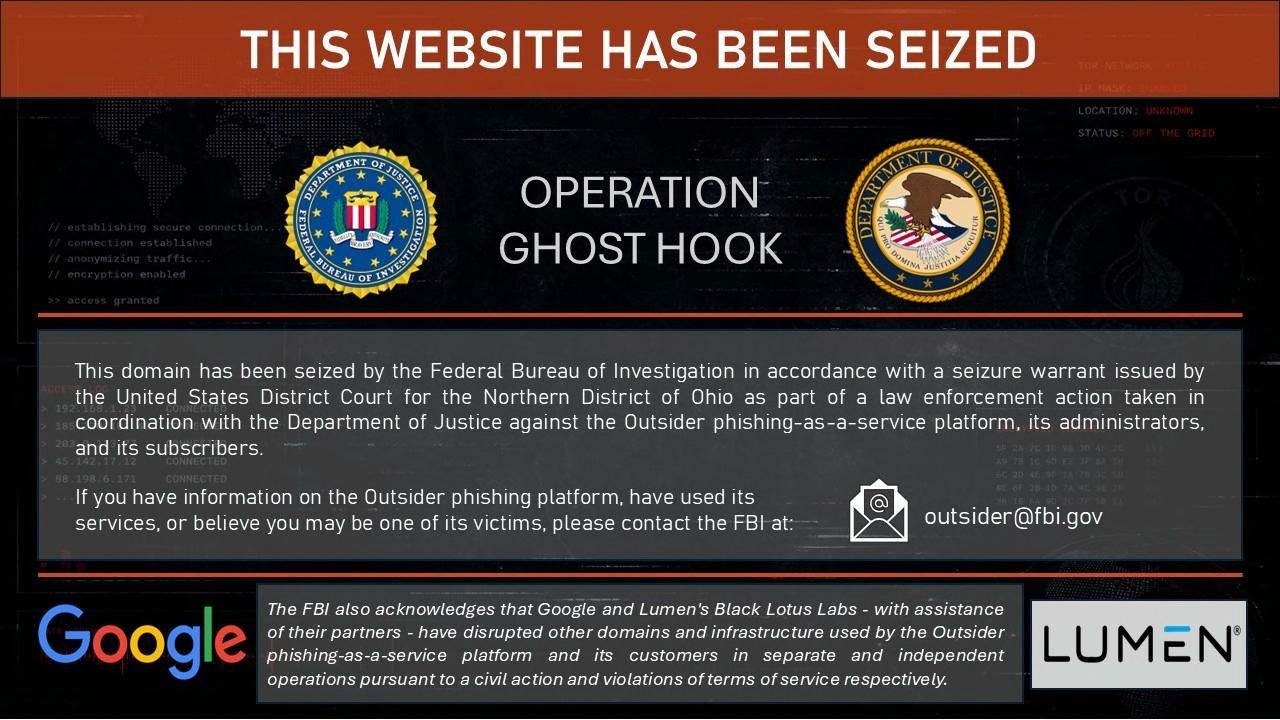
Global Operation Against "BulletProofLink"
The FBI, in a joint operation with international partners, announced the dismantling of "BulletProofLink," a sophisticated Chinese phishing service. This service, active for at least eight years, provided cybercriminals worldwide with the necessary tools to orchestrate large-scale fraud campaigns. The law enforcement intervention led to the seizure of the infrastructure supporting this illicit network, marking a significant step in the fight against cybercrime.
The "BulletProofLink" service operated on a subscription model, offering its clients access to an arsenal of templates and tools for creating phishing pages. The cost, $88 per month, granted access to resources that significantly simplified the creation of fraudulent sites, making them indistinguishable from their legitimate counterparts. The scale of the damage was substantial: authorities link "BulletProofLink" to estimated global economic losses of $1.9 billion and the theft of 3.87 million credit card numbers.
The Role of Artificial Intelligence in Modern Phishing
A distinctive feature of "BulletProofLink" was the integration of AI-generated content. This AI component was used to produce persuasive and credible text for fake login pages, significantly increasing the effectiveness of phishing attacks. The deployment of AI allowed criminals to overcome language barriers and create highly convincing messages, capable of deceiving a larger number of victims.
The accessibility of AI tools, even for malicious purposes, highlights a growing concern for cybersecurity. While businesses explore the potential of Large Language Models (LLMs) to enhance efficiency and innovation, criminals are leveraging the same technologies to refine their tactics. This scenario necessitates critical reflection on the protective measures required to counter evolving threats, especially in contexts where data sovereignty and infrastructure control are paramount.
Implications for Security and Data Sovereignty
The operation against "BulletProofLink" underscores the importance of a robust security strategy, particularly for organizations handling sensitive data or evaluating the deployment of on-premise AI solutions. The ease with which AI can be used to generate deceptive content makes a proactive approach to cybersecurity indispensable. For companies considering local stacks and hardware for LLM inference or training, protection against phishing attacks and ensuring data sovereignty become crucial elements in evaluating the Total Cost of Ownership (TCO).
The ability of a service like "BulletProofLink" to operate undisturbed for nearly a decade, causing multi-billion dollar damages, highlights existing gaps in digital defense. For those evaluating on-premise deployments, there are significant trade-offs between direct control over infrastructure and the complexity of security management. AI-RADAR offers analytical frameworks on /llm-onpremise to evaluate these aspects, helping organizations understand the constraints and opportunities related to protecting their digital assets and regulatory compliance.
The Ongoing Challenge of AI-Powered Cybercrime
The dismantling of "BulletProofLink" represents a significant victory for law enforcement, but it is also a warning. The ease with which artificial intelligence can be co-opted for illicit purposes, such as generating content for phishing, poses new challenges for the cybersecurity community. The battle against cybercrime is constantly evolving, with criminals rapidly adopting new technologies to circumvent defenses.
Organizations must remain vigilant, investing in advanced security solutions and personnel training to recognize and mitigate emerging threats. Protecting data and infrastructure, whether on-premise or in hybrid environments, requires constant commitment and a deep understanding of adversarial tactics. The "BulletProofLink" incident serves as a reminder that while AI opens new frontiers for innovation, it also demands increased attention to security and governance to prevent its misuse.









💬 Comments (0)
🔒 Log in or register to comment on articles.
No comments yet. Be the first to comment!