The Kinetic Cyber Range: An On-Premise Environment for Security
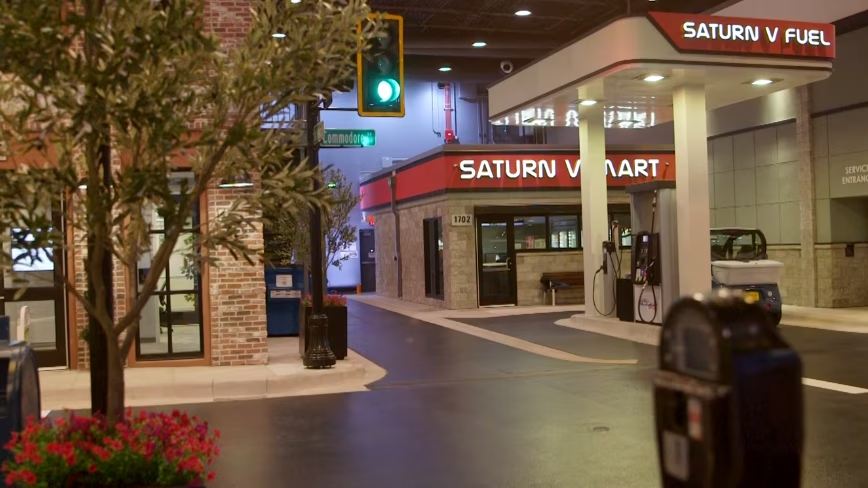
The FBI recently unveiled a significant initiative in cybersecurity: the Kinetic Cyber Range. This is a full-scale replica city, spanning 22,000 square feet, located on the Huntsville, Alabama campus. This facility was designed to provide law enforcement with a controlled and realistic environment to simulate and investigate complex cyberattacks, an approach that reflects the growing need for dedicated and secure environments for sensitive workloads.
Opened in February 2025, the Kinetic Cyber Range has already trained over 1,400 students, including FBI personnel and partners from other federal and local agencies. The existence of a physical, self-hosted facility for such critical training underscores the importance of maintaining direct control over infrastructure, a fundamental principle for those evaluating Large Language Model (LLM) deployments in contexts where data sovereignty and security are paramount.
Architecture and Infrastructural Implications
The replica city includes essential elements such as a hospital and a power company, all interconnected and supported by a robust IT infrastructure comprising 200 servers. This setup is not coincidental: it simulates the vulnerabilities and interdependencies of real-world critical infrastructures, allowing agents to practice scenarios ranging from protecting healthcare data to ensuring the resilience of energy networks.
The presence of 200 servers indicates a significant investment in compute and storage capacity, configured to operate in a potentially air-gapped or otherwise strictly controlled environment. This type of on-premise deployment offers granular control over hardware, software, and data flows, which are crucial for national security and for companies handling highly confidential information. For CTOs and infrastructure architects, the example of the Kinetic Cyber Range highlights how a self-hosted approach can be the preferred solution to ensure maximum security and compliance.
Data Sovereignty and TCO in the Training Context
The adoption of a physical, on-premise cyber range for cybersecurity training aligns perfectly with the principles of data sovereignty and control. In such an environment, data generated during simulations remains within the organization's physical and logical boundaries, eliminating risks associated with reliance on external cloud providers. This is particularly relevant for government agencies and companies in regulated sectors, where compliance is non-negotiable.
From a Total Cost of Ownership (TCO) perspective, an initial investment in bare metal infrastructure and dedicated servers, like the 200 servers at the Kinetic Cyber Range, may entail high CapEx. However, in the long term, it can offer significant advantages in terms of predictable operational costs, eliminating variable cloud fees and ensuring greater flexibility in customizing hardware for specific workloads, such as LLM inference or fine-tuning. For those evaluating on-premise deployments, AI-RADAR offers analytical frameworks on /llm-onpremise to assess trade-offs between initial costs and long-term benefits in terms of control and security.
Future Prospects for Security and On-Premise AI
The FBI's initiative with the Kinetic Cyber Range demonstrates a clear trend towards creating dedicated and controlled environments to address complex and sensitive challenges. This model is replicable and highly relevant in the field of artificial intelligence, particularly for LLM deployments that require high standards of security, privacy, and performance. The ability to manage the entire AI pipeline, from training to inference, on self-hosted infrastructures, offers a level of control and customization that cloud solutions often cannot match.
In an era where cyberattacks are becoming increasingly sophisticated and data protection regulations are becoming more stringent, the choice to invest in physical, controlled infrastructures, such as the Kinetic Cyber Range, represents a forward-thinking strategy. It ensures not only the security of critical operations but also the ability to innovate and train with maximum autonomy, a decisive factor for resilience and competitiveness in the current technological landscape.





💬 Comments (0)
🔒 Log in or register to comment on articles.
No comments yet. Be the first to comment!