Project Nova: Firefox's Deep Renovation
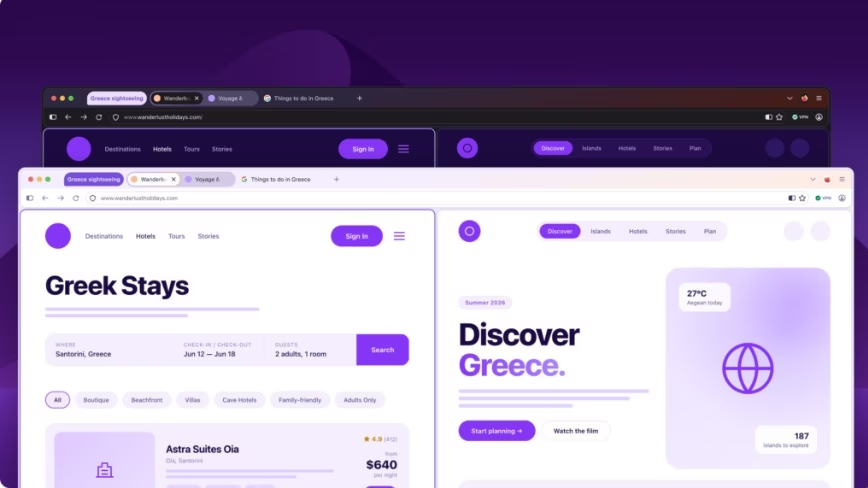
Mozilla has officially announced Project Nova, the most extensive visual update Firefox has received in the last six years, marking a significant evolution since 2020. This ambitious redesign touches numerous aspects of the user interface, from tabs to icons, including spacing, color palette, and browser settings. Mozilla's primary goal is twofold: on one hand, to make the browsing experience warmer and more responsive; on the other, to preserve Firefox's distinctive identity as the only major browser not built on Chromium.
This strategic renovation aims to refresh the browser's image, which is often perceived as a solid but sometimes less modern alternative compared to its competitors. The desire to combine aesthetics and performance is clear, seeking to offer users a product that is not only functional but also visually appealing and intuitive in daily use.
Redesign Details and the Return of Compact Mode
At the heart of Project Nova is the re-elaboration of key interface elements. Tabs, for example, have been rethought to improve readability and organization, facilitating the management of multiple open pages simultaneously. Icons have also undergone a redesign, adopting a more modern style consistent with the new overall aesthetic. Changes to spacing and the color palette contribute to creating a cleaner, less cluttered interface, enhancing the overall visual experience.
One of the most anticipated and celebrated novelties is the return of compact mode. This feature, highly requested by the user community, allows for a reduction in the space occupied by interface elements, offering a larger viewing area for web content. It is a choice that reflects Mozilla's attention to user feedback and its willingness to offer customization options that adapt to different preferences and screen configurations.
Technological Context and the AI-RADAR Perspective
While the redesign of a browser like Firefox represents a significant event in the consumer software landscape, it is crucial to contextualize it within AI-RADAR's editorial mission. Our publication focuses on in-depth analysis of Large Language Models (LLM), local stacks, hardware for inference and training, and deployment decisions that prioritize data sovereignty, control, and Total Cost of Ownership (TCO) for AI/LLM workloads.
Innovations in a browser's user interface, while improving the general browsing experience, do not directly fall within the themes of on-premise infrastructure, hardware specifications like VRAM or throughput for LLM inference, nor compliance considerations for air-gapped environments. This Firefox update is relevant for end-users and the web browser market, but it does not offer direct insights for CTOs, DevOps leads, or infrastructure architects evaluating self-hosted solutions for artificial intelligence.
Implications for the Browser Ecosystem and Final Considerations
The launch of Project Nova is a clear signal of Mozilla's commitment to keeping Firefox competitive and relevant in a market dominated by Chromium-based solutions. Offering a robust alternative with a well-defined identity is crucial for web ecosystem diversity and user choice. The focus on a warmer and faster experience, combined with the return of appreciated features like compact mode, could attract new users and retain existing ones.
In summary, while Firefox's renovation is excellent news for those seeking a privacy-conscious, non-Chromium browser, its technical implications primarily lie in client software design and usability. For discussions related to AI infrastructure, LLM models, and on-premise deployment strategies, AI-RADAR continues to explore the specific challenges and opportunities of that sector, providing detailed analyses of the trade-offs and technological constraints relevant to IT professionals.




💬 Comments (0)
🔒 Log in or register to comment on articles.
No comments yet. Be the first to comment!