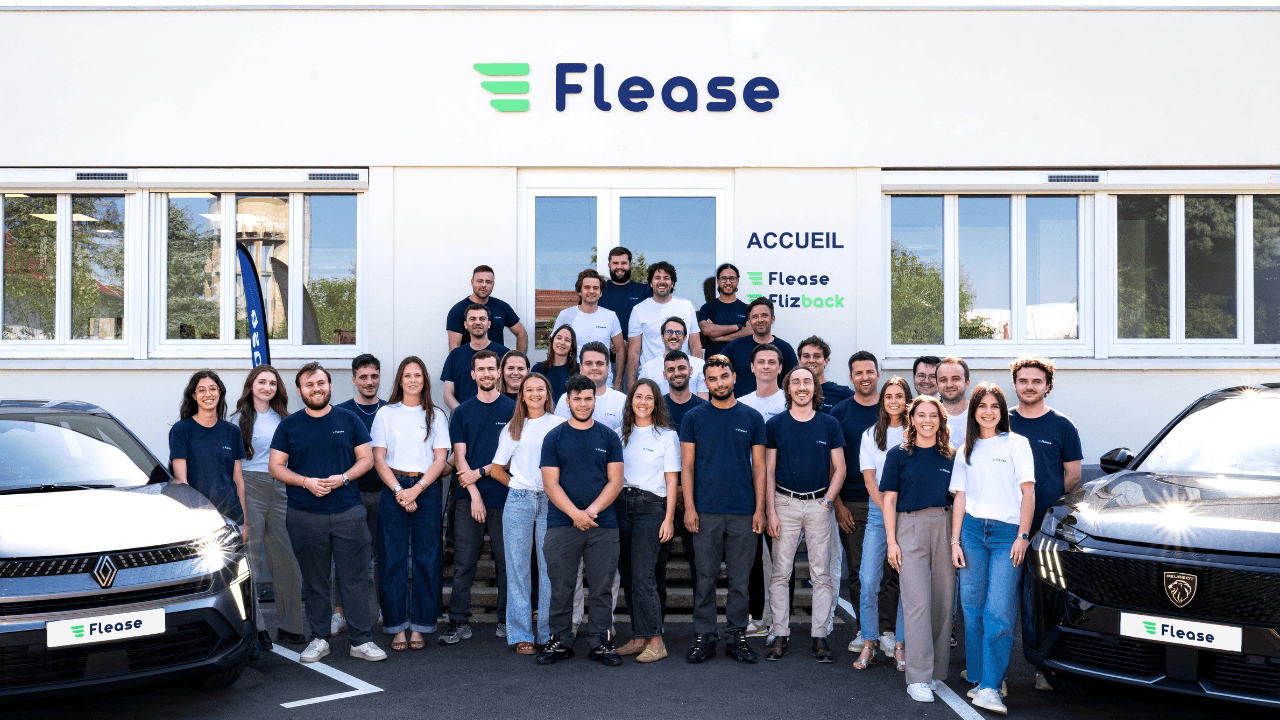
Managing a corporate fleet isn't so different from overseeing a GPU cluster. Anyone who must align operational needs, budgets, and asset lifecycles knows this well. The news of a €13 million funding round for Flease, a French company specializing in reconditioned vehicle leasing, gives us a chance to explore an underappreciated parallel: the Total Cost of Ownership of cars and servers.
The deal and the promise of TCO under control
Founded five years ago in Lyon, Flease presents itself as a flexible and responsible solution for enterprise fleets. Contracts range from 1 to 50 months and cover nearly-new and reconditioned vehicles. The differentiator is a fully telematics-driven fleet management tool that tracks usage, consumption, and service cycles in real time. The stated goal: 'to provide fleet managers with visibility and simplified daily operations,' as co-founder Vincent Dreyfus explains. The round was led by Partech Impact, the growth impact fund of Partech, which was impressed by the founders' 'quality of execution, clarity of vision, and innovative nature of the offering.'
What this has to do with on-premise AI
Looking at the Flease model, a core principle of the enterprise IT world – especially when choosing on-premise solutions for Large Language Models – jumps out: the obsessive pursuit of TCO. Whether you're dealing with GPU-powered servers or commercial vehicles, the challenge is the same: maximize utilization, predict maintenance costs, and extend the lifecycle without compromising performance. For self-hosted LLM infrastructure, the equivalent telemetry comes from resource monitoring systems, energy consumption and temperature tracking, and predictive maintenance on VRAM and storage.
Flease's insight – using real-time data to optimize overall spending – maps perfectly onto the needs of those managing inference racks. Just as with reconditioned vehicles, the on-premise computing world is seeing a growing market for refurbished components and second-life servers that, when properly monitored, offer significant savings without sacrificing reliability.
Transparency and flexibility: the cross-cutting pillars
'Our model is based on three principles: flexibility, transparency, and cutting deployment delays,' says Dreyfus. Words that echo identically in corporate data center hallways. Flease's contractual flexibility – short, adaptable contracts – resembles the needs of AI teams that must scale infrastructure quickly based on training workloads or request volumes. Transparency on costs, historically a weak point of cloud services, becomes a competitive advantage both for vehicle lessors and for those purchasing bare metal nodes.
For those evaluating on-premise deployments, there are clear trade-offs: the initial capital expenditure (CapEx) can be high, but total control and predictable operational spending (OpEx) align with Flease's logic. The company aims 'to serve fleets from just a few vehicles to several hundreds, without compromising on service quality or operational efficiency,' says co-founder Constantin Eliard. In other words, the same approach can apply to a small corporate cluster or to a multi-site infrastructure, provided you have the right monitoring tools.
What this story signals in the bigger picture
The Flease funding isn't just market news: it's a symptom of a mindset shift crossing all asset-intensive sectors. The energy transition mentioned in the article as a driver for sustainable leasing finds a parallel in the growing attention to energy efficiency in data centers hosting LLMs. The diversification of powertrains in the automotive world – electric, hybrid, combustion – mirrors the heterogeneity of hardware accelerators (GPU, TPU, FPGA) that now coexist in inference stacks.
Ultimately, the Flease story reminds us that any fleet – whether of vehicles or servers – needs data-driven oversight to keep TCO in check. It's a lesson we at AI-RADAR apply daily to analyzing on-premise architectures, providing frameworks to evaluate real ownership costs and the trade-offs between control, performance, and data sovereignty.








💬 Comments (0)
🔒 Log in or register to comment on articles.
No comments yet. Be the first to comment!