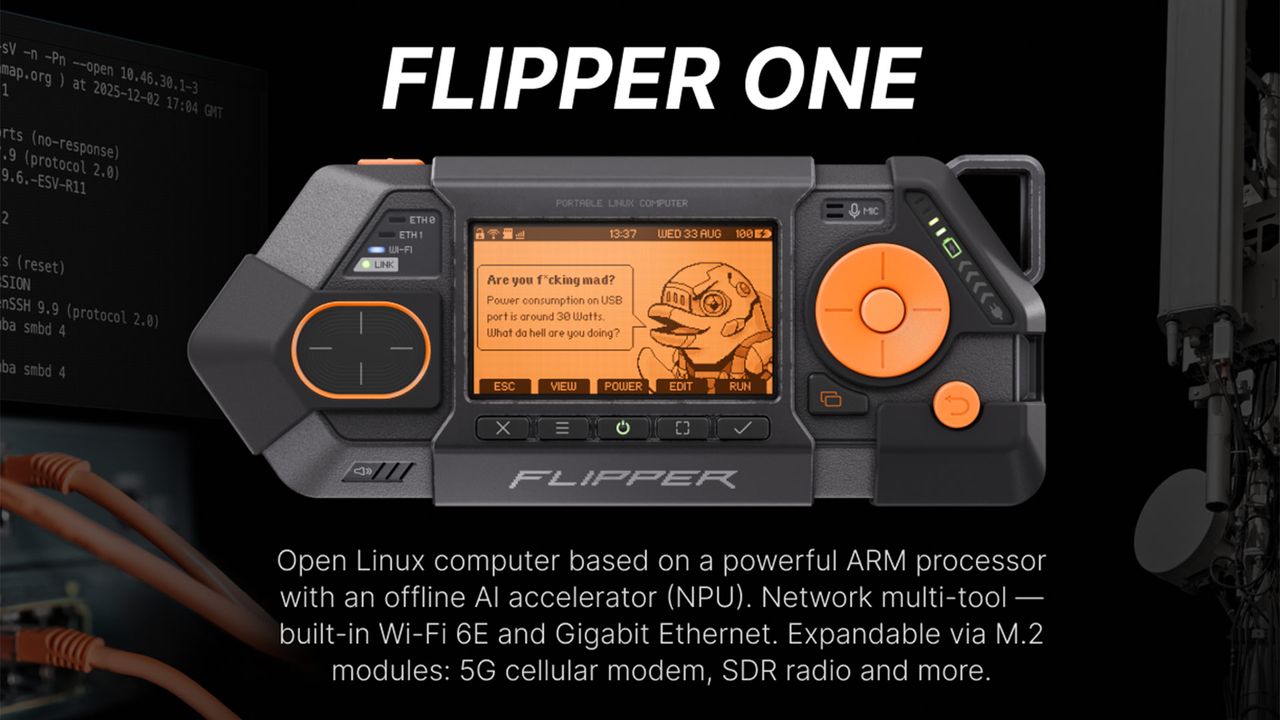
Flipper One: A New Horizon for Edge Computing
The technological landscape continues to evolve towards increasingly compact and versatile solutions, capable of extending computational capabilities beyond traditional data centers. In this context, the Flipper One emerges as a new computing multitool, distinguished by its nature as a keychain device and a fully open Arm Linux computer. This combination of portability and openness offers developers and businesses a flexible platform for a wide range of applications.
The Flipper One is not merely a gadget but a true computational system designed for interaction with its surroundings. Its open source architecture, based on Linux and Arm processors, ensures deep control over both software and hardware, a crucial aspect for those seeking customized and secure solutions. Its small size makes it ideal for edge computing scenarios, where data processing must occur as close as possible to the source.
Technical Details and Connectivity Potential
The Flipper One's connectivity specifications are particularly relevant for its potential applications. The device is equipped with network connectivity, essential for integration into existing infrastructures and for data exchange with other systems, both local and remote. This networking capability makes it an effective node in distributed architectures, enabling real-time data collection and transmission.
Furthermore, the presence of GPIO (General Purpose Input/Output) interfaces paves the way for a wide range of automation and IoT projects. GPIOs allow the Flipper One to interact directly with sensors, actuators, and other custom hardware components, transforming it into an intelligent hub for data collection or control of physical systems. M.2 connectivity, on the other hand, offers significant flexibility for expansion. This slot can be used to add high-speed storage via NVMe drives, advanced wireless modules (Wi-Fi 6E, 5G), or even specific hardware accelerators, boosting the device's computational capabilities for more intensive workloads.
Implications for On-Premise Deployment and Data Sovereignty
The characteristics of the Flipper One align perfectly with AI-RADAR's principles, particularly regarding on-premise deployment and data sovereignty. As a fully open Arm Linux computer, it offers the possibility to develop and deploy applications in a self-hosted environment, maintaining full control over data and processes. This is fundamental for organizations operating in regulated sectors or needing to ensure maximum privacy and compliance.
The use of devices like the Flipper One in edge computing allows for local data processing, reducing cloud dependency and minimizing latency. This approach not only improves performance for time-sensitive applications but also contributes to optimizing the TCO (Total Cost of Ownership) for distributed infrastructures, avoiding recurring costs associated with data transfer and processing in the cloud. For those evaluating on-premise deployment, there are significant trade-offs between centralized computational power and the flexibility and control offered by distributed edge solutions, such as those analyzed in AI-RADAR's frameworks on /llm-onpremise.
Future Prospects and Trade-off Considerations
The potential of the Flipper One also extends to the field of artificial intelligence, particularly for the inference of lightweight or quantized models directly at the edge. While it cannot compete with the computing power of high-end GPUs like A100s or H100s, its ability to process data locally makes it an interesting candidate for specific tasks, such as real-time video or audio stream analysis, or running small LLMs for immediate contextual responses.
Naturally, adopting a device like the Flipper One involves trade-offs. Computational power is limited compared to server-grade solutions, and managing a large number of distributed devices requires robust deployment and monitoring strategies. However, for scenarios prioritizing data sovereignty, low latency, and controlled TCO for specific edge workloads, the Flipper One represents a promising solution, offering developers a versatile platform to innovate in a controlled and open environment.





💬 Comments (0)
🔒 Log in or register to comment on articles.
No comments yet. Be the first to comment!