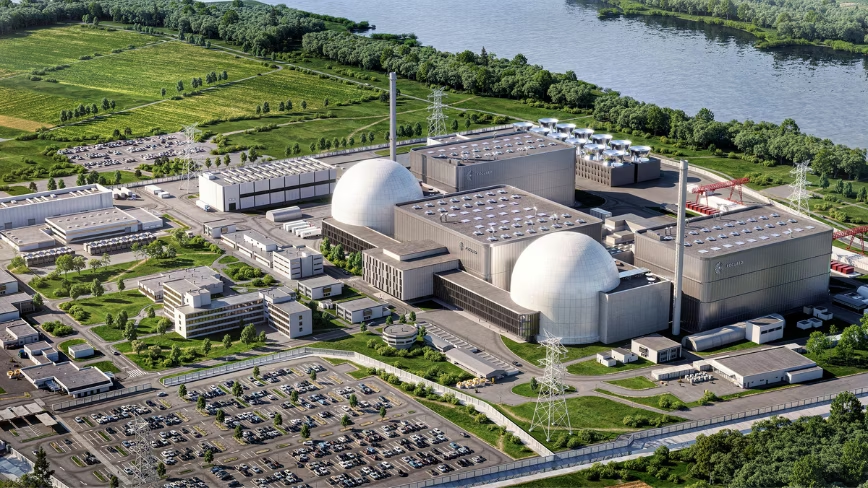
Substantial Investment for Commercial Fusion
Focused Energy, a Germany-based fusion startup, has announced the completion of an oversubscribed Series A funding round, securing $240 million. This latest injection of capital brings the company's total private funding to $300 million. The round was led by RWE, a major German energy utility, underscoring the strategic interest from the energy sector in new frontiers of power generation.
Focused Energy's primary objective is to develop a commercial reactor. The technology underpinning this project is particularly noteworthy: it is based on the same approach that yielded the world's first controlled fusion reaction with a net energy gain. This achievement represents a significant milestone in fusion research, promising an energy future with profound implications for global industry and infrastructure.
The Context of Net Energy Gain Fusion
Nuclear fusion, the process that powers the sun and stars, has been a subject of research for decades as a potential source of clean, virtually limitless energy on Earth. Unlike nuclear fission, which splits heavy atoms, fusion combines light atoms, releasing enormous amounts of energy without producing long-lived radioactive waste and with a much lower inherent risk of accidents.
"Net energy gain" is the holy grail of fusion research. It means that the energy produced by the fusion reaction exceeds the energy required to initiate and sustain it. Achieving this point is an immense technological challenge, demanding extreme temperatures and pressures for a sufficient duration. The approach adopted by Focused Energy, though not detailed in the source, aligns with the one that has already demonstrated this capability, positioning the company at the forefront of global energy research.
Implications for Infrastructure and TCO
For CTOs, DevOps leads, and infrastructure architects, the prospect of an abundant and clean energy source like fusion has far-reaching implications. Energy is a significant operational cost for any data center, especially those hosting intensive workloads such as Large Language Models (LLM) training and inference. A potential reduction in the Total Cost of Ownership (TCO) related to energy could redefine deployment strategies.
While the commercialization of fusion reactors is still distant, investments like that in Focused Energy indicate growing market confidence in the long-term feasibility of this technology. Cheaper and more sustainable energy could not only lower operational costs but also support the exponential growth in computing demand, making on-premise deployments more accessible and reducing reliance on volatile or less sustainable energy sources. This scenario could influence future decisions regarding data center location and infrastructure planning.
Future Prospects and Industry Challenges
The journey from scientific demonstration to large-scale commercialization is notoriously long and capital-intensive for revolutionary energy technologies. Focused Energy will need to address complex engineering challenges, stringent regulatory requirements, and the need to scale energy production cost-effectively. However, the substantial capital raised and the backing of an established player like RWE provide a solid foundation to tackle these obstacles.
This investment is not merely a vote of confidence in Focused Energy's technology but also a broader signal of accelerating global efforts in fusion. As the world seeks sustainable energy solutions to address climate change and growing demand, nuclear fusion remains one of the most ambitious promises. The success of initiatives like Focused Energy could, in the long run, radically transform the energy landscape, offering new opportunities for innovation and sustainability across all sectors, including IT infrastructure.








💬 Comments (0)
🔒 Log in or register to comment on articles.
No comments yet. Be the first to comment!