Introduction
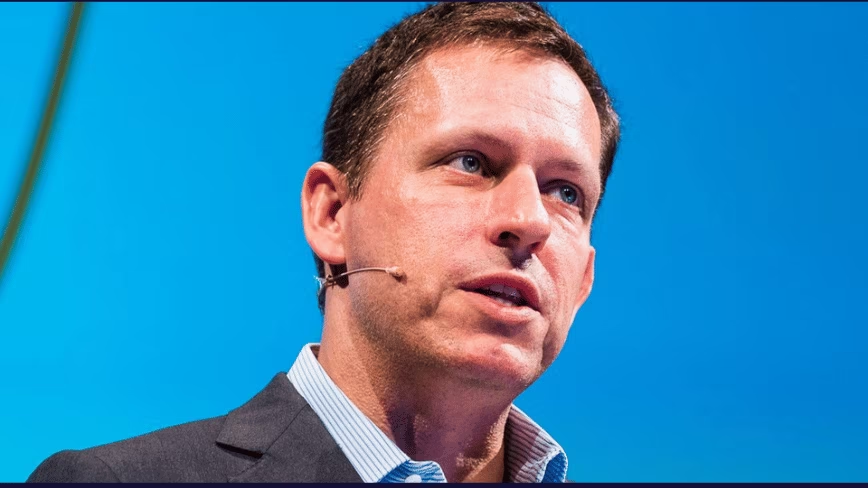
The venture capital landscape continues to show significant dynamism, especially within the artificial intelligence sector. Founders Fund, the renowned venture capital firm co-founded by Peter Thiel, has announced the closing of its largest growth fund to date, reaching $6 billion. This operation, finalized on May 1st, represents the fourth investment vehicle dedicated to late-stage companies, highlighting a clear strategy to support the growth of disruptive technology enterprises.
Raising such a substantial amount of capital in a relatively short period, after already investing $4.6 billion in the previous year, signals strong investor confidence. This influx of resources is set to further shape the future of innovation, with a particular focus on startups operating in the AI field, from fundamental research to practical applications that demand robust and scalable infrastructure.
Fundraising Details and Financial Implications
Founders Fund's new capital injection was fueled by a combination of sources. The majority of the capital, amounting to $4.5 billion, came from external limited partners, notably including sovereign wealth funds. This participation from high-profile institutional players underscores the perceived stability and return potential associated with investments in frontier technology. The remaining $1.5 billion was contributed by Founders Fund's own partners and employees, demonstrating internal alignment and strong conviction in the identified opportunities.
An investment of this magnitude has direct repercussions on the startup ecosystem. It enables companies to access significant capital to accelerate development, scale operations, and address the challenges associated with commercializing complex technologies. For the AI sector, this translates into increased resources for research and development of Large Language Models (LLM), for optimizing Inference and training, and for building the necessary hardware and software infrastructure to support increasingly demanding workloads.
AI Context and Deployment Choices
The capital injection into the AI sector has direct implications for infrastructure deployment decisions. With the increasing complexity and size of models, companies must carefully evaluate whether to opt for cloud solutions or a self-hosted, on-premise approach. Growth funds like Founders Fund can support startups developing innovative solutions for on-premise AI, including local stacks, dedicated hardware for Inference and training, and platforms that prioritize data sovereignty and control.
The choice between cloud and on-premise often comes down to a Total Cost of Ownership (TCO) analysis, compliance requirements, and the need for air-gapped environments for sensitive data. Funded startups might focus on GPUs with high VRAM specifications, advanced Quantization solutions to optimize resource usage, or Frameworks for efficient data pipeline management. This scenario highlights the growing demand for expertise and products that allow companies to maintain control over their AI assets, mitigating risks associated with third-party dependence and ensuring maximum operational flexibility.
Future Outlook and Market Impact
The closing of such a significant fund by Founders Fund is not merely a financial event but an indicator of the direction the technology market is heading. The focus on late-stage companies suggests a maturation of the AI sector, where bets are no longer solely on nascent ideas but on projects with proven traction and consolidated market potential. This could lead to greater stability and reduced risk for investors, but also to more intense competition among startups for funding.
For companies operating in the AI infrastructure space, this signifies an opportunity to innovate and provide solutions that meet scalability, efficiency, and security needs. Whether it's improving system Throughput, reducing Inference Latency, or developing new architectures for distributed training, the capital invested by funds like Founders Fund will fuel the next wave of innovation. AI-RADAR continues to monitor these developments, offering in-depth analysis of the trade-offs and constraints companies must consider in their AI adoption journey, especially for those evaluating on-premise deployments.








💬 Comments (0)
🔒 Log in or register to comment on articles.
No comments yet. Be the first to comment!