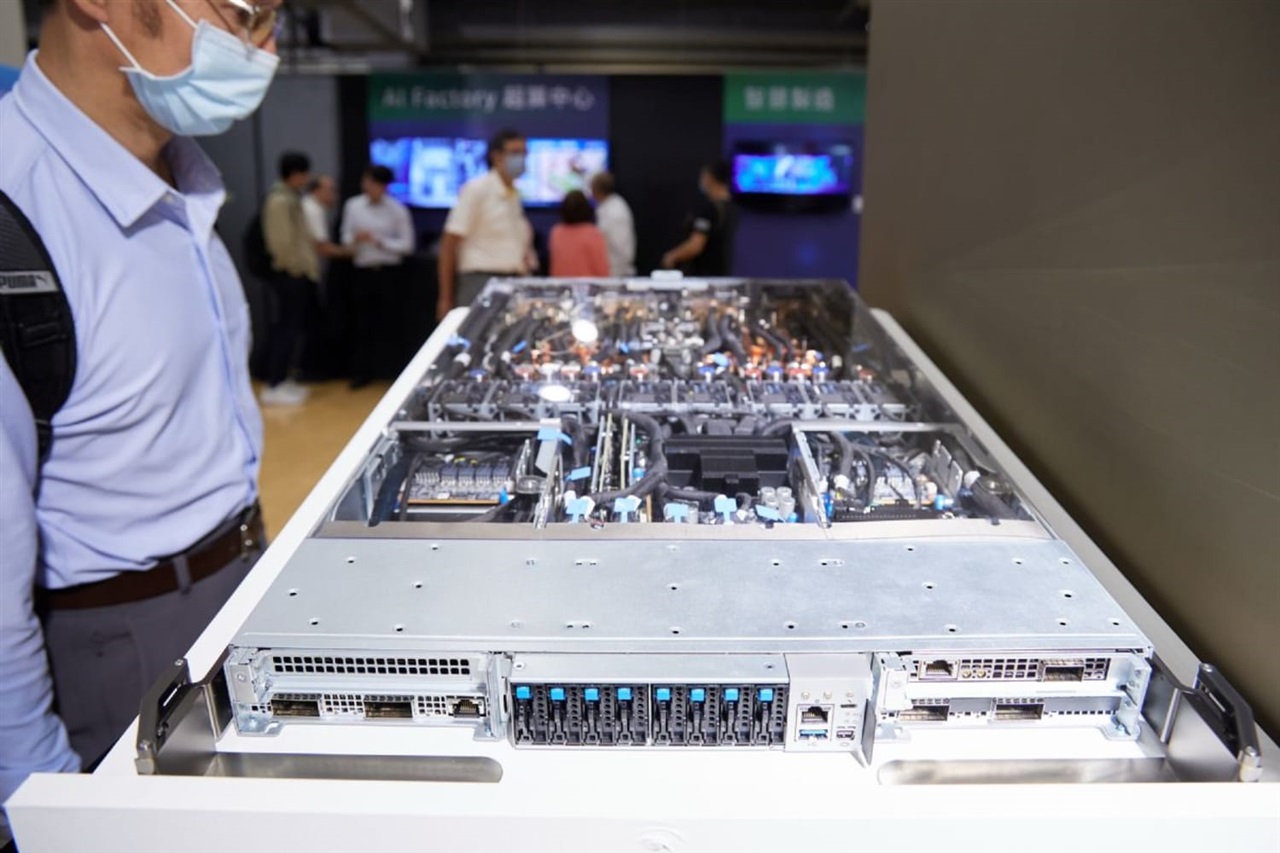
The Exponential Growth of the AI Server Market
Foxconn, one of the world's largest contract electronics manufacturers, has announced a significant forecast for the artificial intelligence server market. The company expects annual shipments of these systems to more than double, a figure that highlights the accelerating demand for robust and specialized hardware infrastructure to support the development and deployment of AI solutions. This projection reflects a broader trend in the technology sector, where AI, and particularly Large Language Models (LLMs), are becoming a fundamental pillar for enterprise innovation.
The momentum behind this growth is twofold, according to Foxconn: on one hand, a diversified "AI server mix," suggesting a range of hardware configurations tailored to different needs; on the other, the adoption of a "consignment model," a supply approach that can optimize inventory management and logistics for large-scale customers. These factors underscore how production and distribution strategies are evolving to meet the complex demands of a rapidly expanding market.
The Crucial Role of AI Servers in On-Premise Deployments
AI servers form the backbone of any dedicated artificial intelligence infrastructure, both for intensive training of complex models and for large-scale inference. Their importance is particularly pronounced for organizations opting for self-hosted or on-premise deployments, where direct control over hardware is paramount. These systems are typically equipped with high-performance GPUs, such as NVIDIA A100 or H100, featuring high VRAM and parallel computing capabilities, essential for handling the computationally intensive workloads of LLMs.
For CTOs and infrastructure architects, selecting the right AI server involves evaluating critical trade-offs. Factors such as the amount of VRAM per GPU, inference throughput (measured in tokens per second), and latency are decisive. An on-premise deployment offers advantages in terms of data sovereignty, regulatory compliance (especially in regulated sectors), and the ability to operate in air-gapped environments. However, it requires significant upfront investment (CapEx) and internal expertise for infrastructure management and maintenance. AI-RADAR, for instance, offers analytical frameworks on /llm-onpremise to evaluate these trade-offs.
Supply Models and TCO Optimization
The "consignment model" mentioned by Foxconn is an example of how supply strategies can influence the Total Cost of Ownership (TCO) for companies investing in AI infrastructure. This model, which involves the supplier managing inventory at the customer's site or a designated warehouse, can reduce warehousing costs and improve supply chain responsiveness. For large enterprises requiring a constant flow of AI servers, such an approach can translate into operational efficiencies and better capital management.
The diversification of the "AI server mix," conversely, addresses the need for scalable and flexible solutions. Not all AI workloads require the same hardware configuration. One company might need servers with high VRAM GPUs for fine-tuning proprietary LLMs, while another might prioritize systems with a larger number of GPUs for distributed inference, perhaps utilizing quantization techniques to optimize resource usage. This flexibility is crucial for adapting to evolving AI project needs and optimizing hardware investment.
Future Outlook and Infrastructural Challenges
Foxconn's forecast is a clear indicator of market confidence in the continued expansion of artificial intelligence. As LLMs and other AI applications become more sophisticated and pervasive, the demand for specialized silicon and dedicated servers will only increase. This trend poses new challenges for companies, which must balance the need for computational power with managing energy costs, the physical footprint of the infrastructure, and operational complexity.
The current landscape sees constant evolution, with new chips and architectures emerging regularly, promising greater efficiency and performance. For technical decision-makers, staying abreast of these innovations and understanding the trade-offs between different hardware solutions and deployment models (on-premise, cloud, or hybrid) is essential for building a resilient and future-proof AI infrastructure. The ability to scale, maintain data security, and control costs will remain absolute priorities in this dynamic scenario.








💬 Comments (0)
🔒 Log in or register to comment on articles.
No comments yet. Be the first to comment!