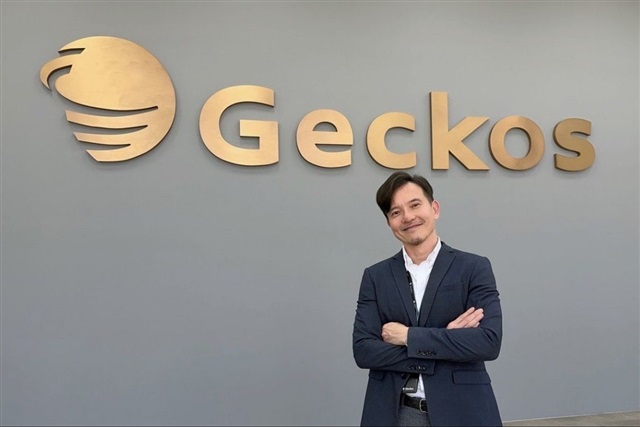
The expansion of AI infrastructure is shifting attention from what happens inside chips to what connects and cools them. It's no coincidence that Geckos, a company known for its nano copper powders and co-packaged optics (CPO) waveguides, is now investing in next-generation materials. The choice, reported exclusively by DIGITIMES, should be read against the grain: it's not just product diversification, but a bet on a layer of the hardware chain that is becoming decisive for anyone running large-scale inference, especially in on-premise environments.
Nano copper is already widely used in sintering processes for advanced chip packaging, enabling low-temperature electrical interconnections. CPO waveguides promise to cut the energy consumption of integrated optical communications. Both are essential for increasing compute density without blowing out power consumption — a constraint well known to those managing private datacenters. But Geckos seems to want to go further, signaling that the evolution of materials for AI has not yet reached a stable plateau.
To grasp the relevance of this move, one must look at the typical workloads of Large Language Models in on-premise deployment. Inference on quantized models — often running on GPUs or dedicated accelerators inside isolated racks — is not limited only by VRAM or raw compute power. Bottlenecks quickly shift to communication bandwidth between processors and memory, and to the ability to dissipate heat generated by sustained vector operations. In this context, any innovation in interconnect or interface materials can directly impact TCO, reducing the need for active cooling or enabling better utilization of available memory.
There is a structural aspect to consider: much of the public attention and investment is focused on algorithms and models. But the actual hardware on which those algorithms run is made of materials, and progress there is slower, less flashy, yet equally disruptive. Geckos' decision — coming from a player with specific expertise in materials chemistry — suggests the industry is recognizing a competitive wedge at exactly this level. It's not hard to imagine hybrid solutions emerging in the coming years that combine conductive, thermal, and optical properties in a single component, lowering system complexity and favoring adoption of more compact and efficient on-premise architectures.
Who loses in this scenario? Vendors of monolithic solutions that are slow to integrate these innovations, and perhaps large cloud providers if companies discover that better materials let them get the same performance in-house without moving sensitive data. It's not a declared revolution, but a slow realignment of incentives. For those evaluating self-hosted LLM deployment today, the difference between a system that fits in a single rack without exotic liquid cooling and one requiring dedicated infrastructure can redefine the economic feasibility of the project. Geckos, with its move to next-gen AI materials, places a piece in that direction.






💬 Comments (0)
🔒 Log in or register to comment on articles.
No comments yet. Be the first to comment!