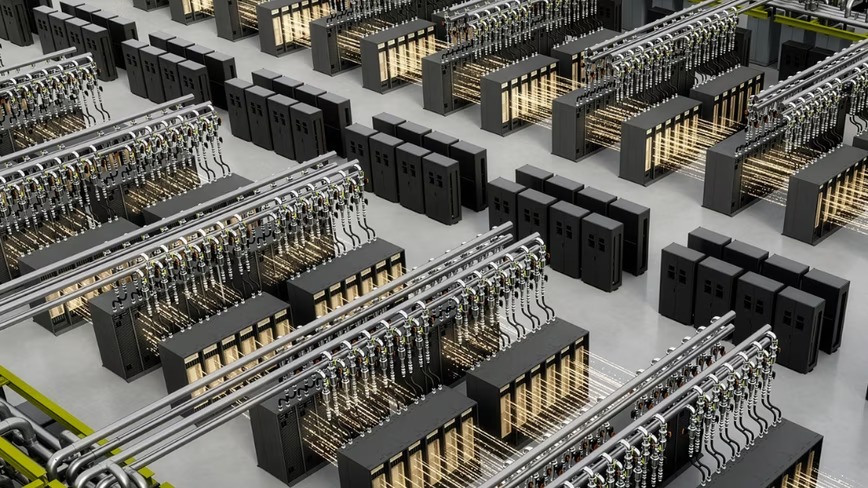
Japan and Nvidia are building what is being touted as the world’s first national AI infrastructure dedicated to physical intelligence, and the numbers alone make this announcement stand out from the usual hype. The planned AI factory will pack 140 megawatts of data centre capacity, 13,750 Nvidia Vera CPUs, and 27,500 Rubin GPUs – a project of unprecedented scale with a very specific target.
Unlike cloud data centres that train large language models or serve inference for digital applications, this facility is designed to train massive models for robotics and physical automation. Nvidia’s full-on involvement, supplying the entire hardware stack, signals a strategic shift: the company is no longer just a component vendor, but a partner in national-scale sovereign infrastructure projects.
The technical details, though still partial, paint a clear picture. Vera CPUs and Rubin GPUs belong to Nvidia’s future roadmap, architectures that have not yet hit the market. This means the Japanese consortium has locked in supply of next-generation technology, likely through multi-year contracts, to build a computing centre that will go live when these architectures mature. Such timing reveals long-term planning and a determination not to fall behind in the race to apply AI to the physical world.
For those following on-premise infrastructure trends, the Japanese case is instructive. A 140 MW system cannot simply be rented in the cloud: it requires direct capacity management, control over data location (critical for sensitive industrial and robotic data), and tailored energy optimization. It is proof that when it comes to physical AI at a national level, the public cloud model gives way to self-hosted deployments of unprecedented size, where data sovereignty and predictable total cost of ownership (TCO) become non-negotiable.
It is no coincidence that Japan, with its deep roots in robotics and industrial automation, is the first mover. The investment aims to create a competitive edge in advanced manufacturing, logistics, and sectors where the integration of AI and robotics is the next leap. The massive hardware will allow training of neural networks for perception, manipulation, autonomous navigation, and more, with training cycles that demand complex simulations and constant adjustments.
On the energy front, 140 MW is no trivial figure: it will likely require a dedicated, possibly renewable, source to sustain operational costs. Here too Nvidia plays its part, with future Rubin GPUs promising improved efficiency, but the TCO of the whole operation will largely depend on electricity costs and thermal management.
The announcement also carries geopolitical weight. While many countries debate AI regulation, Japan is laying down infrastructure that secures independence in developing critical technologies – a model that could be replicated in Europe or other regions pursuing digital sovereignty. Cloud providers, for their part, may need to revisit strategies if the trend toward physical AI factories consolidates, because these workloads demand a level of hardware-software integration and proximity to physical systems that do not fit well with centralized cloud architectures.
Ultimately, this is not just a hardware announcement but a structural signal: AI is moving out of servers and into factories, and the game will increasingly be played on the field of extreme on-premise infrastructure. Those who control these platforms will gain not only technological but industrial and strategic advantage.






💬 Comments (0)
🔒 Log in or register to comment on articles.
No comments yet. Be the first to comment!