
Introduction: The Motherboard's Role in the On-Premise AI Ecosystem
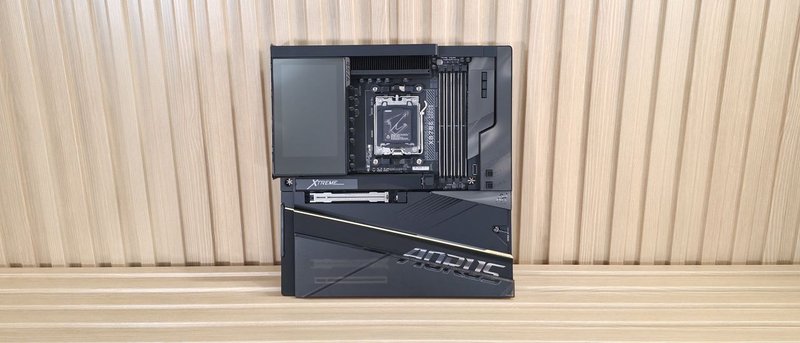
The choice of hardware components is fundamental for organizations planning to implement artificial intelligence solutions locally. In this context, the motherboard serves as the backbone of any system, acting as the platform for the CPU, GPU, memory, and storage. The Gigabyte X870E Aorus Xtreme AI Top is presented as a high-end offering, labeled as a "flagship," suggesting a particular focus on performance and reliability.
This type of hardware is crucial for organizations prioritizing the on-premise deployment of Large Language Models (LLM) and other AI workloads. The ability to support powerful and stable configurations is a prerequisite for ensuring data sovereignty, control over operational costs, and regulatory compliance—all central aspects of AI-RADAR's strategy.
Technical Details and Implications for AI Workloads
A "flagship" motherboard like the Gigabyte X870E Aorus Xtreme AI Top typically features a robust power delivery system (VRM), essential for providing stable power to high-performance CPUs and GPUs, especially under intensive AI training or inference loads. The availability of multiple PCIe Gen5 slots is equally critical for accommodating several GPUs, such as NVIDIA A100 or H100, which are the computational core of modern LLMs.
The mention of the "X3D version" in a review context suggests a preference for specific CPU architectures. While AMD Ryzen processors with 3D V-Cache technology (X3D) are known for their excellent gaming performance due to the extended L3 cache, this feature can also offer benefits in certain AI scenarios that benefit from rapid access to large datasets, thereby reducing latency. However, for most LLM workloads, GPU VRAM and computational power remain the primary limiting factors. Therefore, the CPU choice must be aligned with the specific type of AI workload intended for execution.
The Context of On-Premise AI Deployment
The adoption of dedicated hardware platforms like the Gigabyte X870E Aorus Xtreme AI Top reflects a growing trend towards on-premise deployment of AI solutions. Companies choose this path for several strategic reasons. Data sovereignty is often a top priority, especially in regulated sectors like finance or healthcare, where sensitive data cannot leave corporate or national boundaries. An air-gapped environment, built on self-hosted hardware, offers the highest level of control and security.
Furthermore, a careful analysis of the Total Cost of Ownership (TCO) may reveal that, despite a higher initial investment (CapEx), on-premise solutions can prove more cost-effective in the long run compared to the recurring operational costs (OpEx) of the cloud, especially for intensive and predictable AI workloads. The ability to optimize hardware for specific training or inference pipelines, without relying on standard cloud provider configurations, offers an additional layer of efficiency.
Outlook and Trade-offs in Hardware Selection
Selecting a flagship motherboard like the Gigabyte X870E Aorus Xtreme AI Top is just one piece of a larger puzzle. System architects and DevOps leads must consider the entire hardware stack: from GPUs with sufficient VRAM to host large models, to system memory (RAM) for datasets, and high-speed NVMe storage for data ingestion. Each component presents specific trade-offs in terms of cost, performance, and power consumption.
The decision between different CPU architectures, such as those benefiting from X3D technology, and the choice of specific GPUs, must be guided by the LLM's requirements and the workflow pipeline. AI-RADAR provides analytical frameworks on /llm-onpremise to help evaluate these trade-offs, offering guidance based on specific constraints and requirements rather than generic recommendations. The goal is to build a robust, efficient AI infrastructure aligned with data control and sovereignty needs.








💬 Comments (0)
🔒 Log in or register to comment on articles.
No comments yet. Be the first to comment!