
Google Cloud Next 2026: The Era of AI Agents and Hardware Evolution
Google Cloud leveraged its Next 2026 event to unveil a series of significant innovations, emphasizing the evolution of artificial intelligence and its underlying infrastructure. Key announcements included the introduction of a dedicated AI agent platform and the eighth generation of its Tensor Processing Units (TPUs). These presentations reflect a clear strategic direction towards the pervasive integration of AI into business processes, with a focus on managing an increasing number of intelligent agents.
According to Google Cloud, approximately 75% of its customers already use its AI products, a figure that underscores the rapid adoption of these technologies. Sundar Pichai, CEO of Google and Alphabet, highlighted a 40% quarter-over-quarter growth in paid monthly active users of the Gemini Enterprise system in the first quarter of 2026. Thomas Kurian, CEO of Google Cloud, described Gemini Enterprise as the “connective tissue” that unites enterprise data, applications, and AI agents, facilitating the integration of processes into a single system.
Hardware Innovations and the Intelligent Agent Platform
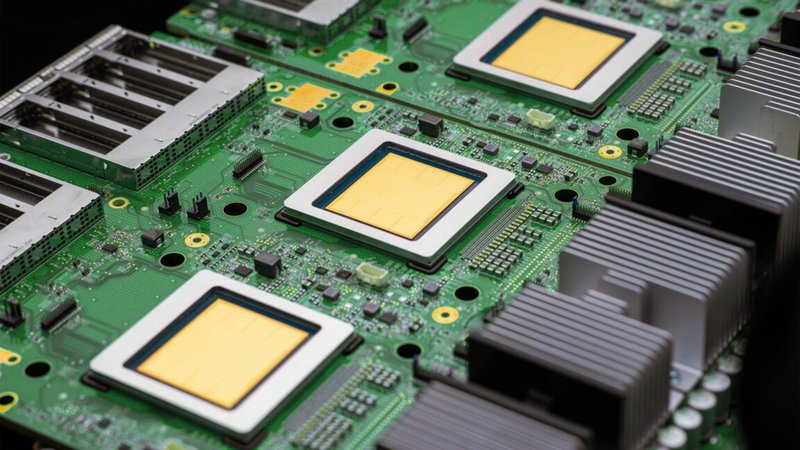
At the core of the hardware novelties are the TPU 8t and TPU 8i, Google's eighth generation of custom processing units. The TPU 8t is specifically designed for model training, aiming to reduce development times through higher compute throughput and increased memory bandwidth. The TPU 8i, on the other hand, is optimized for inference workloads, equipped with 288GB of high-bandwidth memory (HBM) and 384MB of on-chip SRAM, features that support low-latency processing.
Google Cloud stated that these new TPU systems deliver up to 80% better performance per dollar compared to the previous generation. Both chips are expected to become generally available later in 2026. In parallel with the hardware, the company introduced the Gemini Enterprise Agent Platform, an expansion of the Vertex AI system. This platform is positioned as a “mission control” for the Agentic Enterprise, providing a centralized environment for building and managing AI agents. The platform supports access to over 200 AI models, including Gemini 3.1 Pro and models from partners such as Anthropic, including Claude Opus 4.7.
Data Architecture, Security, and Productivity Tools
Google Cloud also introduced significant updates under the Agentic Data Cloud framework, which enables “systems of action” capable of using enterprise data in real-time via AI agents. A cross-cloud lakehouse based on Apache Iceberg allows organizations to query data stored on platforms like AWS and Azure without the need for transfer, offering “zero-copy” access to enterprise applications and data platforms. This capability is particularly relevant for companies evaluating hybrid or on-premise deployment strategies, as it addresses concerns related to data sovereignty and compliance by allowing data to remain in its original location.
On the security front, Google Cloud outlined improvements to its cybersecurity platform, integrating its Threat Intelligence and Security Operations tools with the Wiz cloud security platform. The company reported that its Triage and Investigation Agent has processed over five million alerts, reducing analysis time from 30 minutes to approximately 60 seconds. Dark Web Intelligence, which analyzes external threat data using AI models, and a Threat Hunting Agent to identify new attack patterns were also introduced. Finally, Google Cloud Fraud Defense, replacing reCAPTCHA, is designed to discern the legitimacy of bots, humans, and AI agents in online interactions. Productivity tools have been enhanced with Workspace Intelligence, a new feature that connects data across emails, documents, and meetings to support AI-driven task execution, including AI-assisted email management and automated content generation.
The Enterprise AI Outlook
Google Cloud's recent innovations highlight a vision where AI agents become fundamental components of enterprise infrastructure, automating and optimizing a wide range of operations. The ability to process over 16 billion tokens per minute via API, a significant increase from 10 billion in the previous quarter, demonstrates the scalability and growing demand for Google's AI models. This scenario compels businesses to consider not only computational power but also the data architecture and security strategies necessary to support an increasingly complex ecosystem of AI agents.
For organizations exploring on-premise or hybrid deployment options for their AI workloads, understanding hardware specifications like those of the new TPUs and cross-cloud data integration capabilities is crucial. AI-RADAR offers analytical frameworks on /llm-onpremise to evaluate the trade-offs between cloud and self-hosted solutions, considering factors such as TCO, data sovereignty, and performance requirements. The direction taken by Google Cloud Next 2026 suggests that the future of enterprise AI will increasingly focus on intelligent agents and flexible, secure infrastructures.



💬 Comments (0)
🔒 Log in or register to comment on articles.
No comments yet. Be the first to comment!