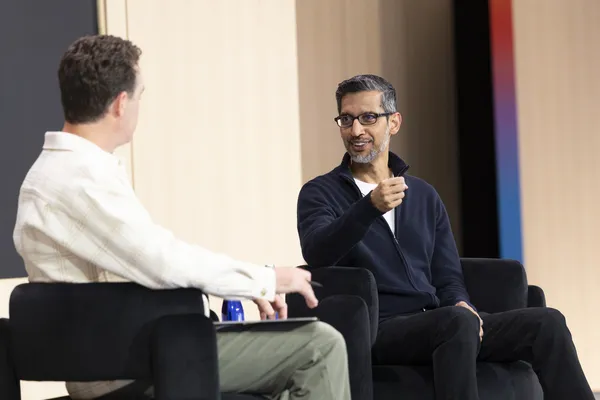
Google I/O 2026: Visions of the Technological Future
Google I/O 2026, as usual, offered a glimpse into the future directions of technological innovation. Among the various sessions, the one named "Dialogues" served as a crucial meeting point for industry leaders and thinkers. Here, the debate focused on some of the most transformative areas of the moment: artificial intelligence, quantum computing, robotics, and the role of creativity in the digital age.
These discussions are not merely academic; they outline the challenges and opportunities that CTOs, infrastructure architects, and DevOps leads will face in the coming years. The convergence of these disciplines, in fact, necessitates a deep reflection on deployment strategies, resource management, and data protection—central aspects for those operating with on-premise AI/LLM workloads.
The Impact on AI, Quantum, and Robotics for On-Premise Deployments
Artificial intelligence, particularly Large Language Models (LLM), continues to demand significant computational resources. For organizations opting for self-hosted deployments, managing these workloads involves critical decisions on specific hardware, such as GPUs with high VRAM, and system architectures capable of ensuring high throughput and low latency. The discussion on AI advancements at Google I/O 2026 underscores the importance of planning scalable and resilient infrastructures.
In parallel, quantum computing, while still in its early stages for many practical applications, promises to revolutionize sectors like cryptography and optimization. If and when these technologies mature, their integration with existing infrastructures, or the need for new dedicated architectures, will become a determining factor. Robotics, too, with its increasing autonomy and complexity, will require edge and on-premise processing capabilities to ensure real-time responses and adhere to stringent security and privacy requirements.
Data Sovereignty and TCO: Strategic Priorities
The discussions from the "Dialogues" at Google I/O 2026 reinforce the focus on data sovereignty, a crucial topic for many businesses, especially in regulated industries. The choice to keep data and AI models within one's own infrastructure boundaries, through self-hosted or air-gapped solutions, is often driven by compliance and control needs. This approach contrasts with cloud-based models, offering greater control but requiring a higher initial investment and more complex management.
Total Cost of Ownership (TCO) analysis therefore becomes fundamental. Evaluating CapEx for hardware acquisition (GPUs, servers, storage) and OpEx for power, cooling, and maintenance is essential to effectively compare on-premise options with the operational costs of cloud services. Creativity, understood as the ability to generate new ideas and solutions even through AI, must be supported by an infrastructure that allows for experimentation and innovation without compromising security or economic sustainability.
Future Prospects for AI Infrastructure
The topics addressed at Google I/O 2026 highlight a continuously evolving technological landscape, where today's infrastructural decisions will have a significant impact on an organization's ability to innovate tomorrow. For decision-makers, understanding the implications of AI, quantum computing, and robotics means preparing an infrastructure that is not only performant but also secure, compliant, and economically sustainable.
The need to balance performance, costs, and data control drives a careful evaluation of the trade-offs between on-premise deployment and cloud solutions. AI-RADAR, with its analytical frameworks available at /llm-onpremise, offers tools to support these evaluations, providing a neutral perspective on the constraints and opportunities of each approach. The future of AI and related technologies will largely depend on companies' ability to build the right foundations today.







💬 Comments (0)
🔒 Log in or register to comment on articles.
No comments yet. Be the first to comment!