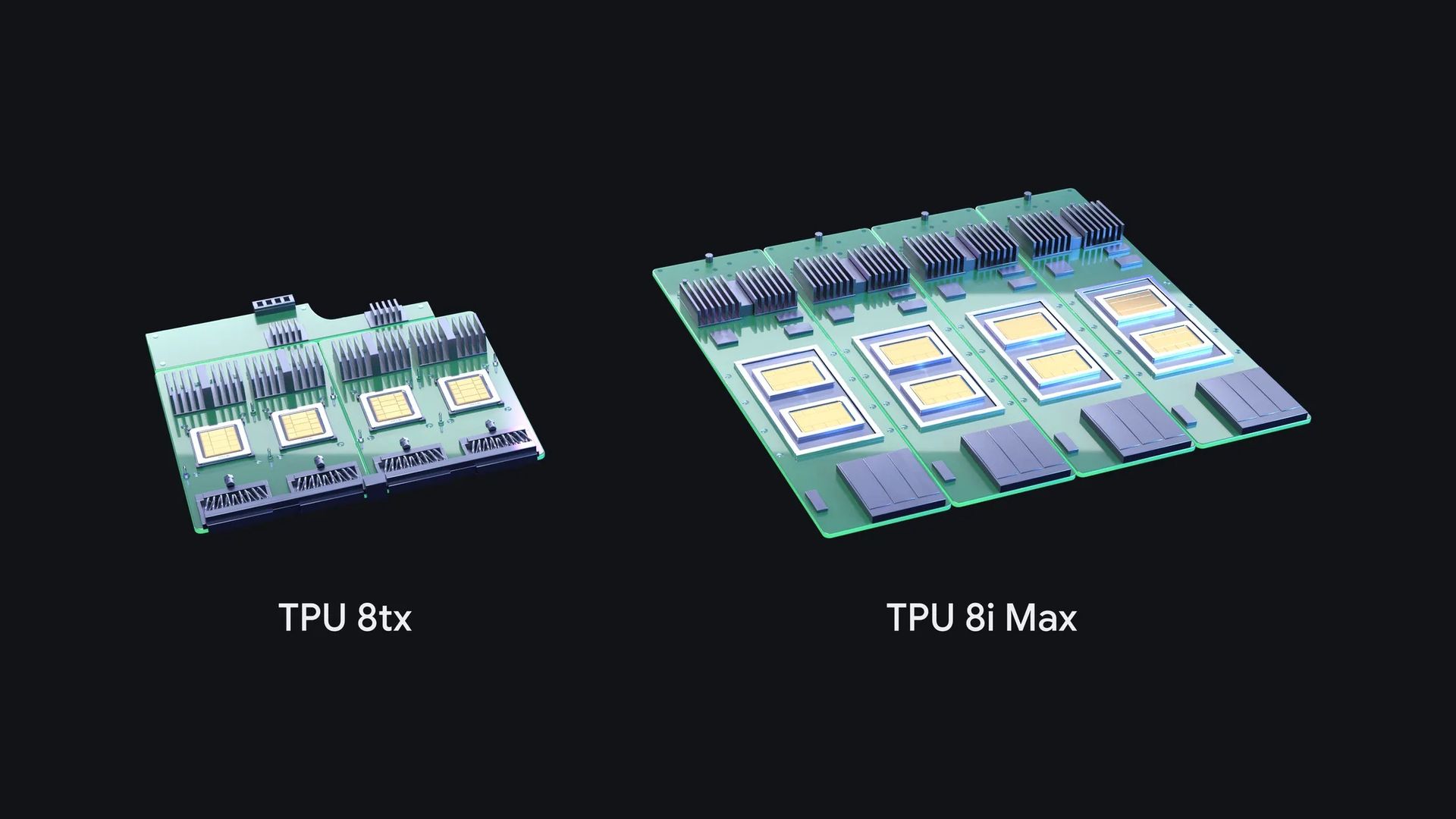
When a silicon vendor decides to rework its accelerators into specialized systems, it is not doing a simple refresh. It is saying that the market no longer accepts a single architecture for training and inference. The news that Google is redirecting its TPUs toward two specific areas — agents and security — should be read as a positioning move: the next phase of AI infrastructure will be dominated by workload specialization, not raw compute power.
Autonomous agents based on LLMs have different needs from models that answer single prompts. They must maintain context over long horizons, chain calls to external tools, and manage memory and planning. An accelerator designed to maximize throughput on homogeneous batches can waste resources when the load becomes irregular and interactive. Security, for its part, requires isolation, attestation, and low-latency policy enforcement: features that often do not emerge as priorities in a general-purpose design. Reworking silicon for these needs means intervening on memory hierarchies, scheduling, and interconnects, not just increasing FLOPS.
The structural point is that specialization shifts value from hardware to software and platform control. Whoever owns the silicon and the orchestration framework can optimize the entire stack, but also makes it harder for customers to separate components. For a company evaluating on-premise or hybrid deployments, this raises a concrete question: will the specialization be available outside the vendor's data centers, or will it remain an exclusive cloud advantage? Recent AI infrastructure history shows that proprietary architectures tend to make deployment choices more rigid, even when they promise efficiency.
It is no coincidence that security appears alongside agents. Autonomous agents act on enterprise data and systems; a policy error or context leak has immediate consequences. Designing hardware dedicated to security implicitly acknowledges that AI is no longer just a performance problem, but a matter of trust and boundaries. This strengthens the demand for local controls, audit, and data isolation — factors that often push toward self-hosted or hybrid solutions.
For those evaluating these trade-offs, AI-RADAR offers analytical frameworks on /llm-onpremise to compare control constraints, TCO, and sovereignty without reducing the choice to a simple benchmark question. The real contest in the coming months will be whether TPU specialization becomes a reusable building block outside the Google ecosystem or remains a closed architecture. The answer will determine not only the future of data centers, but also which organizations will really be able to bring AI close to their own data. The signal is clear: AI hardware is moving from the race for transistors to the race for workloads. And anyone who has to manage agents and security in-house will need precise answers, not promises.




💬 Comments (0)
🔒 Log in or register to comment on articles.
No comments yet. Be the first to comment!