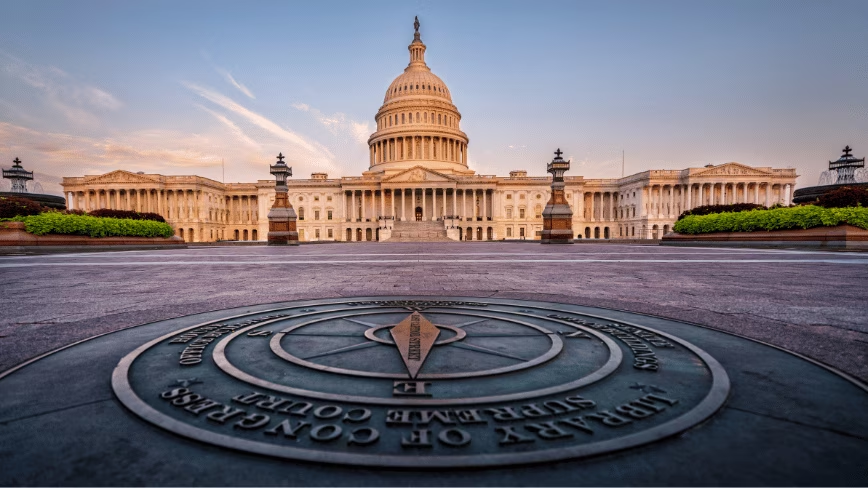
A super PAC with a notably modest budget has trained the spotlight on AI regulation. On Thursday, Guardrails Alliance announced its launch with an initial $5 million raised from tech employees, labor unions, and parents. Its declared goal: to counterbalance the massive political influence of big Silicon Valley companies, which have already spent over $100 million to elect candidates favoring a hands‑off approach to artificial intelligence.
The political breakthrough and the spending asymmetry
Five million against more than one hundred – the asymmetry is stark. While tech giants bankroll campaigns promising deregulation, a committee of Democratic operatives and civic allies is attempting to build an unusual coalition. The money comes from people who work inside tech companies but fear the consequences of unchecked development, from unions concerned about job displacement, and from parents worried about unregulated AI use affecting children.
The stakes go beyond ideology: the norms that Congress or federal agencies will shape will define the operational perimeter of AI for years, directly affecting organizations that are now deciding whether to adopt on‑premise, hybrid, or cloud infrastructure for training and inference.
An ecosystem under pressure
The rules under discussion go well beyond statements of principle. Transparency obligations, model audits, impact assessments, and – critically – requirements for data residency and local processing could force organizations to completely rethink their architectures. In such a scenario, on‑premise deployment ceases to be a control choice and often becomes a compliance necessity.
When regulations mandate that sensitive data must not leave a specific jurisdiction, self‑hosted solutions on dedicated hardware become the most direct path to continue using LLMs without running afoul of the law. Those who have already invested in high‑VRAM GPUs or local clusters can adapt quickly; those anchored to centralized cloud services risk colliding with fast‑evolving legislation.
Sovereignty and infrastructure: why rules matter for deployment
For the professional audience that follows AI‑RADAR, this political conflict is an early indicator of what will happen in the AI supply chain. A regulatory crackdown would boost the attractiveness of on‑premise as a lever for sovereignty, but would force companies to deal with higher capital expenditure (CapEx) and maintenance complexity. Conversely, a victory for the deregulatory line would tilt the balance toward cloud consumption with its operational spending models (OpEx) but fewer guarantees about data location.
Total Cost of Ownership (TCO) calculations thus become entangled with regulatory uncertainty. Those choosing local inference hardware today – think of INT8 quantization to cut VRAM consumption, or fine‑tuning pipelines kept under their own control – are implicitly betting on a scenario of stricter rules. Guardrails Alliance is trying precisely to steer that future.
Beyond lobbying: the future of local AI
The challenge launched by this super PAC is not just a David‑and‑Goliath tale. It signals a shift in awareness among tech workers, who are beginning to mobilize to influence the very architecture of the market. If political action produces rules that mandate transparency and data localization, the hardware landscape for inference and training will be transformed.
For infrastructure decision‑makers, the message is clear: the regulatory match is not played only in Washington – it unfolds inside every data center. Tracking developments and preparing for multiple scenarios becomes essential. Ultimately, the battle for billions of dollars of AI will also be decided by the ability to keep data and models under one’s own roof, far from prying eyes and unsteady jurisdictions.








💬 Comments (0)
🔒 Log in or register to comment on articles.
No comments yet. Be the first to comment!