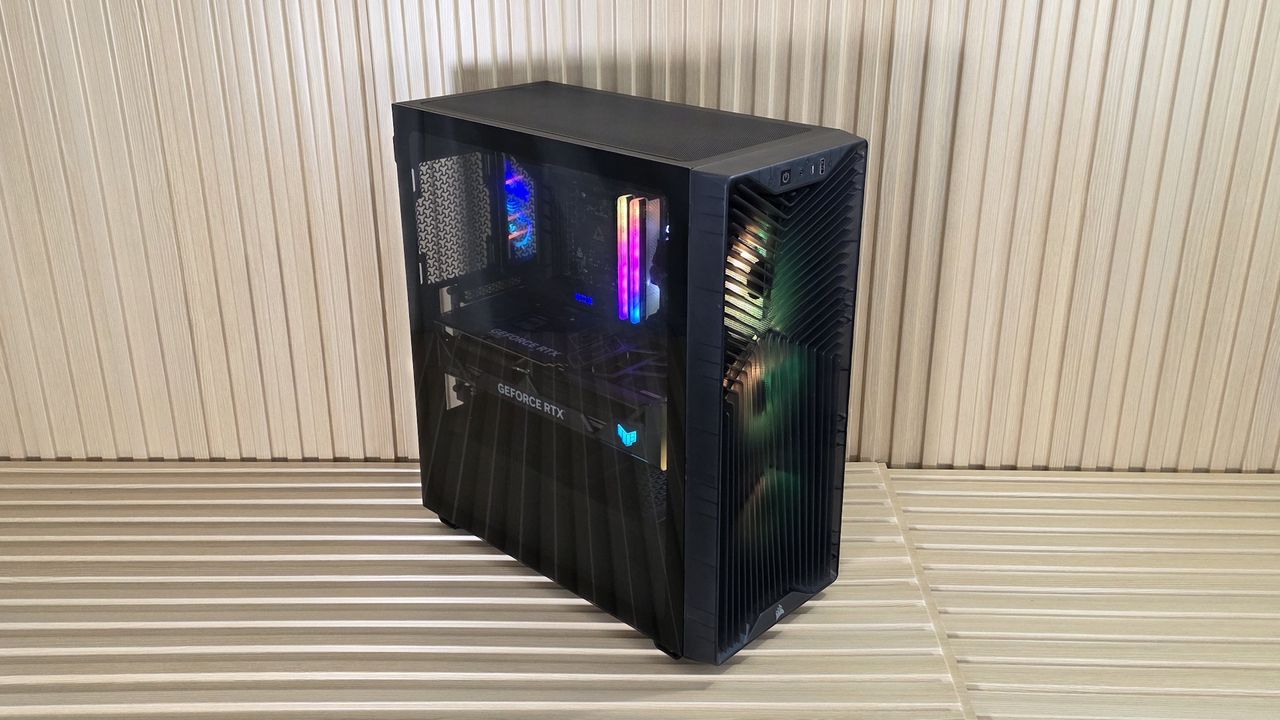
On-Premise Hardware and the Cost Factor: The Case of the Corsair 3200D RS ARGB Chassis
In the rapidly evolving landscape of Large Language Models (LLMs), hardware infrastructure selection represents a strategic decision for companies aiming for on-premise deployments. While attention often focuses on high-performance GPUs and rack servers, even seemingly minor components, such as a PC chassis, can offer significant food for thought. The Corsair 3200D RS ARGB, a mid-tower chassis that includes three fans and is positioned as a budget-friendly solution, exemplifies how cost considerations extend to every level of the hardware stack.
This type of component, while not directly an AI accelerator, is an integral part of a system that will house the computing hardware. Its “budget” nature and the inclusion of fans suggest an approach aimed at reducing initial cost, a crucial aspect for those evaluating the construction of local LLM infrastructure, especially for pilot projects, development environments, or smaller-scale deployments.
Balancing CapEx and Performance for Local LLMs
The decision to adopt a self-hosted approach for LLM workloads is often driven by the need for granular control and the desire to optimize the Total Cost of Ownership (TCO) in the long run. A chassis like the Corsair 3200D RS ARGB, with its economical positioning, can help contain initial Capital Expenditure (CapEx). This is particularly relevant for organizations looking to experiment with Open Source LLMs or implement smaller models, where investment in top-tier hardware might not be justified.
However, choosing a budget chassis also involves trade-offs. While the three included fans may be adequate for standard configurations, Inference and especially training of larger LLMs generate considerable heat, requiring more robust cooling solutions and advanced thermal management systems. For intensive workloads, a “budget” chassis might limit the ability to house multiple GPUs or liquid cooling systems, directly impacting the Throughput and latency of LLM operations.
Data Sovereignty and Control: Beyond Cost
Beyond economic considerations, the drive towards on-premise deployments is strongly linked to issues of data sovereignty and compliance. For regulated sectors or companies with stringent data localization requirements, a self-hosted infrastructure offers the assurance that sensitive data does not leave corporate boundaries, avoiding the risks associated with third-party cloud services. Even a system assembled with more accessible components, such as the Corsair chassis in question, can serve this fundamental purpose.
The ability to maintain the entire LLM development and Deployment Pipeline within one's own datacenter, potentially even in air-gapped environments, provides an unparalleled level of control and security. This approach allows organizations to directly manage updates, security patches, and hardware configuration—critical aspects for maintaining the integrity and confidentiality of the models and data used.
Perspectives for Decision-Makers: Balancing Constraints and Opportunities
For CTOs, DevOps leads, and infrastructure architects, selecting hardware for on-premise LLM workloads is an exercise in balancing budget constraints, performance requirements, and strategic needs. A budget chassis like the Corsair 3200D RS ARGB can represent a valid starting point for exploring the potential of LLMs in a controlled environment, but it is essential to understand its limitations in terms of scalability and thermal management for more demanding workloads.
TCO evaluation must consider not only the initial cost of components but also long-term operational costs, including energy consumption, maintenance, and the potential need for upgrades. For those evaluating on-premise deployments, AI-RADAR offers analytical frameworks on /llm-onpremise to assess the trade-offs between different hardware and architectural solutions, providing neutral guidance for informed decisions that prioritize data sovereignty, control, and cost optimization.






💬 Comments (0)
🔒 Log in or register to comment on articles.
No comments yet. Be the first to comment!