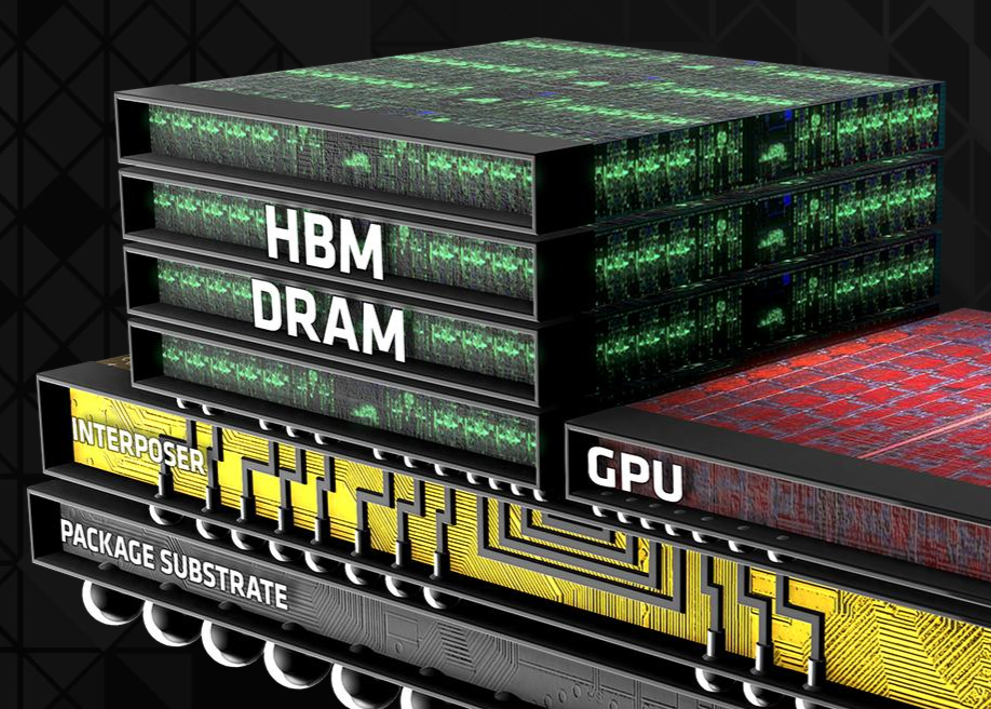
When the semiconductor industry calls High Bandwidth Memory (HBM) essential for artificial intelligence, it usually means one thing: more bandwidth to feed ever-hungrier GPUs. But there’s a problem benchmarks don’t show—heat. Stacking DRAM dies vertically creates an increasingly hostile thermal path, imposing hard limits on density and clock speeds. Two projects, one Korean and one Japanese, are trying to answer with an idea as simple as it is radical: rotate HBM 90 degrees and rest it on its side, expanding the dissipation surface and decoupling memory cells from the logic layer that controls them.
The Korean V-Die design and the Japanese MOSAIC share the same architectural intuition: instead of piling DRAM dies on a horizontal substrate, they place them vertically, side by side, using through-silicon vias (TSVs) on a rotated plane. The result is a stack that exposes more contact area to the heatsink, lowering thermal resistance without resorting to complex micro-channel or liquid cooling solutions.
For anyone evaluating on-premise deployment, the news carries weight beyond the academic announcement. Racks housing inference nodes already contend with high power density; every extra watt dissipated by memory is a watt taken from useful compute or one that demands more expensive cooling infrastructure. If these new designs can push bandwidth beyond 3 TB/s per stack while keeping temperatures in check, the impact on Total Cost of Ownership (TCO) would be direct: less air conditioning, more GPUs per square meter of data center, and the ability to hold larger models entirely in VRAM without thermal bottlenecks forcing throttling.
There’s a structural signal here. As the model market polarizes between cloud-scale giants and open models that enterprises want to run in-house, sideways memory innovation shifts the goalposts for on-premise hardware. It’s no longer just about raw compute acceleration; memory must coexist with air cooling or simplified liquid loops without becoming the most fragile component on the board. Teams evaluating an inference cluster across multiple GPUs already know that the thermal budget is often the real limiting factor, not theoretical TFLOPs. Technologies like V-Die and MOSAIC could make the idea of mandatory immersion cooling for large-model local inference look outdated.
Data sovereignty plays into this as well. Organizations handling sensitive data that cannot be entrusted to external providers are pushed toward on-premise, but they face energy and thermal costs that often make the cloud cheaper in the short run. Cooler, denser memory rebalances the equation by enabling more boards to be racked without retrofitting entire machine rooms. That’s not a minor detail: in local AI projects, the cost of preparing the physical environment can outweigh the hardware itself.
Both designs are still at the research stage, and turning a patent into a commercially viable memory product takes years of silicon engineering and supply-chain work. But the fact that two independent research hubs are converging on the same geometric solution suggests the industry has identified memory heat as a bottleneck worth investing in—and that today’s vertical HBM may turn out to be merely a transitional phase.







💬 Comments (0)
🔒 Log in or register to comment on articles.
No comments yet. Be the first to comment!