
One GEMM, three variants: the bottleneck shifts
The Helion linear backend for vLLM introduces a change of perspective: instead of maintaining multiple specialized implementations for 8-bit GEMMs, it proposes a single kernel covering Standard GEMM, Split-K and Swap-AB. Decisions that used to be encoded in dispatch heuristics become tunable parameters. The ahead-of-time autotuner explores memory layout, scheduling and algorithmic variants for each input shape. This is not a cosmetic simplification: it moves where the performance battle is fought. In a framework like vLLM, heuristics exist to handle the variability of tensor shapes during inference. Split-K divides the K dimension when M or N are too small; Swap-AB rewrites the operation to improve cases with small M. They work on average, but are not optimal for every model or workload. Helion turns variant selection from a design decision into a numerical search problem. The result is an optimization pipeline that can adapt to a single workload, not to an average workload. For teams running LLMs in production, this is a signal: kernel optimization can become a repeatable process, not a craft effort redone for every architecture or model.
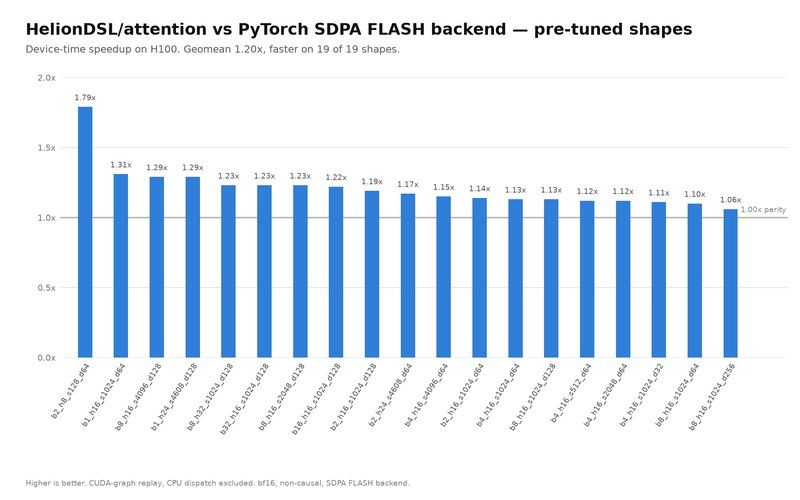
The second implication is less visible but more structural. Complexity does not disappear: it is absorbed by ahead-of-time tuning. The team behind Helion describes split_k and swap_ab as tunable parameters, with split_k limited to powers of two up to 256. The autotuner systematically compares combinations and chooses the best configuration for each workload. In practice, the cognitive cost of deciding which variant to use shifts from the kernel developer to the tuning infrastructure. On an NVIDIA H100 80GB HBM3 GPU, Helion kernels achieve geometric mean speedups of 1.110× over CUTLASS for FP8_Dynamic, 1.178× over CUTLASS for W8A8_INT8, 1.149× over FlashInfer and 1.177× over DeepGEMM for Block_FP8. The speedup distribution varies from shape to shape, and that variation confirms the value of per-shape tuning over a single configuration. The point is not the average gain, but the ability to reduce model-specific bottlenecks.
This approach also changes the relationship with frameworks. Many linear backends today delegate primitives to CUTLASS or DeepGEMM. If a unified kernel like Helion can cover the same variants with heavy automation, the barrier to introducing new quantization formats or new architectures could fall. The cost of maintaining dozens of specialized kernels is replaced by the cost of maintaining an autotuner and its configuration files. It is not always cheaper, but it is a different engineering model.
From GPU craftsmanship to automated search
For years, GEMM kernel optimization has been seen as territory for a few low-level GPU programming specialists. It required deep knowledge of NVIDIA architectures, tiling strategies and memory layouts. Helion, as a native PyTorch kernel DSL that is hardware-agnostic, tries to reduce this dependence. It allows writing a kernel once in concise Python code and generating specialized code for different platforms. It is not magic: ahead-of-time tuning can take hours and still requires knowing what is being optimized. But it shifts the center of gravity of skills. A team serving a specific model on self-hosted infrastructure can get configurations tailored to its workload without maintaining deep CUDA expertise internally. It must, however, invest in automation, configuration management and the ability to read autotuner results.
This has organizational implications. Kernel work is no longer only a code-writing problem, but a search-space design problem. Algorithmic choices become parameters, and their value emerges only if the search space is rich enough and the tuning process is reliable. For a company running LLMs in-house, the question is no longer only does someone know how to write a CUDA kernel, but do we have a pipeline to generate and validate optimized configurations for our models. These are different profiles. The first is often hard to hire and retain; the second can be built with MLOps and automation skills.
The shift in incentives matters. The Red Hat and Meta team behind Helion describes the work as production-ready, but in a vLLM fork. Upstream adoption is not guaranteed. In this context, the ability to generate specific configs before deployment becomes an operational asset. Organizations with many models or heterogeneous hardware can see ahead-of-time tuning as a way to extract more value from GPUs they already own. Those looking for plug-and-play integration may face more friction, because the process cost includes not only initial tuning but also maintaining configs as models or framework versions change.
The price of per-shape tuning: hours of compute and config governance
The hybrid dispatch strategy described for Helion offers an interesting compromise. For small shapes up to a max_helion_size, set to 32 in the work, the linear backend uses Helion under CUDA Graph replay; beyond that threshold it falls back to the default CUTLASS or DeepGEMM kernels. This reduces CPU overhead from kernel dispatch and launch outside CUDA Graphs and limits the number of shapes to optimize. In practical terms, tuning does not need to cover the entire possible space, only the shapes that actually flow through CUDA Graphs. This makes the maintenance of precomputed configs more manageable, but introduces a threshold that must be chosen carefully. Too low a value leaves part of the workload outside and reduces benefit; too high increases the number of configurations to generate and validate.
The trade-off between performance, usability and maintainability is explicit. Finer tuning improves performance but increases the autotuning effort on the client side or the burden of distributing precomputed configs. The source indicates the team is evaluating a model where Helion kernels and the integration framework are maintained upstream with a default config for functional testing and CI, while workload-specific autotuning is delegated to end users. This favors performance and maintainability over immediate usability. For production model serving, that can be an acceptable trade-off: offline optimization is an investment that pays off if the workload is stable and the request volume justifies the cost.
There is also a governance question. Configuration files optimized for models and hardware become critical artifacts, almost as important as model weights. They need versioning, testing and distribution. If a vLLM update changes CUDA Graph behavior or introduces new shapes, existing configs may no longer be optimal. Teams adopting Helion in a fork must consider the cost of keeping the fork, configs and hardware fleet aligned. This is not unlike other automatic optimization systems, but here the perimeter is wider because it involves the linear backend of a serving framework.
What it means for on-premise and self-hosted deployments
AI-Radar has been tracking a shift toward LLMs run on owned infrastructure. In this scenario, TCO depends not only on GPU cost, but on the number of tokens served per unit of hardware. A linear backend that multiplies 8-bit GEMM performance on H100 can translate into higher serving capacity with the same fleet. End-to-end benchmarks with vLLM serve and the ShareGPT dataset show consistent throughput gains on Qwen3 models of different sizes, with improvements above 10% in some workloads. That is not marginal: for stable workloads, 10% can mean delaying new GPU purchases or increasing headroom for peaks.
The signal for teams running LLMs in-house is more cautious, however. Default framework kernels are not an insurmountable constraint, but workload-specific optimization has a process cost that must be included in deployments and updates. That is the central message. It is not enough to apply a backend and hope for an average gain: a continuous cycle of measurement, tuning and validation is required. Tensor shapes change with the model, sequence length and batching strategy. An ahead-of-time autotuner can generate optimized configurations before deployment, but someone must decide which workloads justify the investment.
On data sovereignty, the topic is indirect but connected. A more efficient backend makes self-hosted model operation on owned GPUs more practical. It does not move data to external services; it reinforces the idea that optimization can happen internally. For organizations that cannot or will not use external APIs, the ability to improve local inference without depending on a specific kernel vendor is an additional element of control. The vLLM fork, however, introduces a dependency on a non-upstream branch. Adopters must assess whether that dependency is compatible with their maintainability and update requirements.
Beyond Hopper: Blackwell, AMD, TPU and the fork perimeter
The presented work focuses on NVIDIA Hopper GPUs, but the Helion team is extending support to NVIDIA Blackwell through the CuteDSL backend, with work also underway on AMD GPUs and TPUs. This direction is consistent with the DSL's nature: write a kernel once and generate specialized code for different platforms. If the approach holds, portability costs could fall compared to hand-written CUDA kernels. But the promise must be verified on different architectures, where memory constraints, layouts and available primitives change. Blackwell, for example, introduces relevant differences in tensor core and memory management; AMD and TPU bring non-trivial software stack issues.
The integration is available today in a vLLM fork. This is a point to watch. A production-ready fork in the hands of a well-resourced team can be acceptable, but alignment with upstream is a continuous cost. vLLM changes frequently, including in the linear backend, CUDA Graphs and quantization format handling. If Helion does not go upstream, adopters will need to rebase the fork on every significant release, with potential conflicts. The model proposed by the authors — Helion kernels and integration framework upstream with default configs, workload-specific tuning delegated to end users — could reduce friction, but it does not eliminate the need for an update strategy.
Extending to MoE models is another stated goal. In mixture-of-experts models, the MoE backend becomes the main optimization target. GEMM shapes in MoE differ from dense models: there are often many experts with small dimensions, and Split-K or Swap-AB choices can have sharper effects. If per-shape tuning extends to expert GEMMs, the improvement potential could be significant, but the search space complexity also grows. Organizations evaluating self-hosted MoE should watch closely.
What to watch in the coming months: MoE, auxiliary kernels and upstream maintenance
For inference infrastructure managers, the next signals to monitor are not only benchmarks. The first is whether Helion enters upstream vLLM. If it does with a default config for CI and functional tests, the adoption barrier falls, but the real value remains in workload-specific tuning. The second signal is the evolution of Blackwell support. Blackwell GPUs are entering datacenters and labs; understanding whether the CuteDSL backend maintains the advantages measured on Hopper is crucial for hardware planning.
The third signal concerns auxiliary kernels. The source indicates that for quantization, activations and normalization, initial experiments show significant improvements with a reduced number of configs. If this holds, maintenance costs could fall and open a lighter path to upstream adoption. In a serving pipeline, GEMMs are not the only bottleneck. Inefficient auxiliary kernels can erode part of the gains from GEMMs. A linear backend that also covers these kernels with a unified approach would have broader impact.
Finally, the autotuner's behavior on real workloads deserves attention. Benchmarks with ShareGPT and Qwen3 are positive, but production workloads are more heterogeneous: long prompts, variable batches, decoding with different token counts, mixed quantization. The ahead-of-time autotuner chooses the configuration for each input shape, but cannot anticipate every runtime combination. The CUDA Graph replay strategy with a threshold of 32 can mitigate CPU overhead, but the threshold choice and shape coverage remain variables to validate case by case. This is not skepticism: it is the nature of a system that shifts optimization toward a search process. That process must be governed.


💬 Comments (0)
🔒 Log in or register to comment on articles.
No comments yet. Be the first to comment!