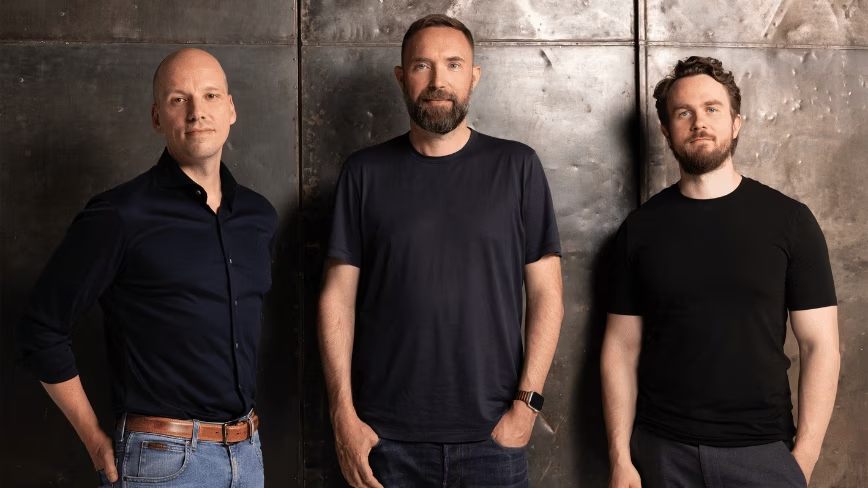
Helsing’s massive capital injection, which pushed its valuation to $18 billion, is more than a financial headline. It’s a thermometer of the contradictions simmering inside Europe’s ambition to build a sovereign AI for defence. The $1.8 billion Series E confirms the market’s appetite: demand for AI in sensitive contexts is exploding, but the origin of the money — largely American — raises uncomfortable questions. Who is really funding European digital sovereignty?
For a startup developing software for military platforms, “sovereign AI” isn’t a slogan. It means machine learning stacks running on-premise, in air-gapped environments, with granular control over data, training, and inference. It means, in other words, not relying on cloud APIs from non-EU providers. The problem is that the hardware supply chain to run those models — GPUs, interconnects, high-bandwidth memory — has an overwhelmingly American and, further upstream, Taiwanese center of gravity. Helsing’s round replicates that dependency on the financial side: the large funds betting on European defence are often the same ones that invested in the very companies producing the chips and cloud services from which Europe seeks to emancipate itself.
This short circuit has deep implications for anyone designing on-premise deployments of LLMs in government contexts. On one hand, the capital inflow accelerates the development of sophisticated solutions that could potentially run on heterogeneous hardware and reduce licensing constraints. On the other, the governance power that comes with multi-billion-dollar investments can condition architectural choices: which GPUs get optimized first, which serving frameworks are prioritized, which fine-tuning pipelines make it into contracts. It’s not about conspiracy, but about ordinary market incentives.
For organizations evaluating local AI stacks, the Helsing case signals a structural point: control of capital is as much a layer of sovereignty as data locality. A technically on-premise platform developed with entirely foreign capital and components changes the risk profile, especially when the GPU supply chain is subject to export controls. The tension between sovereignty rhetoric and the reality of hardware-financial dependency will reshape procurement criteria for sensitive workloads, pushing toward greater geographic diversification of components and toward open-source models that avoid downstream lock-in.
It’s no coincidence that Europe’s ecosystem is investing in chip design (with initiatives like SiPearl’s Rhea processor) and in open LLM frameworks compatible with non-Nvidia accelerators. Yet the scale of a round like Helsing’s shows how unbridgeable the venture capital gap between Europe and the US remains without American participation. The paradox is served: sovereign AI is born already globalized. Managing that tension is the real challenge for the next decade.






💬 Comments (0)
🔒 Log in or register to comment on articles.
No comments yet. Be the first to comment!