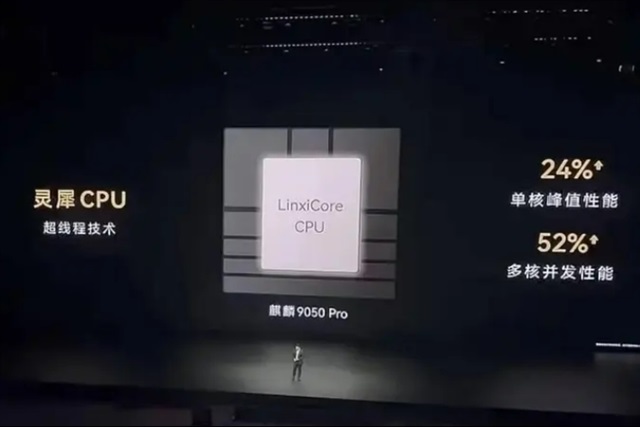
The Kirin 9050 Pro is not just another iteration of the Kirin family: it is the public test bed for LogicFolding, a design solution Huawei is validating in the field. The source points to two main results: a 55% density gain and a 66% reduction in NPU power draw. In a sector where every percentage point of energy efficiency translates into battery life, cooling cost, and the ability to run more complex models on-device, these numbers carry real weight.
Beyond the limited technical details released, the signal is clear: the race for local AI is not only about compute power, but about circuit density and the energy required to sustain inference. An NPU that consumes two-thirds less power, at equivalent load, is not an incremental improvement: it changes the design constraints for anyone running models in environments without stable connectivity or with strict thermal limits.
That is why the news matters for on-premise and edge deployments, not just for the mobile market. Density gains make it possible to integrate more logic into a smaller silicon area, which can translate into lower production costs or more capacity in the same package. The energy gain on the NPU, in turn, lowers the operational cost of distributed inference: less dissipated power means less heat to manage, less battery used, and, in industrial settings, lower cooling requirements. It is a parameter that feeds directly into the TCO of a deployment.
Who benefits? First, edge device vendors: a more efficient NPU allows a larger share of inference work to move from the cloud to the device, reducing latency and dependence on connectivity. For companies that must respect data sovereignty constraints, doing more processing locally reduces the need to send data to external servers. This does not eliminate the cloud, but redefines its role: less continuous processing, more orchestration and model management.
The source does not report throughput, latency, or quantization levels supported by the NPU, so it is too early to draw conclusions about specific models. But the two released parameters are enough to see the direction. For those designing local inference infrastructure, the center of gravity is shifting: the question is no longer just how many TOPS an accelerator can deliver, but how much energy each local token costs. The Kirin 9050 Pro's answer to that question, at least on the NPU side, is a two-thirds reduction. For those evaluating on-premise deployments, the trade-offs between edge and cloud remain complex; AI-RADAR offers analytical frameworks at /llm-onpremise to compare them, but the underlying fact is that local hardware is becoming cheaper to operate.




💬 Comments (0)
🔒 Log in or register to comment on articles.
No comments yet. Be the first to comment!