Intel and Qualcomm Seek New Synergies in the AI Market
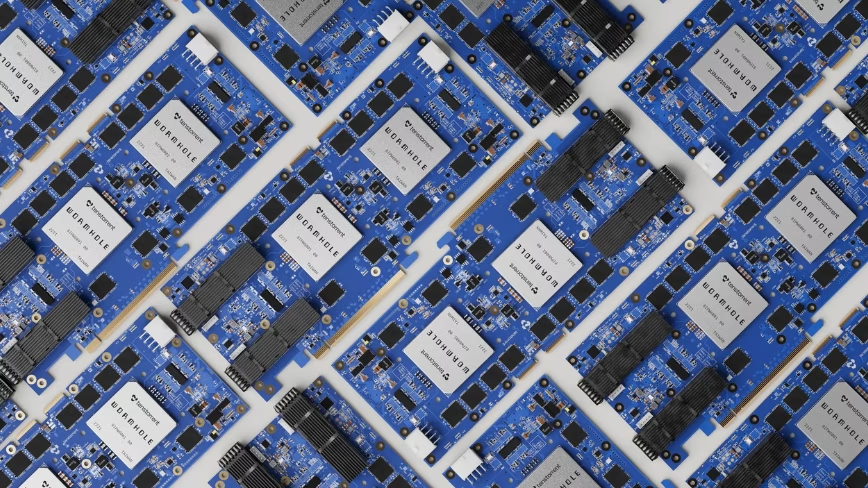
The landscape of artificial intelligence chips is in constant flux, with major industry players seeking to consolidate their positions or acquire new capabilities. In this context, Bloomberg recently reported that Intel and Qualcomm have initiated preliminary talks for a potential acquisition of Tenstorrent, a startup specializing in AI chips. The company, led by renowned engineer Jim Keller, has attracted market attention not only for its technology but also for its impressive growth trajectory, culminating last year in an $800 million funding round and a $3.2 billion valuation. Its backers include prominent names such as Bezos Expeditions and Samsung, attesting to the startup's recognized potential.
The interest of giants like Intel and Qualcomm in Tenstorrent is not coincidental. It represents a clear signal of the increasing urgency to diversify the offering of AI accelerators and to propose viable alternatives to the currently dominant products on the market. Competition in the sector is fierce, and the ability to innovate in silicon is crucial for maintaining a competitive edge. Strategic acquisitions like this could allow established players to integrate new architectures and expertise, accelerating the development of more efficient and customized solutions for emerging AI needs.
The Strategic Context: Diversification and Silicon Control
The search for alternatives in the AI accelerator market is a priority for many companies developing and deploying Large Language Models (LLM) and other artificial intelligence workloads. Dependence on a limited number of suppliers can lead to constraints in terms of cost, availability, and architectural flexibility. The entry of new players or the strengthening of existing ones, through acquisitions such as the one hypothesized for Tenstorrent, could lead to greater innovation and a reduction in the Total Cost of Ownership (TCO) for enterprises.
For companies like Intel and Qualcomm, integrating technologies like those developed by Tenstorrent could mean not only expanding their product portfolio but also gaining greater control over the silicon development pipeline. This is particularly relevant in an era where hardware customization is fundamental for optimizing the performance and energy efficiency of AI models. A more open or specialized chip architecture could offer significant advantages for specific workloads, allowing customers to choose solutions better suited to their deployment needs, whether in the cloud or on-premise.
Implications for On-Premise Deployments and Data Sovereignty
The emergence of new players in the AI chip market has a direct impact on deployment decisions, particularly for organizations prioritizing self-hosted or air-gapped solutions. The availability of a broader hardware offering means more options for CTOs and infrastructure architects who must balance performance, TCO, and data sovereignty requirements. A Tenstorrent acquisition by Intel or Qualcomm could accelerate the development of chips optimized for on-premise scenarios, offering greater control and security over sensitive data.
For those evaluating on-premise deployments, silicon choice is crucial and goes beyond simple VRAM or throughput specifications. It includes compatibility with existing frameworks, the robustness of the software ecosystem, and the ability to scale in bare metal environments. New chip architectures can offer opportunities to improve energy efficiency and reduce long-term operational costs, which are critical factors for large-scale AI infrastructures. AI-RADAR provides analytical frameworks on /llm-onpremise to evaluate these complex trade-offs, helping companies make informed decisions.
Future Prospects and the Dynamics of the AI Market
While talks are still in early stages, the news of Intel and Qualcomm's interest in Tenstorrent underscores the dynamism and strategic importance of the AI chip market. Any potential acquisition or partnership redefines the competitive landscape, influencing innovation and the options available to end-users. A company's ability to offer comprehensive and competitive hardware and software solutions will be a key factor for long-term success.
The sector will continue to see significant investments and consolidations as companies seek to best position themselves for the next wave of innovation in artificial intelligence. For organizations that need to implement LLMs and other AI applications, this means an evolving market with an increasingly diverse offering, but also the need for careful evaluation of the trade-offs between different available solutions in terms of performance, costs, and specific deployment requirements.








💬 Comments (0)
🔒 Log in or register to comment on articles.
No comments yet. Be the first to comment!