Huawei Unveils 'Tau Scaling Law' to Counter Chip Sanctions
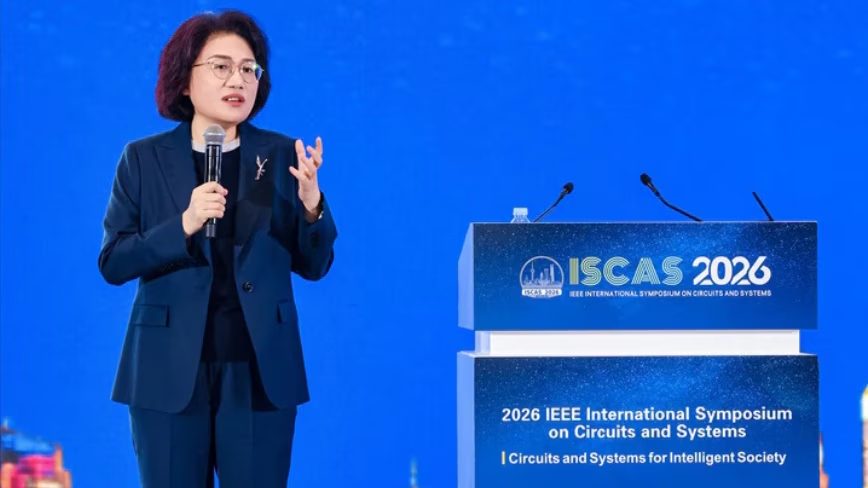
Huawei recently unveiled its "Tau Scaling Law," an innovative approach to semiconductor design that the Chinese company proposes as a strategic solution to address US-imposed restrictions. The announcement was made by He Tingbo, a Huawei representative, during a keynote delivered in Shanghai at the IEEE International Symposium on Circuits and Systems. This new design philosophy marks a potential turning point in the industry, shifting the focus from transistor miniaturization to a new technological frontier.
Huawei's presentation comes at a crucial time for the global semiconductor industry, characterized by increasing competition and geopolitical tensions that deeply influence supply chains and development strategies. Huawei's initiative is part of a broader quest for technological autonomy, particularly relevant for companies operating in strategic sectors that require reliable and controllable hardware solutions for their critical workloads.
The "Tau Scaling Law": A New Design Paradigm
At the core of the "Tau Scaling Law" is the argument that the next frontier in chip innovation lies not so much in the continuous reduction of transistor sizes, but rather in decreasing signal propagation time. This perspective represents a significant departure from the traditional Moore's Law scaling path, which has guided the industry for decades through component densification. Huawei stated that it has been quietly working on chips based on this idea for six years, suggesting a long-term strategy and a considerable investment in research and development.
Reducing signal propagation time can lead to improvements in performance and energy efficiency, crucial factors for complex systems. In an era where the physical limits of transistor miniaturization are becoming increasingly evident and costly to overcome, exploring alternative avenues like the one proposed by Huawei could open new opportunities for chip architecture. This approach could have profound implications for the design of future processors, including those intended for intensive workloads such as AI and Large Language Models.
Implications for AI and On-Premise Deployments
Innovation in chip design, such as the "Tau Scaling Law," has a direct impact on the ability to execute artificial intelligence workloads, particularly for on-premise deployments. Silicon efficiency is a determining factor for the Total Cost of Ownership (TCO) of a local AI infrastructure, influencing power consumption, cooling, and compute density. If reducing signal propagation time translates into faster and more efficient chips, this could offer significant advantages for companies choosing to keep their LLMs and AI stacks within their own data centers.
For CTOs, DevOps leads, and infrastructure architects evaluating self-hosted alternatives to cloud solutions, the emergence of new hardware architectures is a key element. The availability of silicon optimized for specific performance and energy consumption needs can influence decisions related to data sovereignty, compliance, and the ability to operate in air-gapped environments. A company's ability to internally develop and produce chips with innovative architectures can also reduce dependence on external suppliers and mitigate risks associated with supply chain disruptions.
Future Prospects and Technological Autonomy
Huawei's "Tau Scaling Law" is not just a technical proposal but also a strategic statement in the current geopolitical landscape. It represents an attempt to assert technological autonomy and find innovation paths that are not directly hindered by existing restrictions. This type of development is particularly relevant for technical decision-makers who must balance performance needs with those of control, security, and TCO.
The success of such an approach will depend on its effective implementation and Huawei's ability to translate these principles into concrete products that can compete in the global market. For those evaluating on-premise deployments, the evolution of hardware architectures is a critical factor. AI-RADAR continues to monitor these developments, providing analysis on the trade-offs and constraints that companies must consider when choosing between self-hosted and cloud solutions for their AI workloads.



💬 Comments (0)
🔒 Log in or register to comment on articles.
No comments yet. Be the first to comment!