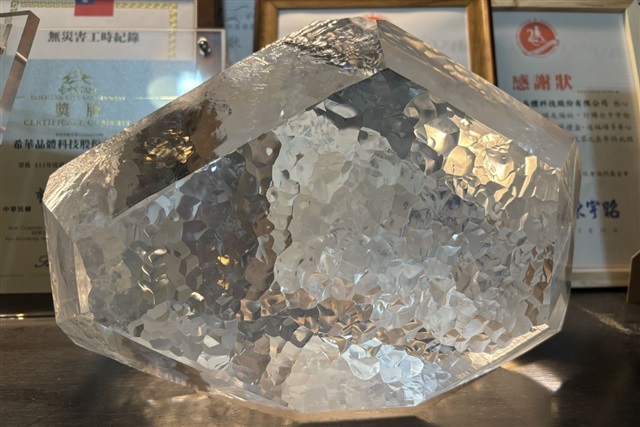
"Quartz doesn't make headlines, but without it chips don't get made." The industry quip reveals a harsh truth: ultrapure quartz components are the silent backbone of lithography and etching equipment, and when their producers hike prices, the entire semiconductor ecosystem trembles. According to DIGITIMES, several makers of quartz components for chip manufacturing equipment are raising prices, squeezed by the rising cost of raw materials. The news is a warning siren for anyone building a hardware strategy for Large Language Models, especially those eyeing on-premise deployment.
To grasp the scale of the matter, recall that synthetic quartz of extreme purity is used to make tubes, crucibles, optical windows, and supports that operate inside furnaces at extreme temperatures and in aggressive chemical environments without releasing contaminants. A defect in these components means defective wafers and collapsing yields. That is why chip manufacturers – from TSMC to Samsung, from Intel to smaller foundries – depend on a handful of specialized suppliers, whose room for maneuver on costs is being squeezed between energy hikes and mineral raw material inflation.
The rise in quartz component prices does not stay confined to the cleanrooms of fabs. It propagates downstream, inflating the cost of lithographic equipment and, in turn, wafer prices. For the most advanced chips, the ones used to make GPUs like the NVIDIA H100 or B200, every extra charge piles onto the already chronic shortage of production capacity. The result is further upward pressure on the price of inference and training cards, with immediate effects for anyone designing on-premise infrastructure.
In an on-premise deployment scenario, the total cost of ownership (TCO) is already strained by the need to buy, cool, and maintain multi-GPU nodes with tens of gigabytes of VRAM. If the hardware price gap widens, the trade-off with the cloud becomes even more asymmetric. Large hyperscalers, thanks to multi-year supply agreements and unattainable purchase volumes, can dilute these price increases. Companies that instead want – or must, due to data sovereignty constraints – keep workloads in-house end up paying a growing premium. It's not only an IT budget problem: it's a brake on technological autonomy.
Yet the game is not already decided. The tension in the supply chain pushes towards a more careful use of compute resources. Optimization techniques like quantization – the jump from FP16 to INT8 or INT4 – reduce VRAM demand without dramatically sacrificing inference quality. Smaller, specialized models, combined with efficient serving pipelines, allow squeezing more out of every single GPU, extending its useful life and improving the performance/cost ratio. In other words, the silicon shortage is fought with software.
Looking deeper, the rise in quartz prices raises a structural issue. Dependency on ultrapure materials, often concentrated in a few geographical areas and an even smaller number of suppliers, makes the entire chain fragile. For those investing in on-premise capacity, this means hardware procurement planning can no longer rely on linear projections. It is necessary to incorporate the risk of upstream bottlenecks, diversify equipment suppliers, and, above all, evaluate workload flexibility: a hybrid deployment that balances local capacity with cloud bursts becomes not a compromise but a resilience choice.
Ultimately, the quiet move by quartz producers is a wake-up call for the whole self-hosted AI sector. It is not an isolated event, but another piece of a strained global supply chain where costs cascade and resource planning becomes a strategic matter. For those designing the next on-premise LLM cluster, the message is clear: optimizing every watt and every byte is no longer an engineering luxury, it is an economic necessity.







💬 Comments (0)
🔒 Log in or register to comment on articles.
No comments yet. Be the first to comment!