
A Dispute Resonating Beyond 3D Printing
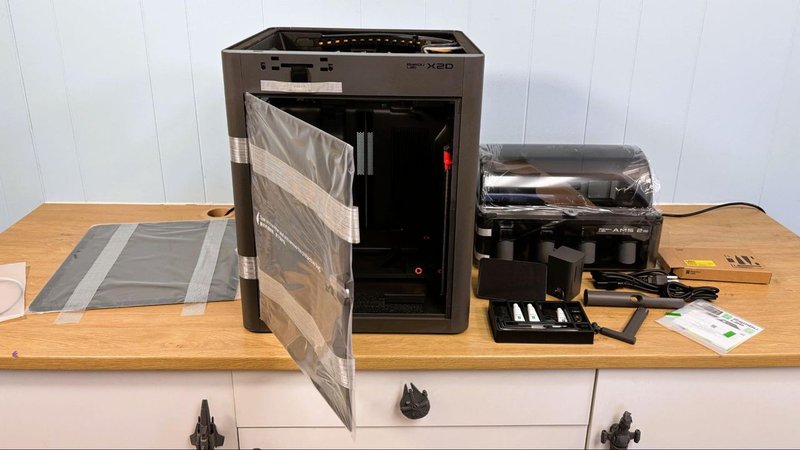
The tech scene has recently been shaken by a dispute that, while originating in the 3D printing sector, carries far broader implications. Bambu Lab, a well-known 3D printer manufacturer, has initiated legal action against a community developer behind OrcaSlicer, an Open Source software derived from PrusaSlicer. The incident has drawn the attention of Louis Rossmann, a prominent figure and staunch advocate for the "Right to Repair," who has offered his legal support to the threatened developer.
This seemingly localized episode highlights a fundamental tension between manufacturers seeking to maintain tight control over their ecosystems and the community of developers and users striving for greater freedom to modify, innovate, and customize. It is a dynamic that manifests across various technology sectors and, by analogy, offers critical insights for those operating in artificial intelligence, particularly for Large Language Models (LLM) deployments in enterprise environments.
Open Source, Control, and the AI Ecosystem
The principle of the "Right to Repair" and the Open Source philosophy are pillars for ensuring users and developers have the ability to understand, modify, and improve technology. In the context of 3D printing, this translates into the possibility of using alternative software or repairing one's devices without exclusive reliance on the manufacturer. Translating this concept into the AI world, Open Source has become a crucial driver for innovation, allowing teams and companies to access models, frameworks, and tools without restrictive licenses.
However, the Bambu Lab incident serves as a reminder that vendor control can extend to software and hardware, influencing freedom of choice and customization capabilities. For CTOs and infrastructure architects evaluating AI solutions, the availability of Open Source LLMs and local stacks is fundamental to avoid vendor lock-in and maintain sovereignty over their data and processes. The ability to perform fine-tuning, optimize pipelines, and manage inference in self-hosted environments inherently depends on the transparency and openness of the underlying technologies.
Implications for On-Premise AI Deployments
The decision to opt for on-premise AI deployments, rather than relying on cloud services, is often driven by the need for granular control, regulatory compliance (such as GDPR), and the requirement for air-gapped environments for sensitive data. In this scenario, the freedom to modify and adapt models and frameworks becomes a non-negotiable requirement. A dispute like Bambu Lab's highlights the potential risks when a company attempts to limit the use or development of Open Source alternatives.
For those investing in dedicated AI infrastructures, such as servers with high VRAM GPUs for inference or training, the certainty of being able to rely on a robust software ecosystem not subject to arbitrary restrictions is essential. The Total Cost of Ownership (TCO) of an on-premise deployment includes not only the acquisition of silicon and hardware but also the flexibility and resilience guaranteed by an Open Source ecosystem that promotes collaborative innovation and reduces dependence on a single vendor.
Towards Greater Technical Sovereignty in AI
The legal battle between Bambu Lab and the developer community is a warning for the entire technology sector. It underscores the importance of protecting Open Source developers and fostering an environment where innovation is not stifled by proprietary interests. In the field of artificial intelligence, where the pace of development is extremely high and the ethical and social impact is profound, transparency and openness are more crucial than ever.
For decision-makers guiding their organizations' AI strategy, it is fundamental to consider not only the technical specifications of an LLM or hardware but also the philosophy behind the chosen frameworks and tools. Opting for solutions that guarantee control, flexibility, and a solid Open Source foundation is a strategic choice that strengthens technical sovereignty and long-term adaptability, protecting investments and ensuring full mastery of one's AI capabilities.







💬 Comments (0)
🔒 Log in or register to comment on articles.
No comments yet. Be the first to comment!