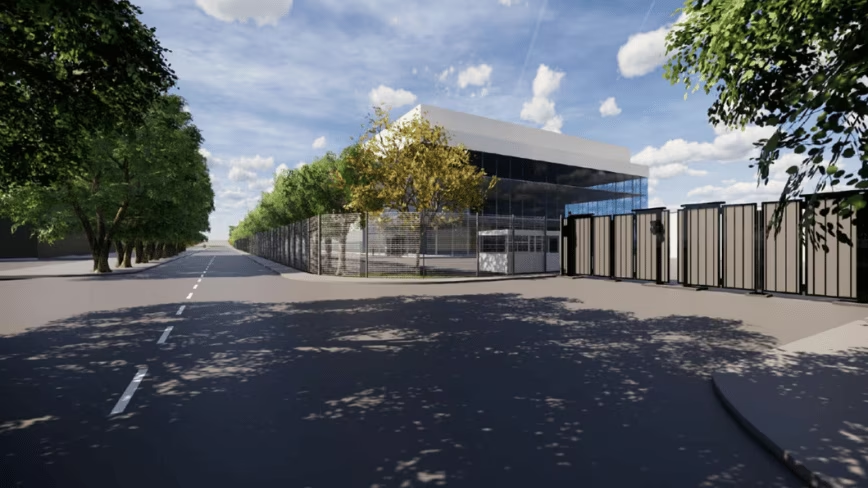
The British government dreams of becoming an AI superpower. One of the flagship data centres for this ambition, Nscale’s £2 billion site in Essex, has run into an obstacle no algorithm can bypass: electricity. The project has secured funding, planning permission, customer agreements, and even a grid connection. Yet the power isn’t arriving in time to switch on the servers. It is a warning bell that tells a story much larger than bureaucratic delay.
The episode exposes a structural tension that anyone evaluating self-hosted AI infrastructure would be wise to consider. Hardware – GPUs, VRAM, compute nodes – grabs the spotlight, but the real bottleneck for Large Language Models and large-scale inference workloads is often the electrical grid. A modern data centre dedicated to training or inference can draw tens of megawatts, equivalent to the consumption of a small town. Without stable and guaranteed power, on-premise deployment plans remain on paper.
In the UK, the distribution grid is under pressure from the electrification of transport and heating, and upgrades are moving slowly. This is not a problem of nominal capacity at the connection point, but of actual activation timelines: you have the contract, but the voltage is not physically available when you need it. Those planning on-premise architectures must therefore include the energy variable in Total Cost of Ownership from day one, alongside the usual factors like GPU specs, VRAM, and throughput in tokens per second. Overlooking this means exposing yourself to delays that can wipe out the competitive advantages of direct data control.
The Nscale case signals something deeper. The race for digital sovereignty – keeping data and models within national borders, away from extra-European cloud jurisdictions – depends on physical infrastructure that actually works. If flagship projects stumble over the grid hookup, the whole ecosystem of on-premise AI loses credibility among companies that are considering moving away from the cloud for compliance or control reasons. The risk is that enterprises will postpone internalisation decisions, or choose locations where energy is more abundant and better planned.
A second effect is a shift in investment toward autonomous generation. This is not science fiction: some hyperscalers are already signing deals for dedicated nuclear reactors. For a smaller on-premise deployer, this could translate into partnerships with local renewable energy providers or the adoption of large-scale storage systems, which add complexity and upfront costs but reduce dependence on the public grid.
Then there is a third, less visible but no less significant, consequence. The data centre market is fragmenting between those who can afford to buy time and capacity on the grid and those who cannot. Large cloud platforms have dedicated teams that manage relationships with grid operators and map less congested areas. Those who opt for private infrastructure in an industrially attractive but saturated zone risk getting trapped, with idle servers and customer contracts starting to creak.
For those navigating these choices, AI-RADAR provides analytical frameworks on /llm-onpremise that help weigh trade-offs without shortcuts, integrating the energy dimension into the overall assessment. The Essex lesson is crystal clear: computing power, however impressive, is just cold metal without the watts.







💬 Comments (0)
🔒 Log in or register to comment on articles.
No comments yet. Be the first to comment!