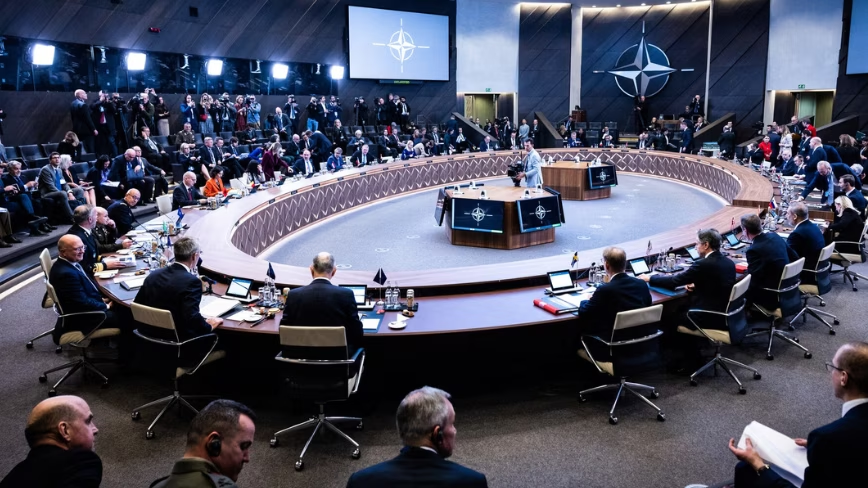
President Donald Trump arrives at next week’s NATO summit in Ankara, scheduled for July 7–8, with unusual leverage: the United States decides which allies get access to the world’s most advanced AI. Politico reports that AI security questions will hang over the agenda just as a new wave of LLMs from Anthropic and OpenAI pushes capabilities further.
The news, though light on operational details, adds a geopolitical dimension to the already heated debate over digital sovereignty. For European countries, accustomed to threading the needle between GDPR compliance and sovereign cloud ambitions, Washington’s control over frontier AI raises an uncomfortable question: what happens if the US restricts access to models for national security or economic reasons?
This is not an abstract worry. Today’s top-performing Large Language Models are distributed mainly via API by American companies, with inference running on overseas cloud data centers. The span of control reaches from training to deployment, and – as semiconductor export controls have shown – the White House does not shy away from using technological leverage when it sees a strategic need.
The Ankara summit could therefore accelerate the debate within the European Union about the need for a local AI stack. Initiatives like GAIA-X have already tried to chart a European path for cloud infrastructure; now the focus shifts to inference and fine-tuning of open-source models running on on-premise hardware. The goal is not to match the raw performance of the latest proprietary models, but to ensure operational continuity and data control even under restrictive scenarios.
For organizations evaluating self-hosted deployment, the geopolitical factor becomes a full-fledged component of Total Cost of Ownership analysis. Software supply chain reliability, data residency, and the ability to operate in air-gapped mode are no longer optional parameters. Modern orchestration frameworks and quantization techniques now allow capable models to run on clusters with a few hundred gigabytes of VRAM, making the on-premise path more viable for public bodies and mid-sized enterprises.
The NATO summit, in short, could turn a technical discussion into a political imperative. The question is no longer just “which model performs better,” but “under whose jurisdiction does the hosting infrastructure fall.” A subtle difference that, in the coming months, may steer budgets and procurement strategies well beyond defense ministries.







💬 Comments (0)
🔒 Log in or register to comment on articles.
No comments yet. Be the first to comment!