
With a $590 million bid, Apple supplier Lingyi iTech has seized the assets of bankrupt Chinese fiber maker Futong. The move, seemingly far removed from the smartphone world, reveals a precise bet: that demand for data center fiber – especially for GPU clusters used in LLM training and inference – will explode in the coming years.
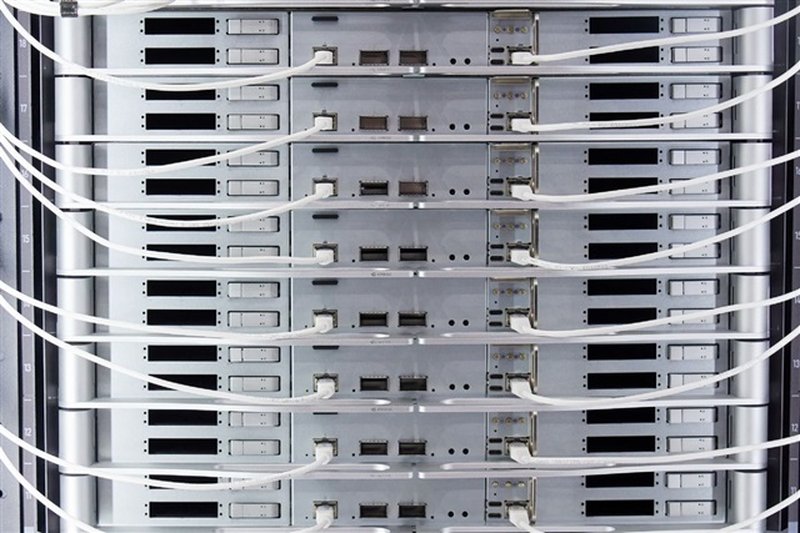
Fiber is no passive cable. In large on-premise setups, communication among GPUs over low-latency optical links is the hardest bottleneck to solve after raw compute. Solutions like NVLink or InfiniBand already push maximum bandwidth, but the physical substrate – optical modules, transceivers, inter-rack interconnects – remains fiber-based. When a cluster of hundreds of GPUs exchanges terabytes of gradients in every distributed training step, the quality of fiber and port density determines actual throughput. Without enough bandwidth, the investment in accelerators degrades into queuing delays.
Lingyi iTech does not come from the networking world. The company makes precision components for Apple (mechanical parts, magnets, flexible printed circuits) and is deeply embedded in the hi-tech manufacturing value chain. Taking over Futong’s assets – likely production lines and fiber IP – means vertically integrating the missing piece for AI data center offerings: moving from discrete components to full connectivity solutions, from connectors to optical modules to rack cabling. For on-premise infrastructure providers, such consolidation could deliver more coherent bundles and, if scale permits, lower costs for high-speed cabling.
This move also reshapes the optical supply chain balance. Today AI interconnect market is dominated by a few names (Coherent, Lumentum, II-VI) with concentrated production. The entry of a mass-scale Chinese manufacturer, backed by an Apple supply chain role, adds capacity and potential price competition. For organizations building on-premise clusters, geographical diversification of fiber suppliers can shorten lead times and reduce the risk of single-source dependency, especially amid export restrictions. Yet consolidation under a single large actor could narrow technology choices in the medium term.
Structurally, the deal confirms that optical fiber has become a strategic asset on par with semiconductors. China, already striving for self-sufficiency in chips and memory, adds with Futong another piece to its autonomy in enabling technologies for AI. For decision-makers evaluating on-premise environments, the signal is clear: high-speed optical network availability deserves the same scrutiny as GPU supply. Without enough cables and transceivers, even the most powerful cluster remains an unfulfilled promise. An Apple supplier betting on the optical backbones of AI supercomputers tells of an industry where the distance between iPhone cases and LLM infrastructure has vanished.




💬 Comments (0)
🔒 Log in or register to comment on articles.
No comments yet. Be the first to comment!