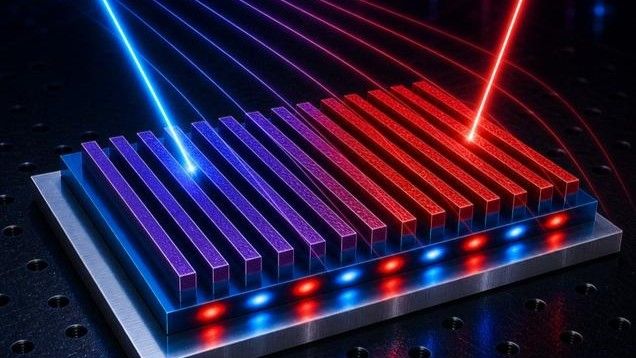
A research team has developed a material with unusual thermal properties: it can actively steer heat flows and retain that configuration without consuming any power. The discovery, originally aimed at microscale thermal management, promises direct impact on cooling chips for AI computing and on silicon photonics—two areas where power density is turning heat dissipation into a structural bottleneck.
In on-premise clusters running LLM inference, heat isn't a minor side effect: it determines how many nodes fit in a single rack, how much air conditioning weighs on total cost of ownership, and how far one can push parallelization before hitting thermal limits. A material that routes temperature gradients exactly where they are needed, with no active control circuitry, could rewrite those equations. The gain would not just be a lower energy bill for cooling, but the ability to design more compact hardware layouts with less restrictive operating margins—a concrete advantage for those running enterprise data centers or edge servers with tight space and power budgets.
The most intriguing feature, from an engineering standpoint, is the material's ability to remember its thermal state after programming, even when power is cut. It's a behavior reminiscent of memristors in electronics, but applied to heat conduction. If brought to maturity, it would allow passive heat sinks with tunable efficiency, thermal layers integrated into chip packages, or interposers that adapt their conductance to workload patterns without the overhead of dedicated sensors and firmware.
Then there is the link to silicon photonics. Integrated optical circuits suffer from temperature-induced drift that degrades signal quality. Fine-grained, passive thermal control could simplify the stabilization of ring resonators and couplers, making chip-to-chip optical interconnects more viable—a key ingredient for future accelerated computing systems.
The road to industrialization is still long and—as always in these cases—there are no guarantees that materials that leave the lab will maintain the same performance in volume production environments. Yet every advance that shifts thermal management from active control to a programmable substrate touches raw nerves of on-premise deployment: compute density, acoustic noise, long-term reliability, and ultimately, the ability to run ever-larger models in physical spaces that were never meant to become thermal plants.





💬 Comments (0)
🔒 Log in or register to comment on articles.
No comments yet. Be the first to comment!