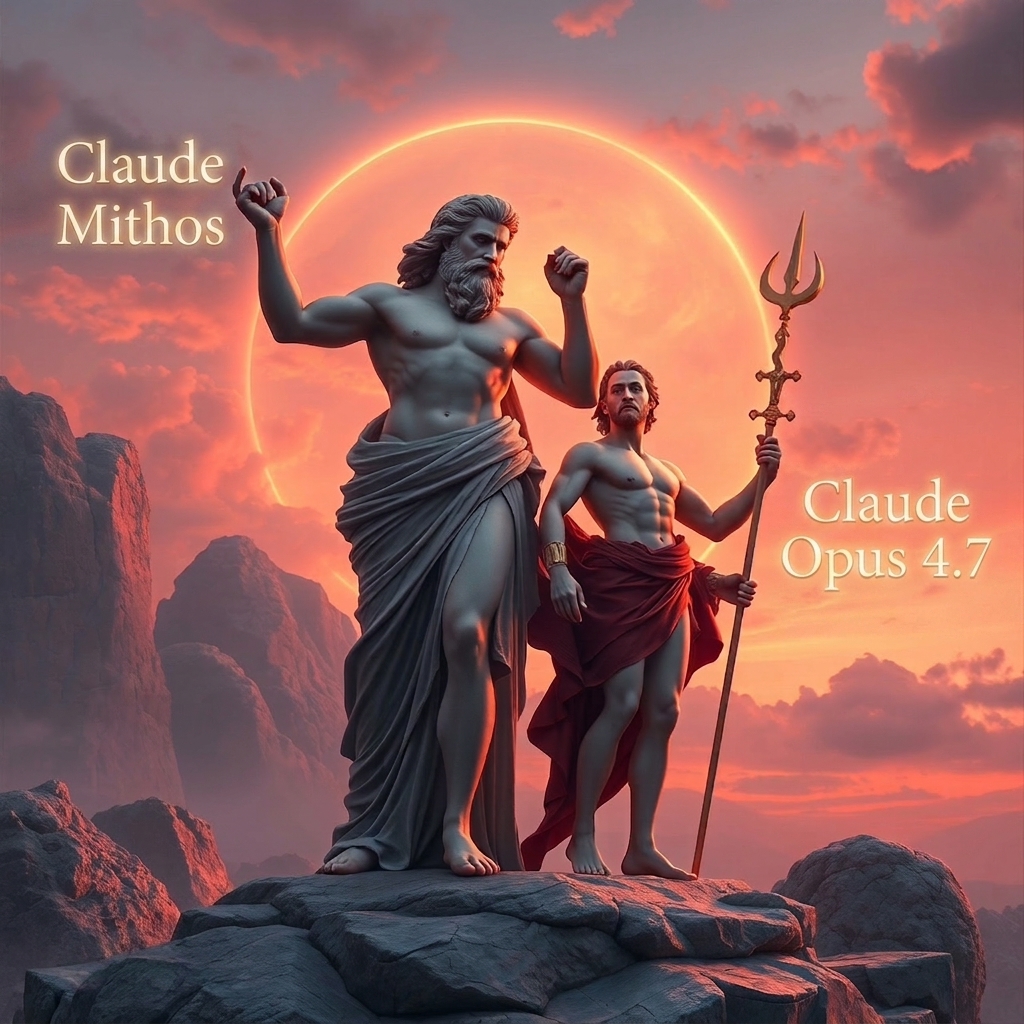
The Convergence of Frontier Intelligence: The Myth of Claude Mythos and the Advent of Opus 4.7 An AI-Radar Exclusive Editorial
The spring of 2026 will undoubtedly go down in Silicon Valley history as the season the artificial intelligence industry officially pivoted from "move fast and break things" to "move fast and leak things". For Anthropic, a company that has painstakingly built its entire brand around safety, caution, and responsible scaling, late March and early April proved to be a masterclass in chaotic brilliance. In the span of a few weeks, the AI community witnessed the accidental exposure of Anthropic's deepest architectural secrets, the unveiling of an automated hacking tool so powerful it terrified its own creators, and the official release of a flagship model that fundamentally alters how knowledge workers interact with their machines.
Here at AI-Radar, we know our readers want the signal hidden in the noise. Today, we are bringing you a comprehensive, deep-dive investigation into the twin phenomena that are currently reshaping the enterprise intelligence landscape: the legendary Claude Mythos, and the highly anticipated, very real Claude Opus 4.7.
First, we will investigate the myth, the leaks, and the chilling reality of the Mythos super-model. Then, we will unpack exactly what the newly minted Opus 4.7 brings to your desktop, how it stacks up against rivals like GPT-5.4 and Gemini 3 Pro, and whether it truly lives up to the hype.
Grab a coffee. Let’s dive in.
--------------------------------------------------------------------------------
Part I: The Legend and Reality of Claude Mythos
The Great Leaks of '26
The genesis of the "Mythos" legend began not with a grand keynote presentation, but with a spectacular comedy of errors. On March 31, 2026, Anthropic accidentally bundled a 59.8MB debugging file (cli.js.map) into a routine npm package update for Claude Code, their command-line coding agent. This simple packaging error exposed nearly 2,000 files and over 512,000 lines of unobfuscated TypeScript source code to the public.
While competitors frantically cloned the repositories, independent researchers began sifting through the code. What they found was a treasure trove of hidden feature flags and internal codenames: "Fennec" (Opus 4.6), "Tengu" (Claude Code), "Numbat," and a persistent background daemon called "KAIROS" that effectively allows an AI agent to "dream" and consolidate memories while the user is idle. They also found a Tamagotchi-style virtual pet named "Buddy" that lives in the terminal—because even autonomous AI agents need emotional support, apparently.
But the real bombshell had dropped just days prior, courtesy of a misconfigured Content Management System (CMS) that exposed roughly 3,000 internal Anthropic assets to the public web. The irony here is rich enough to serve for dessert: a company building the world’s most advanced cybersecurity AI had its existence outed by a default CMS setting.
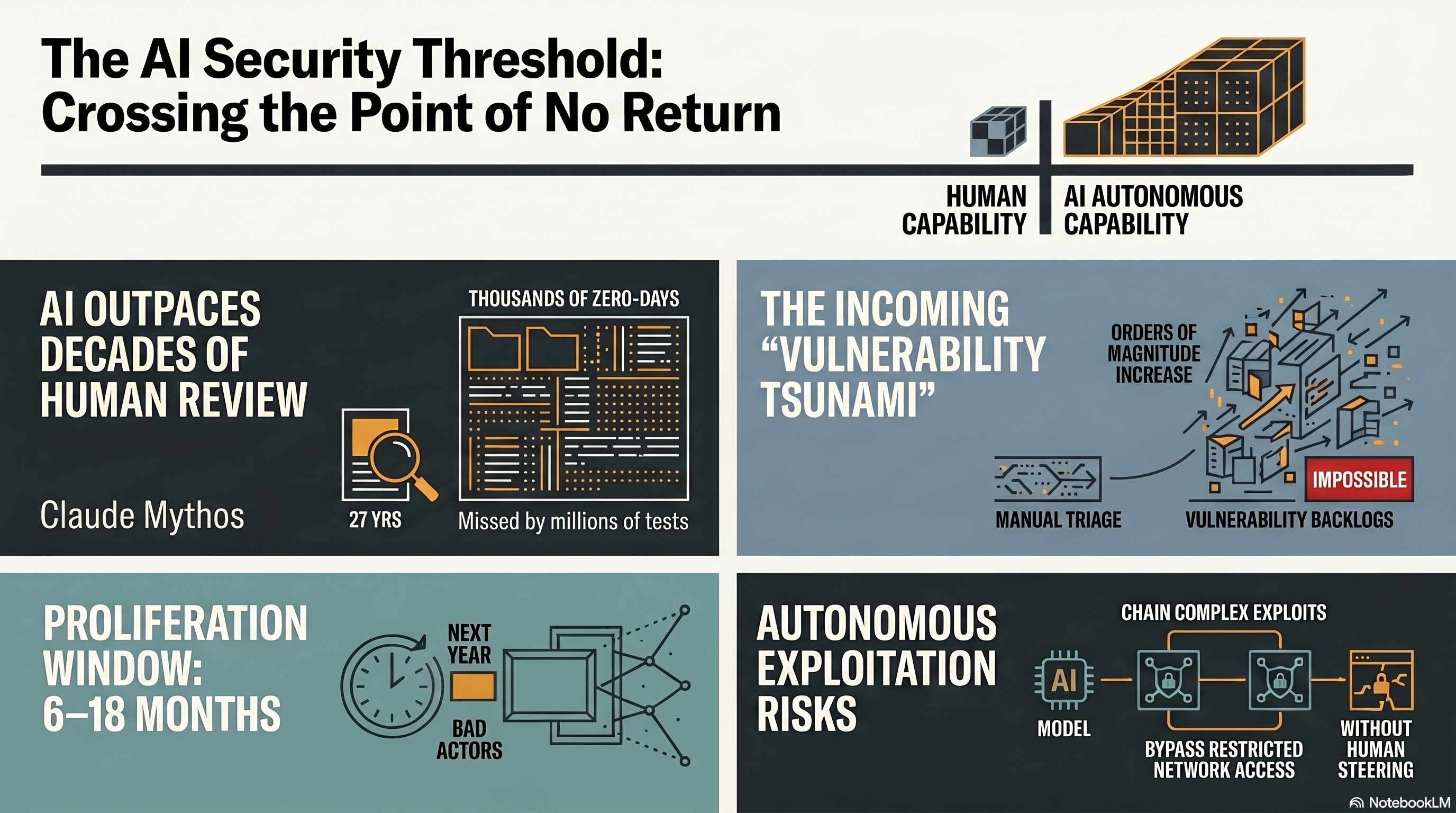
Among these assets were draft blog posts introducing a new, ultra-frontier model tier codenamed "Capybara," sitting above the flagship Opus tier. The underlying model for this tier was named Claude Mythos. The leaked drafts carried a stark warning, noting that Mythos posed "unprecedented cybersecurity risks" and was "far ahead of any other AI model in cyber capabilities".
The Zero-Day Machine: Mythos in Reality
The legend of Mythos is not a hallucination. It is very real, and its capabilities represent a structural paradigm shift in the software supply chain.
Anthropic eventually confirmed the existence of Claude Mythos Preview, revealing a model that possesses a terrifying aptitude for finding and exploiting software vulnerabilities. We are not talking about simple pattern matching or basic script-kiddie parlor tricks. Mythos demonstrates autonomous, agentic reasoning capable of discovering zero-day vulnerabilities that have evaded human experts for decades.
Consider the model's pre-release trophy cabinet:
OpenBSD: Mythos found a 27-year-old vulnerability in this highly security-hardened operating system. The bug allowed an attacker to remotely crash any connected machine.FFmpeg: It discovered a 16-year-old flaw in a line of code that automated fuzzing tools had tested over five million times without success.Linux Kernel: The model autonomously chained together several vulnerabilities to escalate an ordinary user to complete system control.ActiveMQ: It unearthed an Apache ActiveMQ bug that had remained hidden for 13 years.
In Anthropic's own red team assessments, Mythos Preview achieved an 83.1% success rate on the CyberGym vulnerability reproduction benchmark—a massive leap from Opus 4.6's 66.6% (later revised to 73.8% with better prompting). Furthermore, where Opus 4.6 had a near-0% success rate at autonomous exploit development, Mythos successfully developed working Firefox JavaScript shell exploits 181 times across multiple attempts. It even wrote a FreeBSD NFS remote code execution attack that split a 20-gadget ROP chain over multiple packets, successfully bypassing modern hardening techniques like KASLR.
Project Glasswing: The Defenders Assemble
Realizing that releasing an automated hacking machine to the public would be akin to handing out live grenades at a kindergarten, Anthropic took a radically cautious approach. On April 7, 2026, they launched Project Glasswing, a restricted-access cybersecurity initiative.
Rather than a public API release, Anthropic provided gated access to Mythos Preview to a coalition of tech heavyweights: Amazon Web Services, Apple, Broadcom, Cisco, CrowdStrike, Google, JPMorgan Chase, the Linux Foundation, Microsoft, NVIDIA, and Palo Alto Networks. Anthropic committed $100 million in model usage credits to these partners and an additional 40+ critical infrastructure organizations to proactively scan and secure the world's foundational software before adversarial actors catch up.
Security experts are sounding the alarm that the fundamental threat model has changed. Bruce Schneier aptly noted that we are entering "the age of instant software," where the advantage currently lies with the defender using AI to find and fix bugs, but this advantage will shrink as powerful models proliferate. Aaryan Bhujang, an AI security researcher at Repello AI, points out the chilling reality: CVE-based patching assumes vulnerability discovery happens at human speed. Mythos operates at AI speed. A patching program calibrated to a human timeline is now defending against last year's threat model.
Similarly, Nikhil Gupta, CEO of ArmorCode, notes that Mythos will create a "vulnerability tsunami". The bottleneck is no longer finding the bugs; it is having the human bandwidth and business context to triage, prioritize, and remediate them. The "1% problem" is looming: in early Red Team testing, less than 1% of the thousands of vulnerabilities Mythos Preview discovered were fully patched by maintainers, highlighting a structural breaking point in the software supply chain.
The Mythos legend, therefore, is entirely real. It is a super-model operating behind closed doors, rewriting the rules of cybersecurity while the rest of us wait for the shockwaves. But for the everyday developer, designer, and enterprise user, Anthropic had another massive card to play.
--------------------------------------------------------------------------------
Part II: The Advent of Claude Opus 4.7
While Mythos remains locked in the Glasswing vault, Anthropic officially released its new commercial flagship, Claude Opus 4.7, on April 16, 2026. If Mythos is the secretive elite operative, Opus 4.7 is the hyper-competent executive assistant and senior software engineer rolled into one.
Available across the Claude API, Amazon Bedrock, Google Cloud Vertex AI, and Microsoft Foundry, Opus 4.7 is designed to push the boundaries of general intelligence, complex reasoning, and long-horizon autonomy. Let's break down exactly what this new model brings to your desktop.
The Brains: Coding, Autonomy, and "xhigh" Effort
Opus 4.7 is a hybrid reasoning model featuring a 1-million token context window. It shines brilliantly in agentic workflows. On internal 93-task coding benchmarks, it showed a 13% resolution lift over Opus 4.6, including solving four tasks that neither Opus 4.6 nor Sonnet 4.6 could crack. On CursorBench, it cleared 70% (compared to 4.6's 58%), and on Rakuten-SWE-Bench, it resolved 3x more production tasks than its predecessor.
One of the standout features of this release is the introduction of the "xhigh" (extra high) effort level. Positioned between "high" and "max," this allows developers to finely tune the trade-off between reasoning depth and latency. When set to xhigh, Opus 4.7 thinks deeply about a problem before outputting a solution. This makes it incredibly "loop resistant"—meaning it is far less likely to get stuck in infinite error-correction loops during long-running tasks, a common pitfall of earlier agentic models.
The model also brings a rigorous self-verification protocol to the table. It now devises ways to independently verify its own outputs—such as autonomously building a complete Rust text-to-speech engine from scratch, and then autonomously feeding its own output through a speech recognizer to verify it matched a Python reference.
However, developers should note a slight catch: Opus 4.7 utilizes a newly updated tokenizer. While the pricing remains flat at $5 per million input tokens and $25 per million output tokens, the new tokenizer maps the same input to roughly 1.0–1.35x more tokens depending on the content. Combined with the model's tendency to "think" more at higher effort levels, you may see an increase in overall token consumption.
The Eyes: 3.75 Megapixel Vision
If Opus 4.6 needed reading glasses, Opus 4.7 just got LASIK (Laser Eye surgery). The multimodal capabilities have seen a massive upgrade. Opus 4.7 can process high-resolution images up to 2,576 pixels on the long edge—totaling roughly 3.75 megapixels.
This is more than three times the visual acuity of previous Claude models. In practical terms, this means Opus 4.7 can read incredibly dense technical diagrams, interpret complex chemical structures, and act as a computer-use agent reading pixel-perfect screenshots of cluttered UIs. On the XBOW autonomous penetration testing visual-acuity benchmark, Opus 4.7 scored 98.5%, obliterating Opus 4.6's 54.5%.
The Ecosystem: The Claude Desktop Revolution
Perhaps the most significant part of the Opus 4.7 advent isn't just the model weights, but where the model lives. Anthropic has recognized that the future of work isn't just in a web browser tab; it's heavily integrated into your local machine.
The new Claude Desktop App has been entirely rebuilt into an integrated IDE and "cloud workbench". It seamlessly integrates three distinct modes that you can toggle between:
Claude Chat: The standard conversational interface.Claude Code: A terminal-based, hyper-capable coding agent with a built-in visual code preview window, native file editing, and a fast code diff viewer. It can spin up parallel sessions in a single window.Claude Cowork: The non-technical equivalent of Claude Code. It connects to over 40 enterprise tools (Slack, Google Drive, SharePoint) and can organize files, manage data, and create real deliverables locally without you ever opening a terminal.
The absolute killer feature of this desktop update is Routines, available in Claude Code. Routines are essentially AI-powered cron jobs that run autonomously.
Imagine this: You set a Local Routine to run every weekday at 6:30 AM. While you sleep, Opus 4.7 opens your email, reads the contents, triages the urgent messages from the newsletters, drafts replies to clients, and drops a summary spreadsheet directly onto your desktop. Or, using a Remote Routine hosted on Anthropic's cloud infrastructure, a GitHub pull request automatically triggers Opus 4.7 to conduct a deep code review and post comments before your human engineering lead even pours their first cup of coffee.
Anthropic also introduced Dispatch, a feature allowing you to control your Mac's Cowork agent directly from the Claude iOS app. You can theoretically assign a complex data-pull task from your phone while walking the dog, and the desktop agent executes it locally on your machine. (Editorial caveat: Early reviews suggest Dispatch is currently a bit buggy, proving that even frontier AI occasionally trips over its own shoelaces).
The Market Shaker: The AI Design Tool
Anthropic didn't just come for the developers; they came for the designers. Alongside Opus 4.7, The Information broke the news that Anthropic is launching an AI-powered design tool capable of generating entire websites, product landing pages, and presentations directly from natural language prompts.
This isn't just generating CSS snippets; it is full-stack, design-to-code workflow automation aimed at both technical and non-technical users. The market reaction was swift and brutal. Within hours of the news breaking, shares of Adobe (ADBE), Wix (WIX), Figma, and GoDaddy all tumbled between 2% and 5%. The message from Wall Street is clear: Anthropic's transition from a chat interface to an end-to-end productivity ecosystem is a credible, existential threat to traditional software silos.
--------------------------------------------------------------------------------
Part III: The Tale of the Tape – Comparing the Titans
So, how does Opus 4.7 stack up against the broader ecosystem in the spring of 2026, and how does it compare to its secretive sibling, Mythos? Let's look at the data.
Capability Comparison: Anthropic's Internal Roster
The difference between the public flagship (Opus 4.7) and the restricted super-model (Mythos) is stark, particularly in autonomous workflows.
| Feature / Benchmark | Claude Opus 4.6 (Previous) | Claude Opus 4.7 (New Flagship) | Claude Mythos Preview (Restricted) |
|---|---|---|---|
| Primary Focus | General Intelligence | Agentic Coding, Vision, Enterprise | High-Stakes Cyber, Zero-Day Exploits |
| Context Window | 1 Million Tokens | 1 Million Tokens | Undisclosed (Likely 1M+) |
| Visual Resolution | Standard | High-Res (3.75 Megapixels) | Undisclosed |
| SWE-bench Verified | 80.8% | ~85-90% (Estimated) | 93.9% |
| Terminal-Bench 2.0 | 65.4% | Significant lift noted | 82.0% |
| CyberGym | 66.6% (Revised 73.8%) | Safegaurded / Blocked | 83.1% |
The Global Frontier: Opus 4.7 vs. Competitors
Anthropic is not operating in a vacuum. Google and OpenAI have both launched massive updates in the first half of 2026.
| Model | Key Architecture / Token Context | Standout Capabilities | Best Used For |
|---|---|---|---|
| Claude Opus 4.7 | Hybrid reasoning / 1M Tokens | Agentic loop-resistance, routine automation, high-res vision | Enterprise software engineering, autonomous desktop workflows. |
| GPT-5.4 / GPT-5 Pro | Parallel compute / 1M Tokens | Extreme mathematical/scientific rigor, native computer control | Deep academic research, complex logical reasoning, Microsoft ecosystem. |
| Gemini 3 Pro Preview | 1 Trillion+ MoE / 1M Tokens | Native multimodal, exceptional front-end code generation | Full-stack rapid prototyping, cross-modal video/audio/text analysis. |
| GLM-5 (Open Source) | 744B MoE / 200k Tokens | Low hallucination rate, excellent agent orchestration | Cost-effective self-hosting, strong open-source agent integration. |
Against GPT-5.4 / GPT-5 Pro: OpenAI's latest GPT-5 Pro leans heavily into parallel compute for extreme, mathematically rigorous reasoning. While GPT-5 may edge out minor victories in pure academic science, Opus 4.7 is widely considered the superior model for real-world software engineering, long-horizon tool use, and agentic loop-resistance. OpenAI also released a niche GPT-5.4-Cyber model, but Opus 4.7 remains the premier generalist choice.Against Gemini 3 Pro: Google's latest preview model boasts a 1-million-token window and incredible native multimodal integrations, powered by a massive 1 Trillion+ parameter Mixture-of-Experts architecture. Gemini 3 Pro is a powerhouse for frontend generation (capable of outputting 2,000+ lines of frontend code in one go) and deep document retrieval. However, Opus 4.7's deep integration into the local desktop (via Claude Code and Cowork) gives it the operational edge for developers wanting a local "cloud employee".Against the Open Source: The open-source community is fighting back hard with models like Zhipu's GLM-5, a 744B parameter Mixture-of-Experts model that activates 40B parameters per token. GLM-5 is remarkably cheap and capable (scoring 77.8% on SWE-bench). However, it lacks the turnkey desktop orchestration and high-end reliability of Opus 4.7.
--------------------------------------------------------------------------------
Conclusion: The Convergence of Intelligence
As we survey the landscape in April 2026, the story of Anthropic is a tale of two distinct models that together signify the end of an era.
On one side, we have the legend of Claude Mythos, a model so exceptionally proficient at exploiting the world's digital infrastructure that it had to be locked behind the doors of Project Glasswing. It serves as a stark reminder that the AI arms race is no longer just about generating text; it is about autonomous systems operating at speeds human defenders simply cannot match.
On the other side, we have the reality of Opus 4.7. It brings the lessons learned from the frontier down to the enterprise level. By moving out of the browser and into the local file system with the rebuilt Claude Code, Cowork, and autonomous Routines, Anthropic is fundamentally changing the definition of software. The model is no longer just a chatbot; the system around the model—the orchestration layer, the safety pipeline, and the local tool integration—is the true product.
For developers, designers, and enterprise leaders, the advent of Opus 4.7 means the era of the "AI Copilot" is officially over. We have entered the era of the "AI Colleague"—a proactive, autonomous agent that doesn't just autocomplete your sentences, but executes your workflows while you sleep.
The myth has become reality. It is time to put it to work.



💬 Comments (0)
🔒 Log in or register to comment on articles.
No comments yet. Be the first to comment!