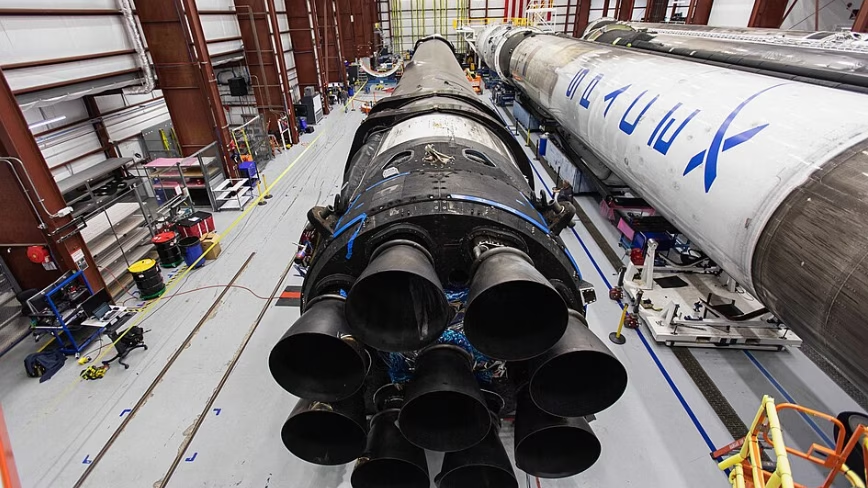
The Space Market Correction: A Signal of Volatility
The aerospace sector, which has seen a remarkable stock rally this year, is now showing significant cracks. The Procure Space ETF, trading under the ticker UFO, has dropped almost 11% in just two sessions. This downturn has also affected individual companies: Intuitive Machines and Rocket Lab have each fallen by approximately 17%. AST SpaceMobile, once a favorite among retail traders, has seen its value decline by nearly 23%.
These figures indicate a clear reversal in a market segment that had attracted considerable capital. The dynamics suggest that investors may be repositioning themselves, perhaps awaiting more direct opportunities or consolidating previous gains. The inherent volatility of high-growth sectors is clearly evident in these performances.
Market Dynamics and Technology Investments
While the current correction is focused on the space sector, it reflects broader market dynamics that can influence the entire technology ecosystem. Innovative sectors, characterized by high investments in research and development and long return periods, are often subject to significant fluctuations. Investor perception, macroeconomic conditions, and future expectations play a crucial role in determining capital flows.
For companies operating in technology-intensive fields, such as the development and deployment of Large Language Models (LLM), understanding these dynamics is fundamental. The ability to attract and retain investments can depend not only on the robustness of the technology but also on the stability of the general market and investor confidence in the long term.
Implications for On-Premise AI Infrastructure
In a potentially volatile market environment, decisions regarding infrastructure for AI and LLM workloads take on even greater strategic importance. The choice between on-premise deployment and cloud solutions is not just a technical matter but also a financial and control one. Investing in dedicated hardware for LLM inference and training, such as GPUs with high VRAM and high-throughput network architectures, requires a long-term vision.
Companies opting for self-hosted solutions often aim to prioritize data sovereignty, regulatory compliance, and granular control over the operating environment, including air-gapped scenarios. These factors can mitigate some risks associated with market volatility, offering greater operational stability and cost predictability in the long run, thanks to a careful Total Cost of Ownership (TCO) analysis. For those evaluating on-premise deployments, AI-RADAR offers analytical frameworks on /llm-onpremise to assess specific trade-offs and optimize infrastructure choices.
Future Outlook and Strategic Resilience
The recent downturn in the space market serves as a reminder that even the most promising sectors are subject to market cycles. For CTOs, DevOps leads, and infrastructure architects, this scenario reinforces the need for a strategic and resilient approach to AI investment planning. Building robust and controlled infrastructure, capable of supporting critical workloads regardless of external fluctuations, becomes an imperative.
The ability to manage LLMs on-premise, leveraging local stacks and optimized hardware, not only ensures performance and security but also provides a bulwark against economic uncertainty. The priority remains to ensure that deployment decisions align with long-term business objectives, guaranteeing control, efficiency, and scalability in a continuously evolving technological and financial landscape.









💬 Comments (0)
🔒 Log in or register to comment on articles.
No comments yet. Be the first to comment!