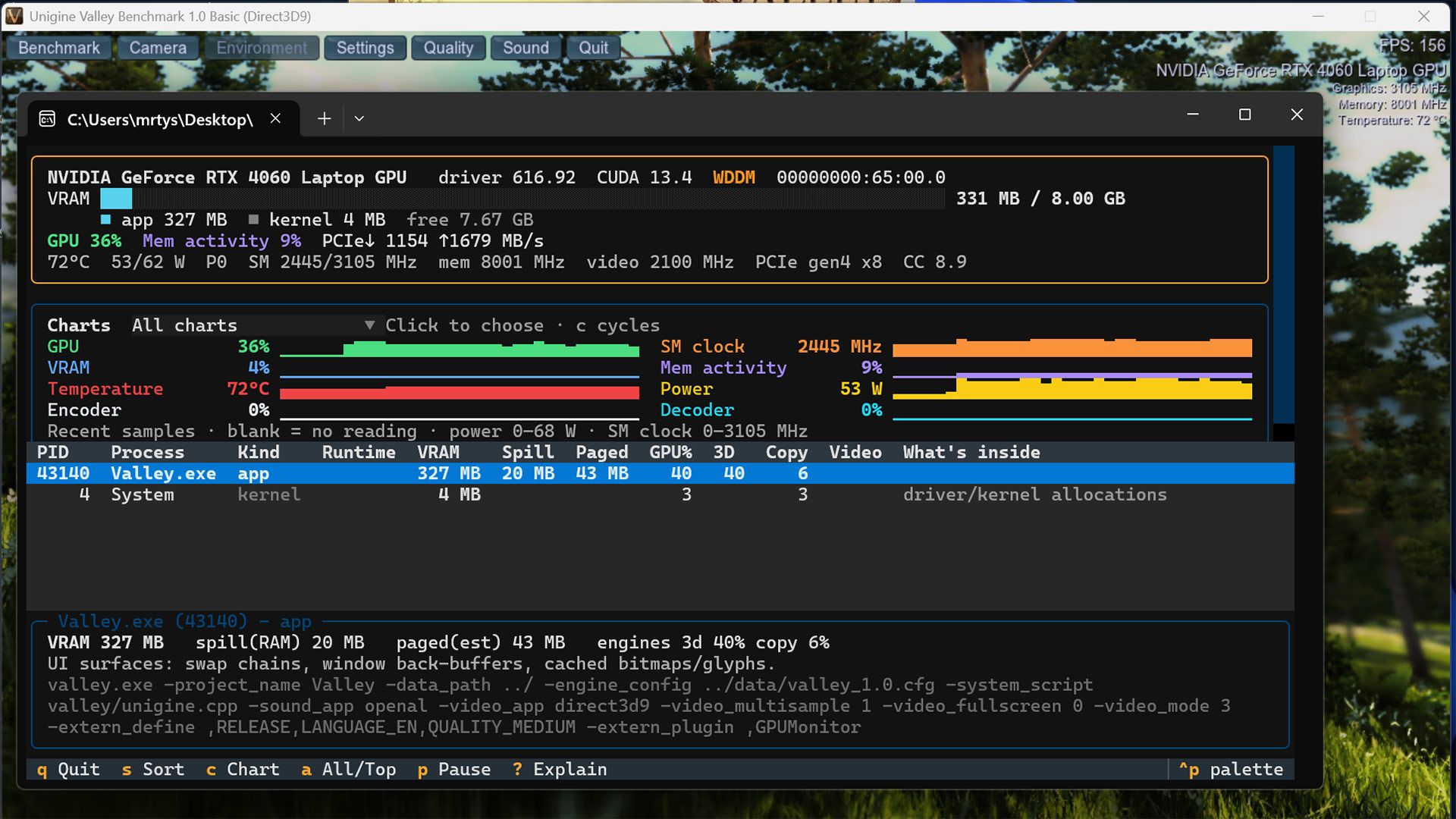
In day-to-day GPU work, VRAM is a contested resource that runs out silently. An LLM that doesn't fit in memory, an inference batch that slows down, or a process holding phantom allocations are often symptoms of consumption that remains invisible. The arrival of an open-source GPU task manager that shows exactly what is occupying VRAM changes the starting point: you no longer begin from aggregate averages or the usual nvidia-smi output, but from a map of processes and their actual requests.
Beyond debugging: VRAM as a resource to govern
This visibility isn't just for debugging. For teams managing on-premise or self-hosted LLMs, knowing which component is consuming memory is the prerequisite for capacity planning and TCO decisions. Without a clear reading of VRAM, choosing between a larger model and a quantized version becomes a gamble. With precise monitoring, you can verify whether a given level of quantization frees enough space to extend the context window or to host more model replicas on the same machine.
Serving pipelines also benefit. Integrating granular VRAM checks into orchestration frameworks allows you to trigger alerts before memory saturates, or to shift load to a node with more headroom. In a data sovereignty context, this observability remains under the control of the infrastructure operator, without depending on a cloud provider's dashboard that aggregates numbers opaquely.
Looking at second-order implications, such a tool pushes hardware and software vendors to expose finer telemetry. If the open-source community can inspect and integrate monitoring into their stacks, GPU sellers or inference platforms can no longer hide bottlenecks behind cherry-picked benchmarks. Buyers of on-premise systems, armed with real consumption data, can negotiate configurations more aligned with actual workloads instead of buying excess memory as a safety margin.
In the medium term, the spread of VRAM observability tools signals a maturing local ecosystem. It's no longer just about running a model on a card, but about managing the GPU as a production resource with reliable metrics and automation. Those who lose are vendors that built their value on opaque metrics; those who gain are teams that can measure, compare, and optimize without relying on estimates. The open question is how long cloud platforms can keep non-transparent counters when the open-source alternative shows that VRAM can be reported in full.






💬 Comments (0)
🔒 Log in or register to comment on articles.
No comments yet. Be the first to comment!