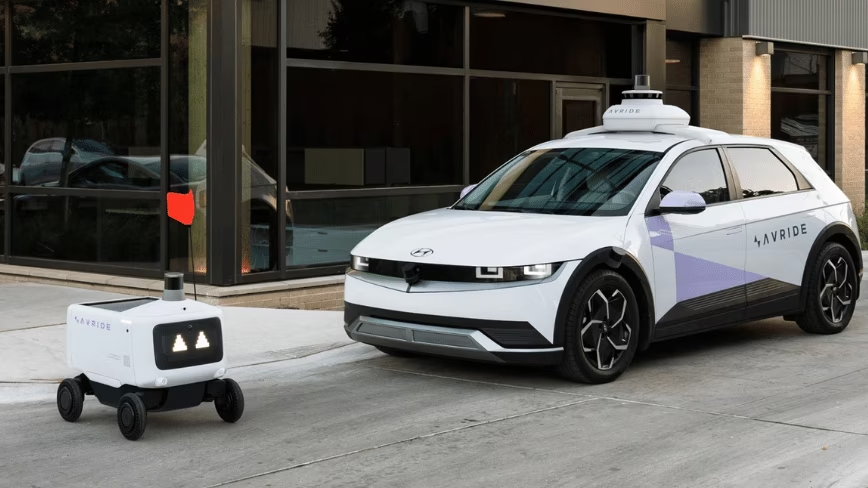
NHTSA Investigation into Avride: 16 Crashes in Four Months for Uber's Robotaxis
The National Highway Traffic Safety Administration (NHTSA) has launched a formal investigation into Avride, Uber's autonomous vehicle partner. This move comes after the agency identified 16 crashes and one minor injury in just four months since the company launched its robotaxi service in Dallas. The regulatory authority's assessment was unusually blunt, describing the vehicles as exhibiting "excessive assertiveness and insufficient capability."
This statement underscores the inherent challenges in developing and deploying artificial intelligence systems for critical applications such as autonomous driving. The complexity of replicating human perception, decision-making capabilities, and real-time responsiveness in unpredictable real-world scenarios remains a significant hurdle. The algorithms governing these vehicles must process vast amounts of data from sensors (cameras, LiDAR, radar), fuse this information, and make decisions in fractions of a second, all while ensuring maximum safety.
Challenges of Deploying AI Systems in Critical Contexts
The autonomous vehicle sector represents an emblematic testing ground for AI systems, highlighting the need for robustness and reliability that extends beyond simple laboratory benchmarks. The phrase "excessive assertiveness and insufficient capability" suggests that Avride's systems may have exhibited overly aggressive or unpredictable behaviors in certain situations, lacking the ability to react appropriately to unexpected or complex events. This can stem from gaps in training datasets, limitations in prediction algorithms, or issues within the decision and control pipeline.
For companies evaluating the deployment of LLMs or other AI systems in self-hosted or hybrid environments, the Avride incident serves as a cautionary tale. Responsibility for safety and compliance falls directly on the operator. It is crucial to implement rigorous testing, validation, and continuous monitoring processes. This includes the ability to handle edge cases, resilience to hardware or software failures, and transparency in AI decision-making, aspects that become even more critical when managing sensitive data or operating in high-risk contexts.
Implications for Regulation and Public Trust
The NHTSA's intervention is not merely a reaction to specific incidents but reflects growing regulatory scrutiny of the safety and reliability of autonomous systems. As AI technology proliferates into sectors such as logistics, healthcare, and transportation, regulatory authorities are tasked with defining clearer standards and effective oversight mechanisms. This evolving regulatory landscape compels companies to adopt a proactive approach to AI governance, integrating ethical and safety considerations from the earliest design stages.
Public trust is another crucial factor. Incidents like those involving Avride's robotaxis can erode the perception of safety and reliability of autonomous vehicles, slowing down widespread adoption. To overcome these challenges, it is essential for technology providers and operators to demonstrate a constant commitment to engineering excellence and transparency, clearly communicating the limitations and capabilities of their systems.
Future Prospects for Autonomous AI
The Avride investigation highlights the ongoing learning curve for the entire autonomous driving industry. While progress has been remarkable, the transition from research and development to large-scale deployment requires a technological and operational maturity that has not yet been fully achieved. Companies must balance innovation with prudence, investing in solutions that guarantee not only performance but also safety and robustness.
For those evaluating the integration of complex AI systems, such as LLMs or advanced perception models, into self-hosted infrastructures, it is imperative to consider the TCO not only in terms of hardware and software but also costs related to compliance, risk management, and potential liability. Data sovereignty and the ability to audit every aspect of the system become non-negotiable requirements, especially in air-gapped environments or those with stringent compliance requirements. The path to full autonomy is fraught with challenges, but also opportunities for those who can address them with rigor and responsibility.








💬 Comments (0)
🔒 Log in or register to comment on articles.
No comments yet. Be the first to comment!