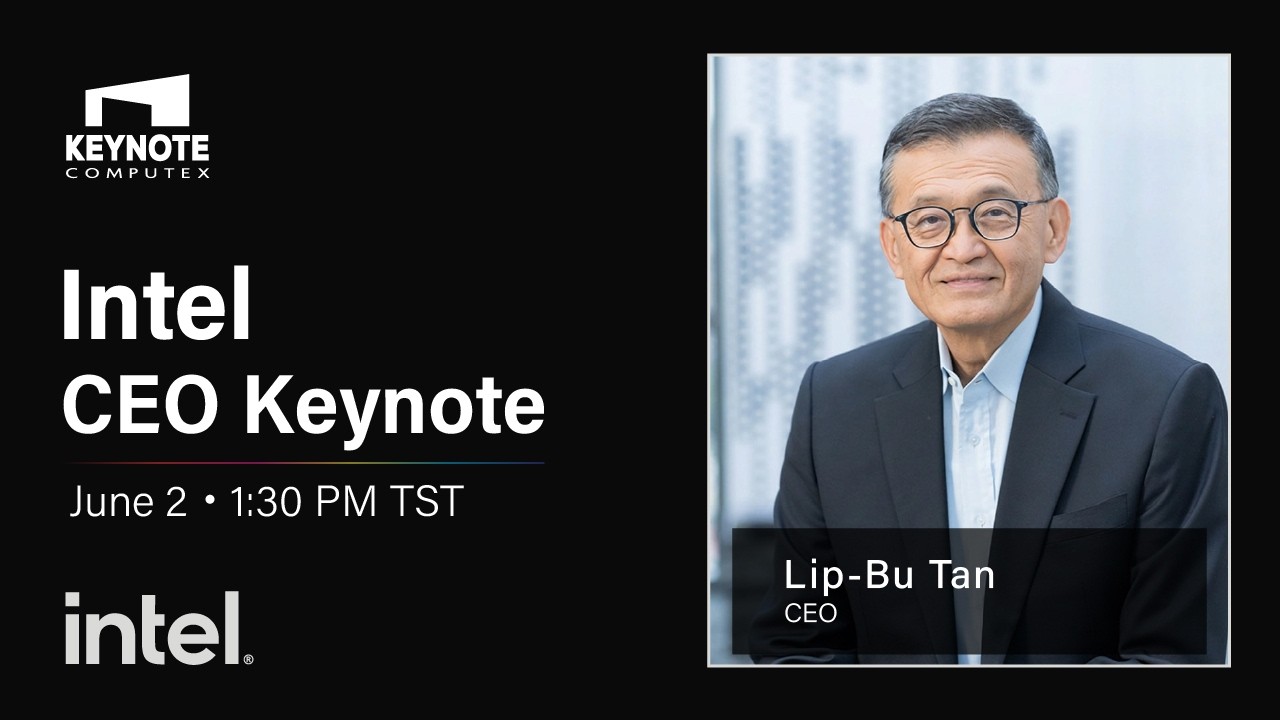
Intel and the Vision for the Intelligence Era at Computex 2026
Intel is set to conclude the second day of keynotes at Computex 2026, one of the most significant global technology events. Attention will be on CEO Lip-Bu Tan, who will take the stage to present the company's strategic vision for what Intel calls the 'Intelligence Era.' This event is particularly relevant for the industry, as it will offer an in-depth look at Intel's approach to engineering dedicated artificial intelligence hardware, intended to serve a wide range of markets.
Tan's presentation will focus on how Intel intends to position itself as a key player in developing the necessary infrastructure to support the expansion of AI. The announcement, although lacking specific details in the source, suggests a continuous commitment to developing solutions that can meet the growing computing and data management demands imposed by Large Language Models (LLM) and other advanced AI applications. For technical decision-makers, understanding this vision is crucial for planning future investments in AI infrastructure.
Engineering AI Hardware: A Pillar for Modern Deployments
The phrase 'engineering AI hardware across multiple markets' is a key indicator of Intel's strategy. This implies the development of an ecosystem of products ranging from data center processors (like Xeon CPUs) to dedicated accelerators (such as the Gaudi series GPUs or Arc cards), optimized for inference and training workloads. For on-premise deployments, hardware selection is a critical factor directly impacting performance, TCO, and scalability.
Companies evaluating self-hosted solutions for their LLMs must carefully consider hardware specifications, such as the VRAM available on GPUs, memory bandwidth, and interconnect capabilities (e.g., via NVLink or UPI). These elements determine the size of models that can be run, the token processing speed, and the overall system latency. An approach covering 'multiple markets' suggests that Intel will aim to provide options for diverse needs, from edge computing to large data centers, offering flexibility for hybrid and air-gapped architectures.
Context and Implications for On-Premise Deployment
Intel's push towards AI hardware has direct implications for organizations prioritizing on-premise deployment or hybrid models. Data sovereignty, regulatory compliance (such as GDPR), and the need for granular control over infrastructure are factors driving many companies to keep AI workloads within their own boundaries. In this scenario, the availability of high-performance and AI-optimized hardware from vendors like Intel becomes crucial.
Evaluating the TCO of an on-premise solution requires a thorough analysis beyond the initial hardware cost, including energy consumption, cooling costs, maintenance, and software licenses. Intel's ability to offer competitive solutions in terms of performance per watt and integration with existing software stacks can significantly influence these decisions. For those evaluating on-premise deployments, AI-RADAR offers analytical frameworks on /llm-onpremise to assess the trade-offs between control, cost, and performance, without recommending specific solutions but highlighting the constraints and opportunities of each approach.
Future Prospects for AI Infrastructure
Intel's presentation at Computex 2026 is set against a backdrop of rapid evolution for AI infrastructure. The industry is witnessing a growing demand for hardware solutions that can handle increasingly large and complex LLMs, with stringent requirements for throughput and latency. Intel's commitment to 'engineering AI hardware' suggests a long-term strategy to compete in this space, offering alternatives and complements to GPU-based solutions from other vendors.
For CTOs and infrastructure architects, the diversification of hardware offerings is an advantage. It allows greater flexibility in designing AI pipelines, enabling resources to be optimized based on specific application needs and budget constraints. The Intelligence Era, as Intel defines it, will require robust, versatile, and scalable infrastructure, and the hardware decisions made today will have a lasting impact on companies' ability to innovate and compete in the artificial intelligence landscape.



💬 Comments (0)
🔒 Log in or register to comment on articles.
No comments yet. Be the first to comment!