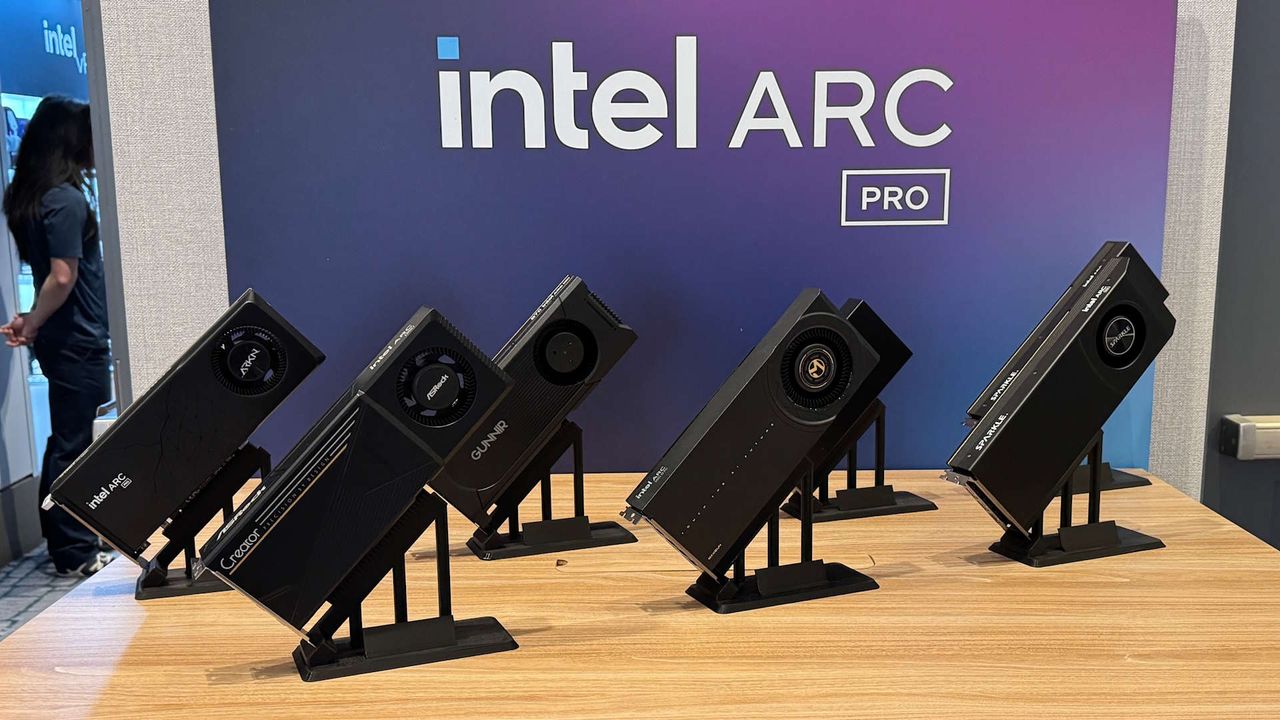
Intel Arc Pro B70: The New Workstation GPU with 32GB of VRAM
Intel has expanded its offering in the professional graphics card segment with the release of the Arc Pro B70 GPU. This new proposition is positioned in the workstation market, a crucial sector for developers and professionals who require high computing capabilities and video memory for demanding applications. The most significant feature of the Arc Pro B70 is its 32GB of VRAM, a substantial amount that makes it appealing for a wide range of workloads, including those related to artificial intelligence and Large Language Models (LLMs).
The availability of such generous VRAM is a decisive factor for executing complex AI models directly on local hardware. For CTOs and infrastructure architects, a GPU with 32GB of VRAM offers the flexibility to manage medium-sized LLMs or perform fine-tuning operations on specific datasets, maintaining data control and reducing reliance on external cloud services. This aligns perfectly with the data sovereignty and operational cost containment needs that characterize many on-premise deployment scenarios.
Performance and Market Positioning
Initial tests of the Intel Arc Pro B70, although primarily conducted in gaming contexts, provide clear indications of its capabilities. The GPU has shown to be roughly twice as fast as the previous Arc B580 on average, highlighting a significant generational leap in processing power. Furthermore, in some titles, the Arc Pro B70 managed to outperform the RTX 5060 Ti, a fact that underscores its competitiveness in a crowded market segment.
These results, while not direct benchmarks for AI workloads, suggest a solid hardware foundation. The ability to handle complex textures and geometries in games often translates into good performance for the parallel processing required by LLM inference or the training of smaller models. The combination of good computing power and ample VRAM makes the Arc Pro B70 an option to consider for those seeking self-hosted AI solutions, where direct control over hardware and data is a priority.
Implications for On-Premise LLM Deployment
For companies evaluating on-premise deployment strategies for their AI workloads, the Intel Arc Pro B70 represents an interesting alternative. The availability of 32GB of VRAM allows for loading and running LLMs locally that would otherwise require more expensive or complex cloud resources. This is particularly advantageous for scenarios requiring high security, regulatory compliance (such as GDPR), or air-gapped environments, where external connectivity is limited or absent.
Deploying LLMs on local workstations or servers with GPUs like the Arc Pro B70 enables sensitive data to remain within the corporate perimeter, ensuring sovereignty and reducing risks associated with transferring information to external cloud providers. While not a high-end GPU for massive model training, its capacity is more than sufficient for the inference of many LLMs and for development and prototyping activities, offering a balance between cost, performance, and control. For those evaluating on-premise deployment, AI-RADAR offers analytical frameworks on /llm-onpremise to assess the trade-offs between self-hosted and cloud solutions.
Future Prospects and Final Considerations
The Intel Arc Pro B70 enters a landscape where the demand for local AI computing capacity is constantly growing. By offering a combination of high VRAM and competitive performance, Intel aims to capture the attention of professionals and businesses seeking robust hardware solutions for their workstations. The choice of a GPU like this implies a careful evaluation of the Total Cost of Ownership (TCO), considering not only the initial hardware cost but also the long-term benefits in terms of data control, security, and operational flexibility.
As the GPU market for AI continues to evolve rapidly, the emergence of options like the Arc Pro B70 underscores the importance of having diversified alternatives. For technical decision-makers, the key is to understand the specific constraints of their environment and the requirements of AI workloads to choose the most suitable solution, balancing performance, costs, and data sovereignty needs.



💬 Comments (0)
🔒 Log in or register to comment on articles.
No comments yet. Be the first to comment!