Introduction to New Intel Hardware
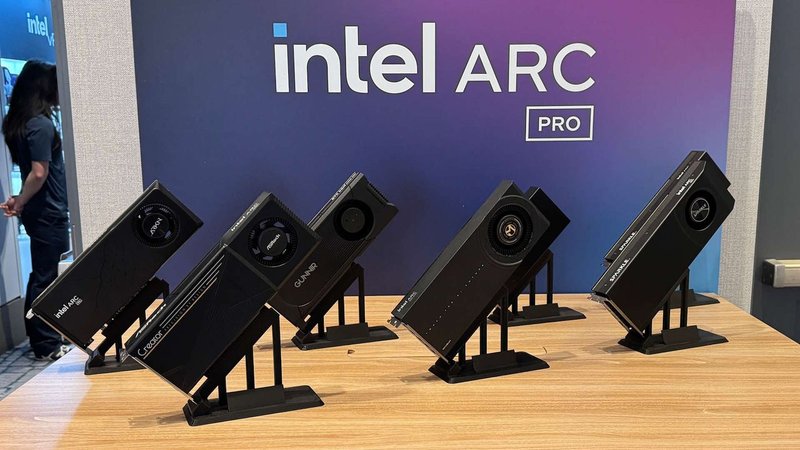
Intel recently introduced the Arc Pro B70 graphics card to the market, a significant addition to its Battlemage product line. This GPU, identified as Battlemage G31, is positioned as the top-end offering in the series, promising new capabilities for a wide range of applications. Featuring 32GB of GDDR6 VRAM and 32 Xe cores, the Arc Pro B70 has been designed to tackle demanding workloads.
The potential of this card extends particularly to Large Language Models (LLM) and artificial intelligence domains, as well as general compute scenarios. Its architecture suggests interesting scalability, especially when considering multi-GPU configurations, a crucial aspect for enterprise deployments.
Technical Details and Initial Performance
The technical specifications of the Arc Pro B70 include 32GB of GDDR6 VRAM, a provision that makes it suitable for handling considerably sized LLM models, where video memory is often a limiting factor. The 32 Xe cores represent the underlying computational power, essential for accelerating complex inference operations and light training.
Initial benchmarks conducted on Linux have explored the capabilities of the single Arc Pro B70 card. These tests covered the acceleration of AI/LLM workloads using OpenVINO and Llama.cpp, two key frameworks for local inference. Furthermore, performance in OpenCL compute benchmarks, and in graphics applications with OpenGL and Vulkan, was evaluated. Early results indicate effective operation with the fully open-source Linux graphics driver stack, a factor that can simplify integration into self-hosted environments.
Implications for On-Premise Deployments
For CTOs, DevOps leads, and infrastructure architects evaluating AI solutions, the Arc Pro B70 presents several implications. The availability of a GPU with 32GB of VRAM, tested on Linux and with multi-GPU potential, directly aligns with the needs of on-premise deployments. In these contexts, data sovereignty, direct control over hardware, and Total Cost of Ownership (TCO) management are priorities.
The option to use multiple Arc Pro B70 cards in a single configuration can offer the scalability required to handle growing LLM workloads while keeping data within the corporate perimeter. This approach contrasts with cloud-based models, providing an alternative for organizations that require air-gapped environments or must comply with stringent regulatory requirements. For those evaluating on-premise deployments, AI-RADAR offers analytical frameworks on /llm-onpremise to assess the trade-offs between self-hosted and cloud solutions.
Future Prospects and Concluding Remarks
The initial benchmarks of the Arc Pro B70 represent only a first step. Further testing, particularly those exploring multi-GPU scenarios and direct comparisons with competitors, will provide a more comprehensive picture of its capabilities. The card's effectiveness with the open-source driver stack on Linux is a positive sign for adoption in enterprise environments that favor flexible and controllable solutions.
Intel, with the Arc Pro B70, positions itself as a relevant player in the AI hardware landscape, offering a solution that can support companies in building robust and high-performing local AI infrastructures. The availability of dedicated hardware with adequate specifications is fundamental to enabling innovation and efficiency in LLM and AI-based workloads.





💬 Comments (0)
🔒 Log in or register to comment on articles.
No comments yet. Be the first to comment!