
A Strategic Partnership for AI Compute
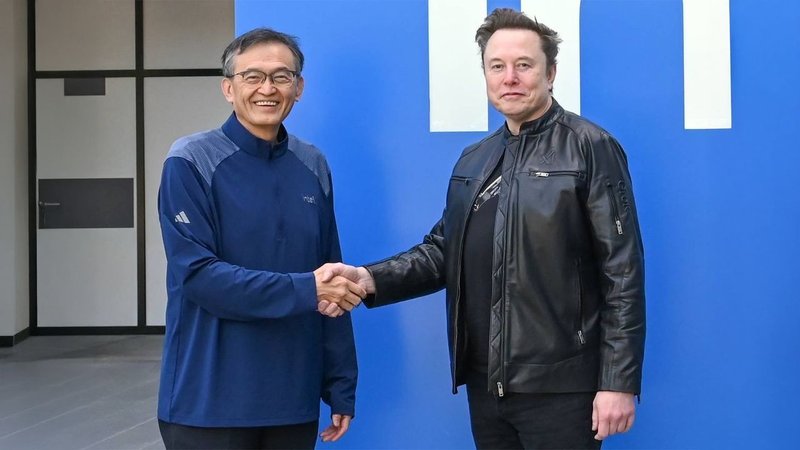
Intel has announced its participation as the primary chip manufacturing partner for Terafab, the $25 billion joint venture promoted by Elon Musk. This ambitious project involves collaboration between Tesla, SpaceX, and xAI, with the stated goal of achieving a terawatt of artificial intelligence compute power annually. The agreement, reported for April 7, 2026, represents a significant step for both parties.
For Intel, this partnership holds crucial strategic value. The company, which recently reoriented its business towards a "foundry-first" model, aimed to consolidate its position in the third-party semiconductor manufacturing market. Securing a high-profile customer like Terafab, with its extreme compute requirements, offers Intel the opportunity to demonstrate its large-scale production capabilities and establish itself as a key player in the AI ecosystem.
Implications for On-Premise AI Infrastructure
The goal of a terawatt of AI compute per year underscores the growing demand for dedicated, high-performance infrastructures. Such a volume of compute requires large-scale deployment, often translating into self-hosted or bare metal solutions to ensure maximum control over performance, security, and operational costs. This approach is particularly relevant for companies handling sensitive data or needing to optimize every aspect of their AI pipeline.
Choosing an on-premise or hybrid deployment allows organizations to maintain data sovereignty, comply with stringent compliance requirements, and operate in air-gapped environments when necessary. For projects of Terafab's magnitude, the ability to customize hardware, directly manage VRAM, and optimize throughput becomes fundamental to achieving performance and TCO objectives. AI-RADAR has on several occasions explored the analytical frameworks available on /llm-onpremise to evaluate the trade-offs between cloud and self-hosted solutions, highlighting how scalability and control are often decisive factors for intensive AI workloads.
The Foundry Model and the Race for AI Silicio
Terafab's decision to rely on a foundry partner like Intel reflects a broader trend in the semiconductor industry. Many companies, while designing their own AI chips or accelerators, choose to outsource production to specialized foundries. This model allows access to cutting-edge process technologies and rapid production scaling without the enormous capital investments required to build and manage one's own semiconductor factory.
The demand for AI-optimized silicio is constantly growing, driven by the evolution of Large Language Models (LLM) and the need to perform inference and training on increasingly large datasets. The ability to provide chips with precise specifications, such as high VRAM and architectures optimized for parallelism, has become a critical success factor for semiconductor suppliers. The partnership with Terafab positions Intel at the forefront of this race, offering a testing ground for its most advanced technologies.
Future Prospects and Technological Challenges
Terafab's ambition to achieve a terawatt of AI compute per year poses significant challenges in terms of engineering, energy, and sustainability. Designing infrastructures capable of handling such power requires innovations not only at the chip level but also concerning cooling, power supply, and system interconnection. These requirements push the limits of current technology and stimulate research and development across the entire industry.
The success of this joint venture could redefine the standards for deploying hyperscale AI workloads. As the industry observes the evolution of this collaboration, attention remains high on Intel's ability to meet the demands of such a demanding customer and on the long-term implications for the competitive landscape of chip manufacturing and AI infrastructure.





💬 Comments (0)
🔒 Log in or register to comment on articles.
No comments yet. Be the first to comment!