Intel's Expanding Offering for the Datacenter
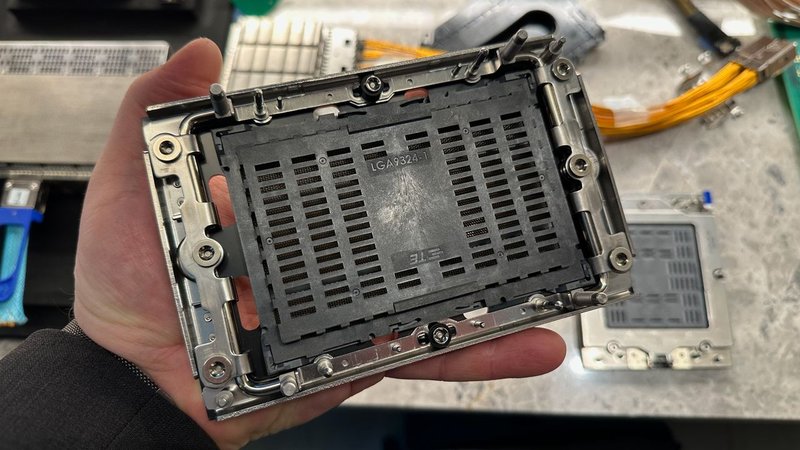
Intel has announced the official launch of its new Xeon 6+ processor series, previously identified by the codename Clearwater Forest. Market introduction is scheduled to begin on June 1st, marking a significant step in the evolution of the company's offerings for modern datacenters. This announcement, which follows an initial revelation at last year's Tech Tour Arizona with limited details at the time, comes in conjunction with the Computex event, providing a broader context for Intel's future strategies in the sector.
In parallel with the new Xeon 6+ processors, Intel has also unveiled the Intel Ethernet E835 network card. This component is designed to support the growing demands for high-speed, low-latency connectivity within computing infrastructures, an increasingly critical aspect for intensive workloads, including those related to artificial intelligence and Large Language Models (LLMs).
Technical Details and Infrastructure Implications
While specific details on the architectures and performance of the Xeon 6+ processors and the Ethernet E835 card were not extensively covered in the initial communication, the introduction of new generations of this type of hardware typically implies improvements in terms of energy efficiency, compute density, and processing capabilities. For datacenters, this translates into the ability to handle a greater number of workloads per server, optimizing space and reducing the Total Cost of Ownership (TCO).
The Intel Ethernet E835 card, in particular, is poised to play a key role in ensuring the necessary throughput for communications between compute nodes and storage, fundamental elements for LLM training and inference. A high-performance network is essential to avoid bottlenecks that could compromise the overall efficiency of AI systems, especially in distributed configurations or with low-latency requirements.
The Context of On-Premise Deployments
For companies prioritizing on-premise or self-hosted deployments, the arrival of new hardware platforms like the Xeon 6+ processors and the Ethernet E835 card represents an opportunity to update and enhance their infrastructures. The choice of on-premise solutions is often driven by needs for data sovereignty, regulatory compliance, and direct control over the operational environment, aspects particularly relevant for sectors such as finance, healthcare, or public administration.
Intel's hardware positions itself as a cornerstone for building robust local stacks, capable of supporting LLM inference and fine-tuning without relying on external cloud services. This approach allows organizations to keep sensitive data within their security perimeter, managing resources and costs independently. For those evaluating on-premise deployments, AI-RADAR offers analytical frameworks on /llm-onpremise to assess the trade-offs between control, performance, and TCO.
Future Prospects and the Intel Ecosystem
The announcement of these new products is not the only front on which Intel is working. The company has also provided updates on future projects, mentioning Crescent Island and Diamond Rapids. These codenames indicate a continuous roadmap of innovation in the processor sector and related technologies, suggesting that Intel intends to maintain a central role in the development of computing infrastructures for artificial intelligence and beyond.
Hardware evolution is a decisive factor in unlocking new capabilities in Large Language Models and making AI deployments more efficient and accessible. With the Xeon 6+ processors and the Ethernet E835 card, Intel strengthens its offering for companies seeking high-performance, controllable solutions for their AI computing needs, helping to define the technological landscape for the coming years.





💬 Comments (0)
🔒 Log in or register to comment on articles.
No comments yet. Be the first to comment!