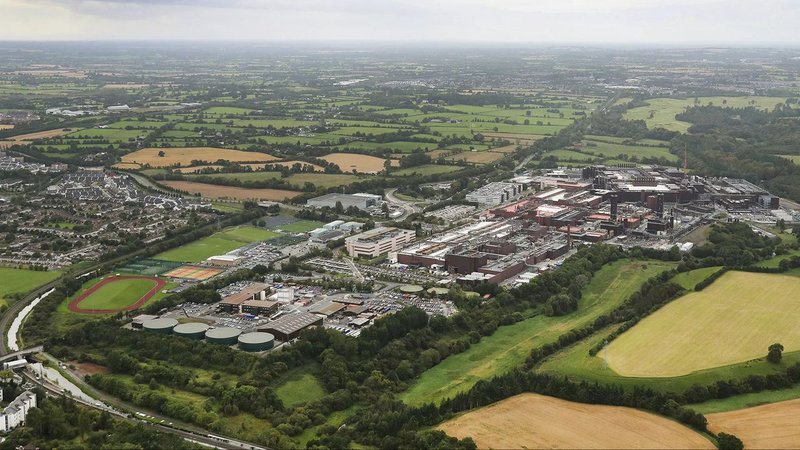
The Leixlip campus on the outskirts of Dublin is getting a €5 billion (around $5.7 billion) infusion to rev up Xeon processor production lines. Intel’s announcement isn’t about building a new fab — it’s a “more from the same” play: the company wants to squeeze more output from existing facilities by installing leading-edge equipment and extending the automated wafer track system.
The move lands at a time when demand for AI servers has exploded, yet the spotlight remains glued to GPUs. Reducing this to a pure semiconductor supply-chain story would miss the point. For anyone handling on-premise deployment of Large Language Models, the Irish investment has a down-to-earth meaning: Intel intends to defend and expand the role of Xeon in AI computing, even as accelerator cards appear to dominate the conversation.
Why Xeons matter for on-premise inference
Xeon processors have long been the quiet engine inside most enterprise data centers. With the rise of large language models, it’s tempting to fixate on GPU compute power alone. But CPU inference remains a concrete option in many industrial settings: low-latency workloads, quantized models, hybrid architectures where the processor manages preprocessing and orchestration, or simply contexts where Total Cost of Ownership (TCO) and hardware availability push toward more balanced solutions.
The Leixlip line upgrade, most likely geared toward advanced nodes such as Intel 4 and Intel 3, promises next-generation Xeons (like the Granite Rapids or Sierra Forest families) with better performance-per-watt and higher core density. For on-premise setups, this isn’t a footnote: lower energy draw and more compute per socket directly affect internal cluster design, cutting physical footprint and cooling costs.
The data sovereignty side effect
Ireland already hosts the data centers of all major cloud providers. Strengthening CPU manufacturing right there adds a pinch of geographic proximity that can tilt compliance assessments. European companies bound by GDPR and aiming to keep data inside EU borders gain an extra argument for self-hosted infrastructure when critical components flow from a regional supply chain. It’s not an automatic guarantee, but it’s a signal that the hardware ecosystem is anchoring itself on European soil, reducing dependence on Asian production nodes and shortening supply chains.
The Intel move also deserves to be read against the backdrop of geopolitical tensions of recent years: having an advanced manufacturing hub in Western Europe allows deliveries to be partly insulated from trade blocks or restrictions. For anyone orchestrating hybrid or fully on-premise deployments, supply stability is an often-underestimated risk factor that can dictate the trajectory of a multi-year AI project.
How market balances shift
The investment isn’t a defensive play against NVIDIA — it’s a thrust aimed at AMD and ARM-based server chip makers that are eroding x86’s data-center dominance. Beefing up Xeon production in Europe means responding faster to enterprises that prefer tried-and-tested architectures with a mature software and library ecosystem.
The message for vendors selling AI-preconfigured servers is equally blunt: Xeons won’t be a bottleneck. The additional capacity and heavy automation also help stabilize prices at a time when AI componentry tends to be pulled upward by insatiable demand. If CPU costs stay in check, the whole on-premise stack — from bare metal servers to orchestration platforms — can remain competitive against cloud alternatives.
In the short term, the Leixlip construction site won’t work miracles. But over a medium-term horizon, those evaluating whether to bring LLM deployment in-house may find a more predictable x86 processor market with a technologically refreshed offering. In a field where hardware decisions are made months in advance, knowing that Intel is reinforcing its European manufacturing footprint is a variable CTOs would be wise to add to their spreadsheets.





💬 Comments (0)
🔒 Log in or register to comment on articles.
No comments yet. Be the first to comment!