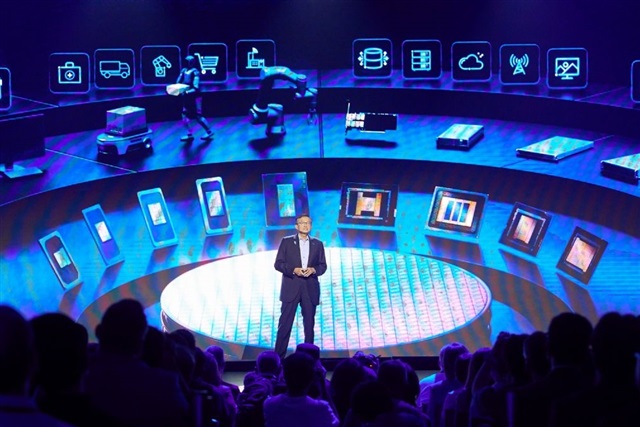
The news, reported by DIGITIMES, is sparse yet loaded with implications: Intel is reassigning its global foundries and aims for early design wins with its 14A process and EMIB-T packaging in the artificial intelligence space. Few details, but enough to glimpse a strategic shift that could reshape the hardware landscape for inference and training, especially for self-hosted environments.
Behind the term ‘14A’ lies the future 14-ångström node, successor to the 18A that Intel is preparing to introduce. This is not a simple generational leap: the Angstrom family promises density and performance per watt capable of competing with TSMC’s most advanced nodes, something that matters enormously when designing chips for AI workloads that push GPUs, VPUs, and dedicated accelerators to their limits. EMIB-T, for its part, is the evolution of the embedded multi-die interconnect bridge with the addition of through-silicon vias, a technology that links heterogeneous dies with very high bandwidth, essential for moving the heavy data flows of Large Language Models without bottlenecks.
Intel’s move is not purely technological. Reassigning foundries means reallocating manufacturing capacity, talent, and capital toward these new initiatives. In a market where demand for AI silicon is growing at breakneck speed, betting on 14A and EMIB-T reveals a clear thesis: the future of AI architectures will not rely solely on raw compute power, but on the balance between density, efficiency, and advanced interconnects. This is where the on-premise battle takes shape. Those deploying LLMs on local hardware often seek total control over latency, privacy, and TCO, but today they face a de facto duopoly (Nvidia and AMD) that dictates pricing and availability. If Intel manages to place 14A-based accelerators in self-hosted solutions, a genuine alternative would emerge, with potential cascading effects: more competition, less single-vendor dependency, and a push to lower operational costs for compute-intensive models.
Of course, the risks are proportionate to the ambition. Intel has accumulated delays in its node roadmap, and bringing a cutting-edge process from zero to production volumes is never automatic. Moreover, winning AI design wins means convincing major customers – cloud providers but also system integrators specialized in on-prem deployments – to bet on an ecosystem that is still being built. EMIB-T, for instance, requires a sophisticated packaging ecosystem and could integrate chiplets from different manufacturers: a promising but complex orchestra-and-conduct scenario.
For the AI-RADAR reader, this story is a gauge of where inference hardware could head in the coming years. It’s not just about nanometers: the 14A–EMIB-T combo suggests Intel is trying to solve memory and bandwidth challenges holistically, a crucial factor for token/s throughput and latency of LLMs with extended context windows. If the gamble pays off, the menu of options for those evaluating an on-prem deployment would expand, perhaps bringing the technological pluralism that is sorely missing today. But we are still in the realm of bets, and like all bets it must be watched with a clinical eye: execution will be everything.





💬 Comments (0)
🔒 Log in or register to comment on articles.
No comments yet. Be the first to comment!