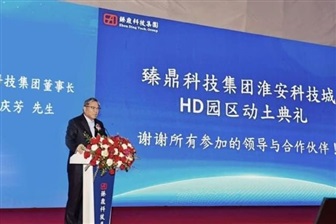
Zhen Ding Expands Manufacturing Capacity in China
Zhen Ding Technology, a key player in the printed circuit board (PCB) manufacturing sector, recently broke ground on a new production site in China. The event was attended by the chairman of Zhongji Innolight, signaling support and the interconnectedness among major technology component suppliers. This investment, though not directly linked to specific AI applications in the source, is part of a broader trend to strengthen global supply chains for high-performance hardware.
The construction of new manufacturing facilities by companies like Zhen Ding is a significant indicator of market dynamics and emerging infrastructure needs. For organizations aiming to build and manage their own AI workloads, the availability and reliability of the hardware supply chain are critical factors. The ability to produce essential components in high volumes and to high quality standards is a prerequisite for the large-scale deployment of Large Language Models (LLM) based systems and other artificial intelligence applications.
The Crucial Role of the Hardware Supply Chain for On-Premise AI
Hardware infrastructure forms the backbone of any AI deployment, whether in the cloud or self-hosted. Components such as Zhen Ding's high-density PCBs are fundamental for the creation of advanced GPU boards, servers, and high-speed networking systems. Similarly, Zhongji Innolight's optical transceivers are indispensable for the low-latency, high-throughput interconnections required in GPU clusters that power LLM Inference and training.
For CTOs and infrastructure architects evaluating self-hosted solutions, the robustness of the hardware supply chain takes on strategic importance. Reliance on a limited number of suppliers or vulnerable supply chains can introduce significant risks in terms of TCO, delivery times, and scalability. A diversified and resilient manufacturing ecosystem is therefore essential to ensure operational continuity and expansion capability for self-hosted AI projects, where direct control over hardware is often a priority.
Data Sovereignty and Supply Chain Control
Investment in new production capacities, especially in strategic regions, also reflects a growing focus on technological sovereignty and supply chain resilience. In an era where data localization and regulatory compliance (such as GDPR) are increasingly stringent, having greater control over the entire hardware value chain, from silicio production to final assembly, becomes a competitive advantage. This is particularly true for companies operating in regulated sectors or handling sensitive data.
Self-hosted deployment decisions for LLM workloads are often driven by the need to keep data within operational or national borders, ensuring air-gapped or otherwise tightly controlled environments. The availability of a reliable and, ideally, geographically diversified hardware supply chain supports this strategy, reducing risks associated with supply disruptions or geopolitical dependencies. For those evaluating on-premise deployments, AI-RADAR offers analytical frameworks on /llm-onpremise to assess the trade-offs between cost, performance, and control.
Future Prospects for AI Infrastructure
While the news of Zhen Ding's new site breaking ground does not provide specific details about its ultimate destination in terms of AI products, it highlights an underlying trend: the industry is investing heavily in the hardware foundations that make the age of artificial intelligence possible. These investments are crucial to support the growing demand for computing power, VRAM, and high-speed connectivity required by Large Language Models and other AI applications.
For technology decision-makers, understanding these supply chain dynamics is fundamental. An organization's ability to effectively implement and scale its self-hosted AI solutions will depend not only on the choice of models or Frameworks but also on the solidity and accessibility of the underlying physical infrastructure. Such strategic investments in the production of essential components contribute to creating a more robust and resilient ecosystem, benefiting all companies aiming for greater control over their AI assets.









💬 Comments (0)
🔒 Log in or register to comment on articles.
No comments yet. Be the first to comment!