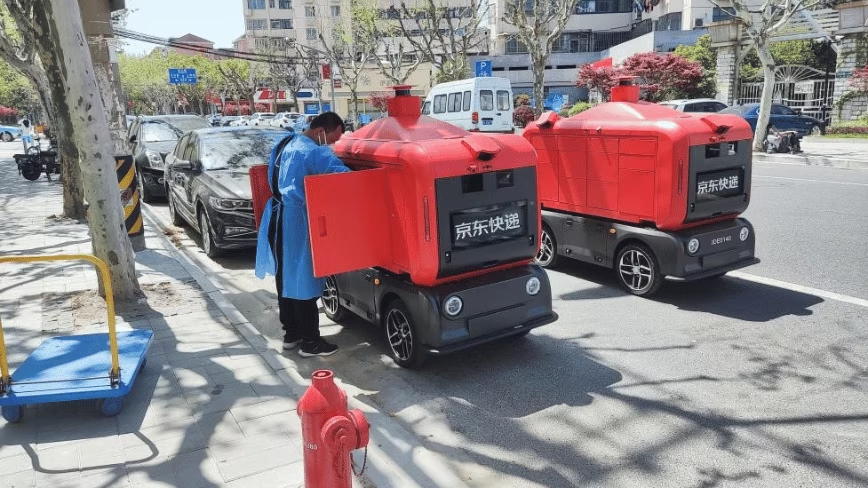
JD.com founder Richard Liu did not mince words: robots will take over the jobs of the company's current 700,000 couriers. His statement, made during the APEC China forum, quickly circled the globe. In an industry where CEOs typically hedge when asked about automation and jobs, Liu chose brutal transparency.
A Chinese giant leading the way
JD.com is one of China’s largest e‑commerce groups, with a sprawling logistics network employing hundreds of thousands of delivery workers. For years, the company has invested in automation: robot‑managed warehouses, drones for rural last‑mile deliveries, and autonomous road vehicles. But Liu’s promise goes further: the entire courier fleet will eventually be replaced by machines.
Automation and labor: a knot to untie
Liu’s admission is rare because it challenges the reassuring narrative of “human‑machine collaboration.” The replacement of 700,000 jobs – even if gradual – is a wake‑up call for blue‑collar sectors previously thought immune to automation. When a major e‑commerce player puts in writing its intent to eliminate human workers from distribution, a domino effect across other logistics giants becomes a plausible scenario.
Edge computing and data sovereignty
A fleet of delivery robots raises technical questions that go beyond simply swapping out labor. To operate safely and with low latency, these systems must process large amounts of data onboard – from lidar and camera feeds to environmental maps. This is a classic edge‑computing scenario, where keeping inference local, on‑premise or on embedded devices, offers advantages in control, regulatory compliance, and protection of sensitive data.
For anyone evaluating on‑premise AI in the enterprise, JD.com’s shift provides a useful parallel. The decision shows that aggressive automation is not just about labor cost savings; it is also a question of architectural choice. Reducing cloud dependency, ensuring operational resilience, and protecting critical information are all factors pushing organizations toward more distributed, autonomous deployments.
A sign of things to come
Liu’s unfiltered statement signals that the technological maturity threshold for large‑scale automation has been crossed. For companies building their own AI infrastructure, the message is clear: the future does not lie in centralized cloud alone, but in distributed compute power, close to the point of action. JD.com, with its 700,000 couriers in the crosshairs, is the litmus test of a transformation already underway.







💬 Comments (0)
🔒 Log in or register to comment on articles.
No comments yet. Be the first to comment!